
http://www.archeolog-home.com/medias/images/potbelly-hill-temple-1.jpg
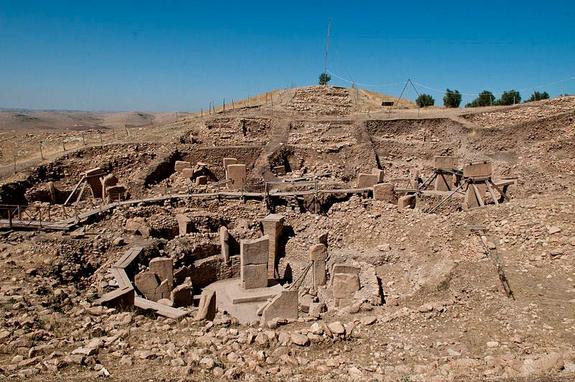
In 1995, German archeologists made an eye-popping discovery in southern Turkey. At a site whose Turkish name means “Potbelly Hill,” scientists are digging up what they claim is the oldest temple in the world. You can see many pictures of it here.
How old is it? Scientists estimate it was built around 10,000 B.C. Some Creationists will object to that, but I’ve become agnostic about prehistoric dates. After all, God has not told us how long Adam and Eve lived in the Garden of Eden, or what He was doing with the rest of the planet during that time. Anyhow, 10,000 B.C. is only a guess, based on the style of the site’s monoliths and artwork.
Suffice it to say they’re convinced it’s really, really old—older than Stonehenge, older than Mesopotamia’s oldest cities, older than the pyramids of Egypt: way older than any of these.
Look at the pictures on the Internet. The big T-shaped monoliths weigh from 40 to 60 metric tonnes each, and may represent standing human figures. Carvings abound, ranging from bas-reliefs to fully 3-D sculpture in the round. It’s not shabby artwork, either, but rather the work of skilled and experienced artists. Everything is beautifully preserved, because at some unknown time in prehistory, the people who were using the temple buried the whole site—without a backhoe!—protecting it from erosion.
Potbelly Hill is a huge site, and diggers have tons more work to do. Most of it has not yet been uncovered. Who knows what else they’ll turn up?
So far, though, they haven’t turned up any of the ancient builders’ tools, no samples of any kind of writing, no evidence of agricultural activity, and no traces of living quarters. There are lots of animal bones scattered around the temple’s finished, ground-limestone floors, suggesting that perhaps animals were sacrificed there. Many kinds of animals, as well as human beings, are represented in the artwork.
Now let’s turn to a rather silly statement by scientists who ought to know better. It’s from the same website cited above.
“Each T-shaped pillar varies between 40 to 60 tonnes, leaving us scratching our heads as to how on earth they [the ancient builders] accomplished such a monumental feat. In a time when even simple hand tools were hard to come by, how did they get these stone blocks there, and how did they erect them? With no settlement or society to speak of, with farming still a far cry away, in a world of only roaming hunter-gatherers, the complexity and developed blueprints of these temples represented another enigma for archeologists…”
Pillars of stone meet heads of stone.
The ossified preconceptions of these scientists are a wonder. Confronted by the testimony of their own eyes that the ancients did in fact accomplish a monumental feat, they perplex themselves with foolish questions.
One would think the existence of the temple would necessarily imply the availability of all the tools needed to build it. But no: “even simple hand tools were hard to come by.” Would they expect to find hammers and saw-horses cluttering up the Vatican? Gee, how did they manage to build St. Peter’s without tools? The temple exists: therefore the tools needed to build it must have existed, too.
The ancient people are presumed to have had “no settlement or society to speak of.” Well, then, what’s the blooming temple doing there? Its presence necessarily implies an organized society! Instead, scientists cling to their evolution-inspired vision of “farming still a far cry away, in a world of only roaming hunter-gatherers.” Don’t change a cherished preconception just because a great enormous temple is standing there.
In the Bible narrative, the true narrative, God created Adam and Eve as mature and perfect human beings, not yet subject to death or disease, more than able to get civilization started after being evicted from the Garden. But the evolutionary mind-set demands “primitive” people who can’t do much of anything, who took tens of thousands of years just to figure out how to set one stone on top of another. Never mind that the earliest preserved examples of cave painting display advanced, sophisticated technique that some artists today would find hard to match.
The temple complex at Potbelly Hill suggests that the long “primitive” stage of human history was never anything more than a product of modern man’s imagination. There is much evidence that does not survive the centuries, much that is perishable and gets lost forever. Maybe the tools, writings, and houses of these ancient people have not survived. Or maybe we just haven’t found them yet.
Maybe it’s time some scientists learned to believe their eyes over their preconceptions.
I’m reading a wonderful book right now, The Genius of Ancient Man, which elaborates on your point here. No sense getting sidetracked by the evidence!
I have that book, too, Greg. I’ve just finished reading it, and plan to write a review.
The Romans built aqueducts that still work, and administered the finances of a vast empire, using Roman Numerals (aaaaagh!) and without the use of “0”. People of the ancient world were definitely smarter than people are today.
The last sentence in your reference article says it. “Do we have to change our vision of how and when civilized human history began? The plot thickens …”
I just laughed right out loud when I read the conclusons by those who were evaluated the “Pott-BellY” finds. As Lee responded, those who se comments he reported must surely be residents of the very type of community in which they “think” the residents of “Pot-Belly” resided.. These “scientists could not possibly be great thinkers or doers. Any child would come to that conclusion! Pity the poor dears!
Don’t know who sponsored that original commentary but it reflects the mentality of most journalists in media these days. Intelligence is not a qualifying criteria. Are we sure it came from archeologists?
I think, but I’m not sure, that the website I quoted from was an official website. If so, then, yes, the silly quotes come from archeologists.
They think that the world was created out of nothing, by nothing, so perhaps it shouldn’t surprise them that the ancient, cave-dwelling, raw-meat-eating, prehistorics who didn’t invent clothes or shoes or discover fire until long after they would have all died out from lack of warmth, could build gigantic temples and make carvings with only crude gardening implements, and then bury these same temples with their bare hands.
Laura Elizabeth, where you been?
Actually, I don’t think the “scientists” are giving the ancient people credit even for simple gardening tools–gardening hadn’t been invented yet, you see.
Aliens taught our ancestors everything… Amazing, the silly positions people get forced into.
I’ve been hither and yon 😀 I just made a new post on my blog, though, and hopefully I’ll be able to keep it updated more often now that I’ve got semi-regular access to the internet again.
Where did the aliens come from? We’re back to the same problem, just on a much higher scale…
Have you seen “Expelled”? I love the scene in which Ben Stein makes a monkey out of Richard Dawkins by trapping him into saying life on earth was planted there by space aliens. Atheism does a great job of turning people into jackasses.
I did see that, but it’s been a few years ago. That’s funny, though 😀 And then we have, oh, what’s his name… Stephen Hawking, I think it is? Talking about aliens and saying that we shouldn’t necessarily assume that if/when we find life on other planets that it will be friendly. Ummm… no duh. We’ve known that since War of the Worlds.
Also you have one of those atheists, whose name I can’t remember, saying that there are really only two alternatives: Intelligent Design, or evolution. Evolution doesn’t make sense, but he had to choose it or risk letting ‘a divine foot in the door’.
His name was Richard Lewontin–a sad case. He seems fully aware of the imbecilities of sheer materialism and its proponents, but he remains committed to their cause. I don’t understand him. He knows a thing to be untrue, but clings to it because he hates God.
Gee, mister–how can you feel that strongly about someone or something which you say does not exist?
There are some attention-grabbing closing
dates on this article however I don’t know if I see all of them heart to heart.
There’s some validity but I will take hold opinion until I look into it
further. Good article , thanks and we want more! Added to FeedBurner as
nicely
I try to keep an eye out for interesting developments in archeology. Potbelly Hill does fill the bill!
Top Pensiuni Romania
What’s Going down i am new to this, I stumbled upon this I’ve discovered It absolutely helpful and
it has helped me out loads. I am hoping to contribute & assist different users like its aided me.
Good job.
Have you ever considered creating an e-book or guest authoring on other websites?
I have a blog based on the same information you
discuss and would love to have you share some stories/information. I know my visitors would
appreciate your work. If you are even remotely interested, feel free to send me an e mail.
Is this a joke or a trap?
There’s no imagining some of what might have have happened in the ancient world. There’s a fellow that claims to have duplicated the tasks necessary to create Stonehenge using simple leverage and some clever pivots. Beats me.
I’ve given up on trying to figure out the chronological aspects of the ancient world. A global flood would make it impossible to date pre-flood events with any precision. Perhaps, one day, all of this history will be revealed.
“Primitive” man was more sophisticated than we are willing to give them credit for. The big mystery is, why did they build these large monolithic structures all over the world? The effort put into them must have been staggering without modern equipment.
I often question the archeological dates they put out. It would seem impossible to me to put a date on a bunch of rocks. Regardless, I tend to lean toward an old-earth view. I think it answers many questions, but some things we may never know on this side of eternity.
“The temple complex at Potbelly Hill suggests that the long “primitive” stage of human history was never anything more than a product of modern man’s imagination.”
Just part of the fairytale of evolution.
”There is much evidence that does not survive the centuries, much that is perishable and gets lost forever. Maybe the tools, writings, and houses of these ancient people have not survived. Or maybe we just haven’t found them yet.
Maybe it’s time some scientists learned to believe their eyes over their preconceptions.”
The arrogance of some of these “scientists” is off the charts. If someone were to do a forensic analysis of my home at some future date, they would probably get a lot right, but they’d probably miss a lot too.
My tools would tell quite a tale on their own, but what if they were pillaged before the rest of my homesite was preserved. In the long term, my tools are probably the most valuable things in my home; tools would be the first thing to be plundered were there a civilizational collapse.
These “scientists” are as religious as anyone on earth, driven by blind faith in an evolutionary narrative that they fear to stray from in any way; at least publicly. At this point, questioning the narrative is career suicide in the academic world. It is no longer about knowing, it’s about preserving the narrative.
Over and over, we hear of archaeological discoveries which come with an elaborate back story, frequently based upon the most sketchy of evidence. Making up stories is a human talent, there’s nothing wrong with that, but when scientists make up stories should we take them as truth cast in stone?
Liberals debauch the language. “Narrative” is now a euphemism for “fable.”
These scientists are the same ilk that tell us we have evolved because of mutations to the DNA, but they can not prove one mutation that has improved the human race. There are millions of mutations that have contributed to our downward spiral intellectually.