A Potboiler With a Vision

Every now and then–especially in his books about “Barsoom” (Mars)–Edgar Rice Burroughs would have a penetrating, almost prophetic vision that would go unrecognized because it was decades ahead of its time.

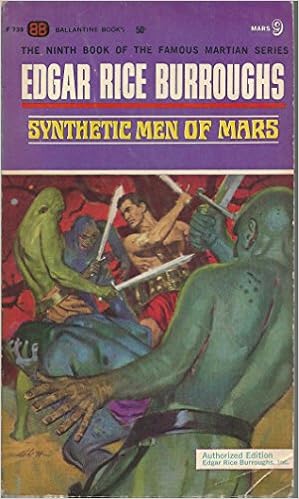
In Synthetic Men of Mars (1939), Ras Thavas, the Master Mind of Mars, embarks on a project to create artificial human beings. He grows them out of culture vats. These creatures, called “hormads,” very seldom seem to turn out quite right. In fact, some of them are such a mess as to be of no use at all. But Ras Thavas, like John Hammond in Jurassic Park, is convinced he can impose his will on nature if only he tries hard enough.

Well, something goes horribly wrong in Vat Room #4. Instead of producing individual hormads, the vats have begun to pump out a solid mass of writhing, hungry, ill-assorted body parts; and no one is able to stop it. It just grows and grows and grows, shooting forth monstrous heads and clutching hands, disconnected legs, undifferentiated tissue like a gigantic amoeba… yech! And if something isn’t done about it soon, it’ll take over the whole lab complex, then the whole island, and, theoretically, could keep on growing until it covers the entire planet and devours everything.

Now that’s what I call a vision. Not only did ERB anticipate cloning, and all that stuff. More importantly, his image of the all-consuming mess in Vat Room #4 is right on target as a metaphor for all-consuming statism. You know–the kind that aspires to a world government that can direct planning and land use for every little village on the planet, and, under the pretext of doing what’s best for us, swallow up every last one of our liberties. The kind of mess that Hitler, Stalin, and Mao did so much to pioneer. The kind that listens in on everybody’s phone calls.

The kind of hell you get after “progressive” thieves and murderers get through with “fundamentally transforming” your country.

In Synthetic Men of Mars, John Carter comes along with his air force and fire-bombs the hideous mass out of existence.

I don’t think our hideous mass will be quite so easy to get rid of.

How Did C.S. Lewis Do It?

I was all set to rail against the government scarfing up tens of millions of Americans’ private phone, email, and Facebook records–but Sen. Dianne Feinstein has like totally set my mind at ease about that. She says they do this in case someone might become a terrorist in the future. Well, now I feel a lot better. Don’t you?

While our country melts into a boiling mass of corruption, I’ve just reread The Lion, the Witch, and the Wardrobe, the first of C.S. LewisChronicles of Narnia (the first one he wrote, I mean). It’s good to get away for a little while, when I lie down in bed.

Every time I read the chronicles, I stand in awe of Lewis’ technique. He makes it look so easy, you just might fail to notice it. The story just flows; and in one paragraph, without even a hint of skimping on the details, he gets more action done than any other writer can accomplish in two or three whole pages. For me, looking at it with the eye of a writer, it looks like magic! All of this stuff happens, or a character is introduced and you learn to know everything about him that you need to know–and yet only a few sentences have gone by. And yet, incredibly, nothing has been left out, either. Pure wizardry!

It’s so simple, any reasonably intelligent child can read it and enjoy it. It’s so deep, any receptive adult can dive into it headfirst without having to worry about cracking his skull on the bottom.

The fact that it was written in Christ’s service doesn’t hurt it, either.

A Treasure Rediscovered

Cleaning out my closet, I found an old paperback copy of The Jungle Books by Rudyard Kipling.

Once upon a time, I guess just about everybody read The Jungle Books. There was even a movie, starring Sabu. Mowgli‘s adventures in the Indian jungle, being raised by wolves and tutored by a bear, a panther, and a python, all told by a master storyteller–it just doesn’t get any better than that.

When I was a little boy, my Aunt Millie gave me for Christmas an illustrated edition of the first part of The Jungle Books (there are two parts). How I loved that book! It fell apart from overuse while I was still a child; but reading the stories now, over 50 years later, I can still see those illustrations as clearly as if they were on the page in front of me. The only difference is, I think I love the stories even better now.

(They’re getting under my skin, too. Last night I dreamed I was going to marry a black-and-white cat who talked and smoked cigarettes.)

If The Jungle Books are not fantasy fiction, very strictly speaking, they certainly share in the spirit of fantasy. Kipling creates something fantastic, something totally at odds with reality–a world of talking animals who have laws and customs–and by the greatness of his art, gets the reader to believe in it. And in visiting this unreal world of his, we wind up seeing the real world more clearly.

If you haven’t read these stories in a while, read them again. If you’ve never read them, and are going to read them for the first time… Well, I envy you!

Tolkien on Politics

J.R.R. Tolkien, world-famous as the author of The Hobbit and The Lord of the Rings, wasn’t much for politics. Nevertheless, he did have some strong opinions on the subject.

The following is from one of his letters, quoted in Secret Fire by Stratford Caldecott (pg. 124):

“I would arrest anybody who uses the word State (in any sense other than the inanimate realm of England and its inhabitants, a thing that has neither power, rights nor mind); and after a chance of recantation, execute them if they remained obstinate! …[Government] is an abstract noun meaning the art and process of governing and it should be an offence to write it with a capital G or so as to refer to people.”

And this from another letter, quoted on pgs. 124-125:

“I am not a democrat, only because ‘humility’ and equality are spiritual principles corrupted by the attempt to mechanise and formalise them, with the result that we get not universal smallness and humility, but universal greatness and pride, till some Orc gets hold of a ring of power–and then we get and are getting slavery.”

Hmm… I wonder what he’d think of current revelations that the Internal Revenue Service, an organ of the government funded by all the taxpayers of America, used its auditing powers, and other powers, to place obstacles in the way of conservative groups while at the same time smoothing the path for left-wing organizations.

Tolkien thought the ruling class was getting way, way, way too big for its britches in the 1950s. He should see it now that the Orcs really have gotten hold of it.

Tolkien Was Deeper Than I Thought

I am reading a book which I discovered accidentally and which is blowing me away. It’s Secret Fire: The Spiritual Vision of J.R.R. Tolkien, by Stratford Caldecott (2003). The author with the unusual name is Director of the Chesterton Institute for Faith & Culture in Oxford, England.

This book explores the deep Christian roots of Tolkien’s fantasy writings. You hardly need to be told that fantasy may often serve as an indirect approach to truth. Sometimes you can see truth more clearly if you look at it from a funny angle.

This morning I read how, sometime after the publication of The Lord of the Rings, Tolkien was visited by a man, a stranger, who showed him “certain old pictures that seemed almost designed to illustrate The Lord of the Rings, but which Tolkien had never before seen. The man remarks after a silence: ‘Of course you don’t suppose, do you, that you wrote all that book yourself?'”

I read this to my wife and she said, “Hmm! Sounds like another fantasy writer I know.” Meaning me, of all people.

But it’s true. On one level I suppose we can’t deny that we “make up” the stories that we write. But on another level, we simply can’t shake the sense that the stories were there all along, somewhere, and that we have been shown them and given the privilege of writing them. Shown by whom? By Our Lord the Living God–who else?

I’ve only just started on this book, and can hardly wait to see what else is in it.

By the Creator of Tarzan…

I have discovered an Edgar Rice Burroughs novel that I am sure I’d never read before.

Burroughs is best-known as the creator of Tarzan. I read him regularly, because no one ever did a better job of juggling complicated plots and keeping the action moving forward. Some reviewers have said I do that rather well. If I do, I learned it from ERB.

I Am a Barbarian, written in 1941 but not published until 1967, 17 years after Burroughs’ death, is a first-person “memoir” by Britannicus, a lifelong slave to the mad emperor Caligula. As a depiction of the life and politics of ancient Rome, it was based on fairly extensive research and is vivid and convincing. But that’s not why I’m telling you about it.

This story is written with a savage bitterness that one does not generally associate with ERB. Indeed, as a lifelong Burroughs fan, I would have trouble recognizing Barbarian as his work if his name weren’t on the cover. What was going on in his life to make him write like that?

Despite being one of the most popularly successful writers in American history, ERB had a terrible habit of investing his hard-earned money in various real-estate and other get-rich-quick schemes that never bore fruit. He’d been poor for most of his young adulthood, and now he wanted to be rich. Very rich. Which he would have been, if he’d only stuck to writing and left the other stuff alone!

In 1941 his second marriage was falling apart–his fault, by all accounts–resulting in a 1942 divorce. The wife, a former silent movie actress 28 years younger than he, Burroughs married on the rebound from his first wife, by whom he had three children. It must have been a very bad time in his life: the tone of I Am a Barbarian shows it.

ERB died in 1950, only a year after I was born, so in spite of all I owe him as a writer, there’s nothing I can do for him. The Bible teaches us that we don’t have to live in bitterness, we don’t have to screw up our own lives. (There are plenty of individuals out there who’ll be only too glad to do it for us.) I suspect ERB wasn’t much committed to the Christian life.

Too bad. He would’ve done better, if he had been.

Hail to Hercule!

Just to keep our sanity, while our country melts into goo right before our eyes, let’s talk about something a little more pleasant, shall we? Let’s talk about detective stories: Poirot stories in particular.

I’m a huge Agatha Christie fan. I’m fascinated by her insights into character, and I applaud the Christian undercurrent in her books, which sometimes comes quietly to the surface. This week my wife and I discovered the many TV and movie episodes starring David Suchet as the Belgian detective genius, Hercule Poirot. (Suchet has instantly become one of my heroes. Raised without religion, he was converted by the Holy Spirit one day in the 1980s, while reading Romans Chapter 8 in a hotel Bible. Since then, he has employed his acting talents in various projects in the service of Christ’s Kingdom. See his documentary of St. Paul’s life, “In the Footsteps of St. Paul,” available online at no charge.)

Like Sherlock Holmes, like Columbo, Poirot goes up against fiendishly clever criminals and always comes out on top. As a fantasy writer, you know I appreciate that! Like Holmes, he is marvelously eccentric; but unlike Holmes, he is a solid Catholic who has a passion to see justice done. (Christie’s other famous sleuth, Miss Marple, is a Protestant who reads her devotionals every morning before she gets out of bed.)

These tales are infused with a moral commitment that we often find lacking in more modern detective stories (but not all of them). Hercule Poirot has his little quirks, but he is thoroughly incorruptible and his faith is his anchor: he can’t be bought, buffaloed, or budged from being on the Lord’s side.

Did I mention that these also happen to be thoroughly entertaining mysteries?

The more  I study these books, the more impressed I am by just how Christian they really are. Dame Agatha never beat her readers over the head with it. In fact, I have no idea what her own religious convictions might have been.

But no artist creates such characters as Hercule Poirot and Jane Marple without a fair amount of help from Above–whether the artist knows it or not.

I Almost Review ‘The Last Banquet’

How far out of the box do I dare to go? Can I review one of my own books?

Well, it needs to be done, so here goes.

The Last Banquet, Book #4 of my Bell Mountain series, is so good, even my mother likes it. Big deal, you say? You bet, says I. Just try to impress your mother sometime. I’ll bet you can’t do it. It took me almost 64 years.

I can’t tell you much about the plot. If you haven’t read the first three books, I don’t want to take the chance of spoiling them for you. Suffice it to say the story continues, and that you’ll be in for some big surprises.

You know what? This is impossible. It’s hard enough to write the books, let alone review them. I’m responsible for my own publicity, but one has to draw the line somewhere.

‘Martin the Warrior’

Look at this: it’s almost 11:00 and no one’s been here yet. Does that mean I can write anything I want, since no one will see it?

I finally got a chance to read one of the Redwall series of fantasies by the late Brian Jacques. Redwall itself, Book #1 in the series, wasn’t available, so I chose Martin the Warrior.

These books have been fantastically successful, spinning off TV specials and even an opera, of all things. Blamed if I know why.

All of the characters in Martin are talking animals. Somehow this works just fine in The Wind in the Willows and the Freddy the Pig books, but I didn’t find it worked for me here. I suspect it was because many of these animals act like badly-behaved human beings. This is supposed to be fiction for juveniles, but I would rate it “R” for violence.

For all the fighting and the journeying in this story, it doesn’t seem that much really happens. Jacques could have told the story in half the time he took. Instead, he padded it with long descriptions of what all the characters were eating, every two or three pages. After a few chapters, this began to strike me as a very strange procedure.

By now you may be getting the impression that I don’t like anything. But can I help it if there’s so much poor workmanship out there? I wanted very much to like this book, but I got kind of turned off by all the blood and guts and the perpetual fascination with food. Was Mr. Jacques starving while he wrote this thing?

How Not to Write a Fantasy

I don’t like to rip an author who has died recently and can’t defend himself; who was extremely popular and successful; and who, in the book I just read, was trying to create something positive and wholesome, even if he didn’t pull it off.

So I’m going to write a review without mentioning the author’s name or the title of his book. Why do such an odd thing? Because the book has lessons to teach anyone who wants to write a fantasy.

The biggest of those lessons is this: Don’t waste good ideas.

The story is a fantasy set in Victorian England. That’s a good idea; makes a nice change from the usual medieval stuff. The hero, unbeknownst to the other characters in the book, is immortal. In fact, he comes out of a legend that they’d all recognize. That’s another idea with a lot of potential.

The hero communicates telepathically with his dog, who is also immortal. The author could have done a lot with that. Instead, the hero and his dog mostly exchange sappy small talk that accomplishes nothing but to add pages to the book. Lots of pages.

There’s nothing in the story that makes it uniquely Victorian. We could just as easily be in New Jersey in 2013. There’s no Victorian feel to the story.

There is no reason for the hero to be immortal. He doesn’t do anything that a mortal hero couldn’t do. He’s been wandering around as in immortal for a couple hundred years, but we are told nothing of his adventures or experiences during that time.

Lesson Two: Please do try to make sense!

Just because your story is a fantasy doesn’t mean it can be incoherent. A lot of the stuff in this book happens for no apparent reason. A boy and his dog are made immortal–by a talking angel–and instructed to walk the earth and “do good.” Wherever they are, the angel warns, they must move on as soon as they hear a bell, any bell, toll once. How come? I dunno. And I don’t know about you, but being sentenced to an eternity of perpetual wandering seems like a heavy burden to me. What did the boy and the dog do to deserve this? Nothing, actually. Maybe the angel was just in a bad mood.

Lesson Three: It’s really hard to believe a story in which everyone is either 100% good or else totally mean and rotten. Worse, all the nice characters are really smart, but all the bad characters are abysmally stupid and incompetent. It’s hard to imagine how these villains could find their way out of bed in the morning, much less pose a threat to anyone.

This book was written for young readers, 12 years old or so. Unless an author has a warped desire to write to idiots, I think it’s always better to write up to children than to write down to them. Just because your readers are young doesn’t mean they’re unintelligent. Show them some respect. Give them credit for being able to understand that bad people sometimes look like good people, until you get to know them better, and that wicked schemes are dangerous precisely because they aren’t clearly labeled “wicked schemes.”

Give pre-teens credit for some smarts.