So I’ve Read ‘Inkheart’

A pretty good movie has led me to an even better book. Finally–a fantasy novel that tells a good story, doesn’t insult my intelligence, and both entertains me and gives me food for thought. That’s Inkheart by Cornelia Funke (a real person, after all), first published in 2003 (in German). There’s a sequel available and I’ll read that, too.

The screenplay follows the plot of the novel only in a very general way, but that’s not a problem. My problem is to tell you about the book without spoiling it for you. I’ll try.

Funke’s hero, Mortimer, has a un1que talent. When he reads aloud, he sometimes can summon objects and living things out of the book and into our world. But there’s a catch: whenever that happens, someone or something from our world gets whisked into the world of the story. This makes life for Mortimer and his 12-year-old daughter, Meggie, rather complicated–and also dangerous. The complications are as bad as the dangers.

This gift of Mortimer’s is not witchcraft. It’s something that just happens, beyond his control. In fact, he can’t control it at all, and his life would be a lot easier without it. So don’t look at Inkheart as some kind of Harry Potter knock-off.

My Search for a Not That Awful Fantasy

In my continuing search for a good fantasy novel written by someone who’s still alive, I picked up City of Secrets, part of the “Stravaganza” series by Mary Hoffman.

Well, I’m still searching.

These books should be good. Should be. It was a nice creative stroke to create a fantasy world patterned after Renaissance Italy, and skew it a little because it’s in a parallel universe. Kids in our own world get access to “Talia” via magic.

Having come up with this really very promising original idea, Mary Hoffman comes up short in the execution of it. She writes down to her readers; it’s as if she thinks too much imagination is beyond their capabilities. So the action in the book is anchored in the real world of school, text messaging, homework, girlfriends, and more school. It is suffocating.

Yo, Mary–every teenager already knows what school is like. They don’t need to read about it. Show some mercy!

As seems to be usual in these books, the teenage characters’ parents are basically nonentities (if they appear at all), their siblings vaguely annoying but quite unimportant, and their age-group peers are everything. This is queer and unnatural; it is also the most enduring legacy of public education. No one really matters except your own narrow group of fellow children–and they matter more than anything. This is the single worst lesson taught by public schooling. They call this abnormal age-group segregation “socialization.”

One of the reasons people read fantasy is to escape. Lord knows we have an awful lot to escape from! Why Ms. Hoffman keeps dragging her characters back to school and peer pressure is a mystery to me. She won’t allow her readers any break from the unrelenting tedium of being a teenager in public school.

All that being said, it’s still better than A Clash of Kings.

‘Game of Thrones’–What’s All the Fuss About?

George R.R. Martin’s A Game of Thrones has turned into a major franchise–best-selling books, a hit TV series, fan clubs all over the world, etc. So naturally I wanted to see what all the fuss is about.

My expectations were high. Martin’s Fevre Dream was one of the best and most original vampire novels that I’ve ever read. I enjoyed some of his science fiction novels, too. Finally, Martin has won just about every fantasy and science fiction award in existence.

I couldn’t get A Game of Thrones, so I’m reading the second book in the series, A Clash of Kings. I’m about 200 pages into the massive volume, and in answer to the question, “What’s all the fuss about?” I can now say, “Hell if I know!”

It’s a disappointment, and I’ll tell you why.

More Fooey (With a Pinch of Bleeaghh…)

The other day, someone–a grown woman, I am sorry to say–told me Fifty Shades of Grey was a hit with her because “it addresses women’s fantasies.”

What a sad commentary on feminism! After 50 years of feminist ranting, a woman’s fantasy is to be the plaything of some rich guy who likes to smack her around? As Hercule Poirot would say, Nom d’un nom!

Anyhow, the exchange aroused my curiosity, so I went back to amazon.com to see what people were saying who liked the book. Here is a sampling thereof.

One reader calls the into-bondage hero “the ultimate alpha male… with a very dark and disturbing desire to inflict pain” (when he’s not solving world hunger), and adds, “…there is a real love story here.” Yikes.

Gushes another, “Chritian [sic], ohhh Christian, what I would do to be yours…” Didn’t her mother teach her any sense?

And a third, “We really believe she [the heroine] might succeed in humanising [sic] this intimidating, masterful man where all the women who went before her have failed.” Good night, nurse! How many poor, misguided women have dribbled their lives away trying to “change” some bum they took up with, who cheats on on her, gambles away the grocery money, lolls around all day playing video games instead of working, and so on? Good bet, lady! Get involved with some sadistic nut, thinking you can “tame” him…

Somehow it all reminds me of “Julia,” the composite woman created by the Obama campaign, who, throughout her entire life, hardly blows her nose without some kind of government assistance.

What is our political class and our popular culture trying to do to women?

I’ve Finished ‘The Hunger Games’

As you can see by the headline, I’ve finished reading the book. I want to review it for the Chalcedon Foundation’s print magazine, Faith For All of Life, so there’s not too much I can say about it here. (Meanwhile, I hope some of you will be curious enough to visit the Chalcedon website, http://www.chalcedon.edu )

In the course of my work for Chalcedon, I read and review a lot of toxic books. I do it so that you don’t have to read them. I do it because it’s important to monitor the culture that we live in, and because it’s a sound practice to keep an eye on what the enemy is doing.

The Hunger Games is intended for an audience of young readers, but I wouldn’t recommend it to any but the most mature for their age. There is too much in it that is, shall we say, unwholesome. I don’t believe the author put it in there to celebrate evil: I’m pretty sure her intention is to warn us off the path our society is treading. That’s a good purpose–but I’m not entirely sold on her execution.

Meanwhile, until I can get a full review written, let me tantalize you with a single point. Although this book is very well written indeed, and very well thought-out, there is a hole in it–a gaping hole through which you could drive a rather large truck.

If you’ve already read the book, or seen the movie, have you seen the hole, too? If not, can you guess what it is?

Rabbit Legacy: Book II of Ellen Maze’s ‘Christian Vampire’ Series

Rabbit Legacy by Ellen C. Maze

(TreasureLine Publishing, 2011)

Just when you thought it was safe to take the garlic down from your windows…

Of course, if you’ve read the first book of Ellen C. Maze’s Christianized vampire trilogy, Chasing Beth Rider, you already know that garlic won’t do any good against these bloodsuckers. Nevertheless, by the time that story was finished, it seemed the vampires were pretty much finished, too. But no–in Rabbit Legacy they’re back, and they’re looking for revenge.

The good news is that the sequel has built on the first book’s strengths. It has more depth of feeling, more insight into character, and more boldly faces hard questions of faith and theology. It is in every way a better book.

Can the vampire be saved?

Again, we aren’t dealing with “real vampires” in the Bela Lugosi sense of the word, but rather with a cryptic race called “Rakum.” We learned in Book One that the Rakum originated with a demon and have lived in secrecy among the human race for thousands of years. Maze’s boldness in throwing out all the vampire story conventions has allowed her to do interesting things with plot and character development.

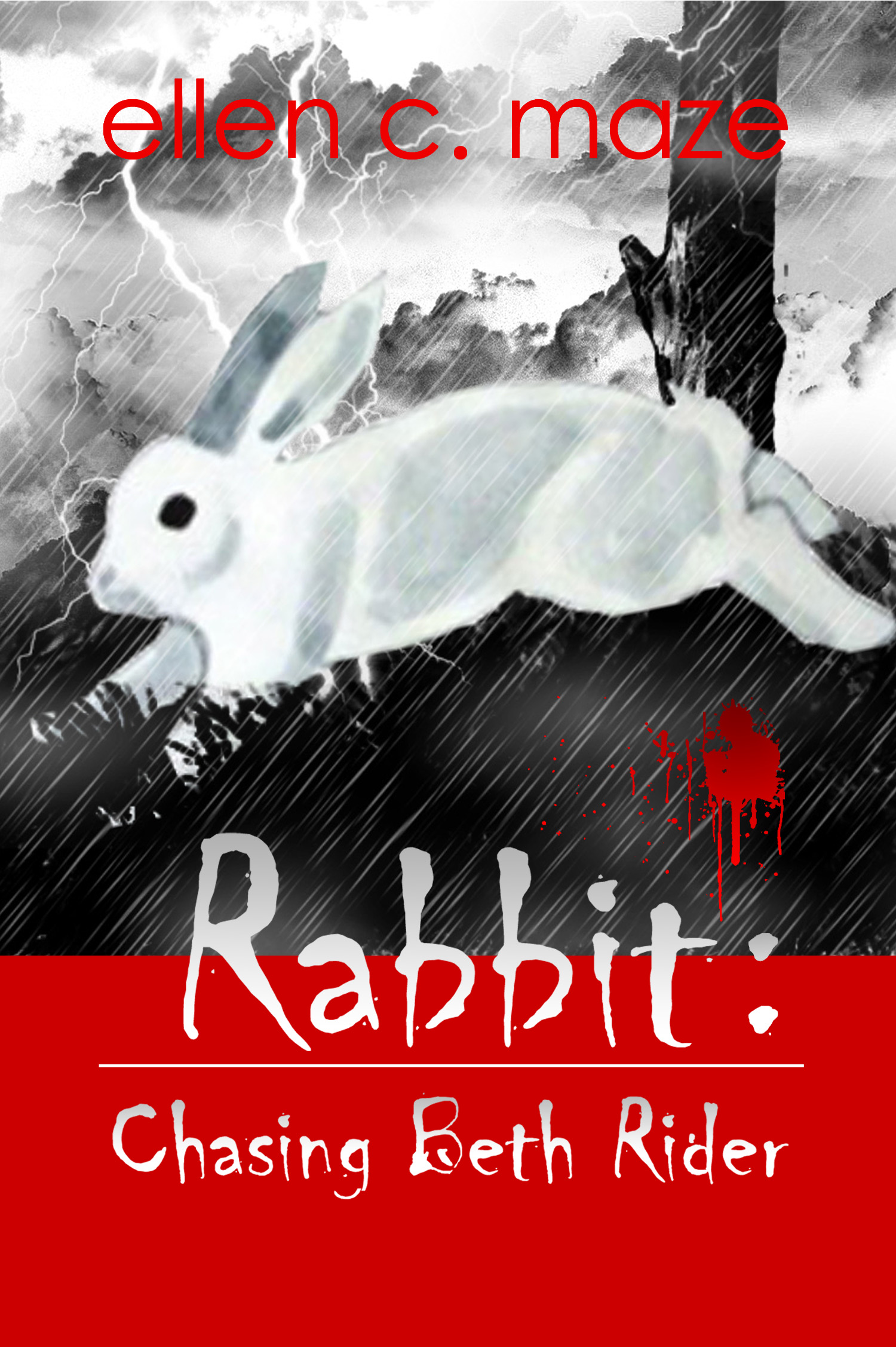
Rabbit: Chasing Beth Rider by Ellen C. Maze

(TreasureLine Publishing: 2010)

For the past two years or so there has been an undercurrent of buzz in the book world as to when we would see the first “Christian vampire novels,” and what they might look like. The subject has even come up recently on my book blog.

Meanwhile, sleazy, slimy, most decidedly un-Christian vampire novels have proliferated (Twilight knockoffs, most of them). With so much of that going on, I had reservations about Ellen Maze’s novel-clearly labeled “Christian HORROR” on TreasureLine’s cover. Frankly, I expected to be saddled with a schlocky, formulaic horror novel with some “Christian stuff” slapped on like a decal.

Happily, I was quite wrong about that.

Why Do It?

Let’s say it right up front. Whatever this book’s shortcomings (and there are a few), Ellen Maze has taken a big step in the right direction. In fact, hers is a pioneering effort, and other Christian novelists ought to be able to build on it-especially if they’re writing fantasy or horror.

Behind this is something very important: the prospect of reclaiming the whole “entertainment” industry for the Kingdom of Christ, starting with print fiction. People in the Western world consume untold quantities of fiction in various forms-novels, stories, movies, television, games, etc.-and the vast majority of it depicts a world that is totally without God, inhabited by characters who have not the slightest sense of God in their lives. This depicts a thoroughly non-religious civilization whose like has never existed on the earth: and consumers of it spend uncounted hours marinating in it. Let the reader imagine its effects on the way such consumers think and live-including the many who identify themselves as Christian.

Perhaps finding a way to write a “Christian vampire novel” is a very little thing. But we know our God delights in producing great effects from little causes.

Looking for the King: An Inklings Novel by David C. Downing

(Ignatius Press, San Francisco: 2010)

Aided by three wise men, two young Americans go tearing around Britain in 1940 in search of a legendary Christian relic … That, in a nutshell, is the plot of Looking for the King.

The wise men are Charles Williams, J. R. R. Tolkien, and C. S. Lewis, the most famous members of a scholarly group of friends who called themselves the Inklings. Williams is not as well-known as the other two, who became popular culture icons; but as a close friend of Lewis and Tolkien, and an acknowledged influence on their lives and works, he has been included in the story.

The relic is the Roman lance that pierced the side of Christ as He hung on the cross, confirming that He was dead and that the body could be taken down, as told in John 19:31–37. The king in question is King Arthur: the quest begins with Tom McCord’s research into the matter of King Arthur’s historicity. Apologizing in advance for what may be considered a “spoiler,” the king Tom eventually finds is not Arthur but Jesus Christ Himself.

This book matters not because it’s great literary art (which it isn’t), or an introduction to three fascinating Christian thinkers (which it is), but because in it we can begin to see how the realm of imaginative fiction might be reclaimed for Christ and put to the service of His Kingdom. Reading this novel might start other writers on that journey.