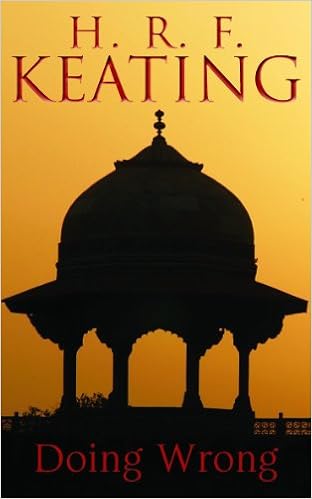
I have just read Doing Wrong, No. 20 in H.R.F. Keating’s Inspector Ghote mysteries, this one published in 1994. There would be a few more before Keating’s death, but not many.
This one is a corker.
Inspector Ghote was Columbo before Peter Falk was Columbo. Ghote works out of the Bombay C.I.D., although, over the years, his investigations have taken him all over India. Doing Wrong takes him to the Hindu holy city of Banares.
Yes, they still burn bodies on the banks of the Ganges, and throw the ashes in the river. If the deceased is too poor for a proper funeral, the body is thrown into the river as is. It is believed that the water of the Ganges has the power to wash away sins, from the dead as well as the living. Persons in search of holiness bathe in the Ganges. They also brush their teeth in it.
Ghote comes to Banares following up a clue in the murder of Mrs. Shoba Popatkar, once a personage in the Indian independence movement. He has very little to go on, and next to no support from his superiors: but Ganesh Ghote, once he has his teeth in a case, never lets go.
This time Keating tells you right up front who committed the murder, and why: a Banares politician, H.K. Verma, strangled Mrs. Popatkar to keep her from broadcasting some embarrassing information that would have ruined his hopes of being appointed a minister in the government.
So where’s the suspense? Well, did you ever have one of those nasty dreams in which you’ve committed a murder and you’re trying to escape the consequences? And the murder in the dream is a given, a fait accompli: it happened before the dream started, and you’re stuck with it.
We have H.K. Verma’s nightmarish experience as Ghote comes closer and closer to a solution to the crime. And we have Verma’s increasingly frantic attempts to rationalize the crime, to justify himself in his own mind. He searches for absolution in the Ganges. He must also deal with a bitterly ironic stroke of fate.
The narrative goes back and forth between Ghote’s point of view and Verma’s, tightly focused on the two of them. The result is suspenseful indeed.
Keating was one of a very few writers who could use dialect without distracting and exasperating the reader. Indian English is not quite the same as American English. Keating’s mastery of it is infectious–and I had better stop thinking-thinking of it only, or it will be seeping into my own writing.
For more than 30 years the Inspector Ghote series was one of the most consistently clever and entertaining mystery series around.
I think it always will be.
