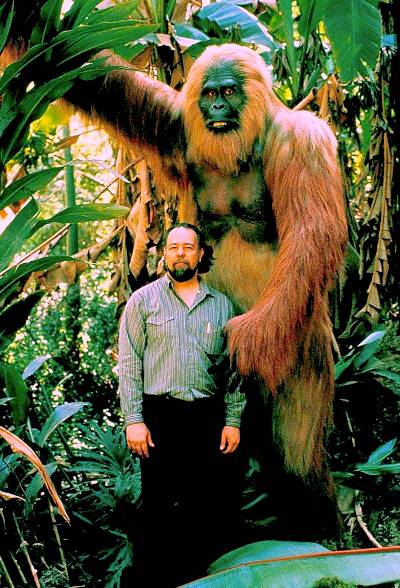
Hi, Mr. Nature here, with a really cool prehistoric creature that ought to get at least a cameo appearance in a Bell Mountain book. Maybe the next one.
Gigantopithecus (“Giant ape”) lived long ago in Southeast Asia. About a hundred years ago, some of its enormous teeth were discovered in Chinese drugstores, where they were sold to be ground up for medicine. To this day all we have of its remains are a bunch of teeth and some bits of jawbone, but the reconstruction is hopefully somewhere near the mark, because these pieces strongly resemble the corresponding pieces in modern great apes. Only much, much bigger! Scientists believe a full-grown Gigantopithecus probably stood ten feet tall. Shades of King Kong.
For a while it was believed those teeth once belonged to gigantic human beings, albeit of a primitive form. Well, that’s Evolution for you. But as Gertrude Stein might say, “A Gigantopithecus is a Gigantopithecus is a Gigantopithecus.” God doesn’t create living things that are on their way to becoming something else. They’re all right just as they are. And all we can say for certain is that there probably aren’t any more of them. Probably.
What must it have been like to see one of these coming your way down a path in the jungle? I don’t think you’d easily forget it!
Pink fur? Was it natural, or done at a salon? 🙂
I think that’s just a trick of the light. With salon prices what they were in those days, no Gigantopithecus could have afforded it.
I’m pretty sure no one would have ever thought they would stumble upon a pink bigfoot. But did you notice that the Gigantopithecus and the man appearing in the photo with him bear a striking resemblance? 🙂
One of the tricks evolutionists like to do in their reconstructions is to make these animals look more human by giving them whites in their eyes. This helps to muddy lines between created species. I also see he is standing totally erect like a human.
I could have used a picture in which he wasn’t standing erect, but I wanted to give readers a better idea of his size compared to a man’s.
When I was a boy reading about Gigantopithecus, which then bore the name “Meganthropus (Giant man),” he was always depicted as standing erect–because they thought he was a kind of man.
Reconstructing prehistoric animals is more an art that a science. Charles R. Knight, whose paintings of prehistoric life are classics, guided his work by his own knowledge of living animals plus input from his scientific advisors.
Sometimes, had he been left to his own devices, Knight’s insights would have been much more reliable than those of the scientists. But they paid his salary, so their opinion prevailed.
So bigfoot was real!
The only Gigantopithecus I want to run into would be in the pages of a “Bell Mountain” story. The “monster” who bellowed but stayed out of sight that was following Ryons in the “Thunder King” was scary enough for me (I read these stories on my bed before going to sleep). But then that gigantic fantastic creature turns out to be God’s avenue for deliverance for King Ryon & God’s faithful army.
I’m so glad you liked that! That whole business started out as a dream I had one night.