Kentucky’s Rare Yellow Cardinals REPRINT

Image result for images of yellow cardinal

From June 12, 2017

Hi, Mr. Nature here–dyin’ from the heat. Last week we had our winter coats on. Today it’s 95 degrees. Well, that’s New Jersey for you.

One thing we don’t have in New Jersey is yellow cardinals–the birds, I mean, not wishy-washy churchmen. For that you have to go to Kentucky.

But even in Kentucky, the yellow cardinal is quite rare. So much so, they urge you to take pictures if you see one. The Northern Cardinal most of us know is bright red (the males) or sort-of red with a green-brown overlay (females). Cardinals mate for keeps, and where you see the male, the female won’t be far behind–and vice-versa. The yellow form, ornithologists say, is a rare genetic mutation.

God has gifted these birds with spectacularly beautiful color, and we delight in them. Even in its fallen state, the world He has created offers beauty.

Whatever will it be like, when He regenerates His whole creation?

A Welcome Weed REPRINT

Image result for dead nettle

From April 9, 2017

The first plant to come up in my wife’s little garden, this year and last year, is the purple deadnettle.

Hi, Mr. Nature here–and it’s called the “dead” nettle because it doesn’t have a sting like the real nettle. It’s a member of the mint family, memorable for its delicate purple flowers and its leaves that are arranged like a stack of dishes. It grows all over the place, around here.

Bob Bakker–the scientist who, more than anybody else, popularized the concept of warm-blooded, active dinosaurs–once told me one of the things that most draws him to God is the self-evident delight which the Creator takes in His creation. I agree! Even this fallen world, the Father stocks with beauty. Even the weeds!

I was happy when I read that a lot of people have come to appreciate the deadnettle for its beauty and are now planting it on purpose, usually as a border for a garden, and because it so delights our eyes.

Give thanks for the beauty of God’s handiwork: it tells us something good about its Maker.

The picture doesn’t do it justice, and yes it still comes up every year PD

Beware the Puss Moth Caterpillar REPRINT

Image result for images of puss caterpillarVideo to follow  (from August 6, 2016)


Hi, Mr. Nature here! I haven’t been around much lately because I don’t want anybody to think I even know Joe Collidge.

But I’m here today to warn you off those furry, cuddly-looking caterpillars that just say “Pet me!” when you look at them. Believe me, you’ll be mighty sorry if you do pet one of them.

These critters are found throughout the Southeastern US, as far west as Texas, where they’re all over the place, and as far north as New Jersey.

If you’re really lucky, getting stung by one of these–and the venom is injected on contact, the caterpillar doesn’t have to do it on purpose–it will only be extremely painful. If you’re not so lucky, it will be much worse. It won’t kill you, but the sting of the puss caterpillar has been likened to that of a scorpion. In some parts of the country they’re called tree asps. (If you don’t know what that means, you need to do more crossword puzzles.)

I repeat: don’t touch!

God is Nigh REPRINT

From April 16, 2017

Our ancient dogwood tree has just come into flower on this Easter morning. It always did have a fine sense of timing.

We’ve been here 40 years, but the tree was here first. Dogwoods can live up to 80 years, says Mr. Nature; but we don’t know when this tree was planted.

Even more remarkable, on the very same day, our ancient tulip has bloomed. Tulips live for 20 years, sometimes a little more. But this, too, was here when we moved in. It used to burst forth into one spectacular, bright red flower. Now it has four instead of one. We hope the squirrels don’t eat the flowers, as used to be their custom. They left it alone last year.

These (even the squirrels) are God’s handiwork. He imagined them, and then created them. They are here because He put them here. Their beauty is one of His countless gifts to us.

But even more than beauty, the dogwood and the tulip, and all the rest of God’s creation, have something important to tell us: God is nigh. Always.

 Note:  the dogwood is gone, but the tulip still blooms every year. PD

One Weird Fish! The Goblin Shark REPRINT

From July 6, 2017

Hi, Mr. Nature here–with a deep-sea creature that looks like the product of a special effects crew.

The goblin shark wasn’t discovered until 1898. It has two far-out features. First, that long thing sticking way out the top of its head. It’s not a nose or a horn. It’s full of tiny sensors that enable the shark, in deep and lightless waters, to detect electrical fields given off by living things it might want to eat.

The second weird feature is a set of jaws that can be shot out in front of its head to catch prey–sort of like the choppers on the monster in Alien. Zap! Gotcha!

The shark in the video probably didn’t mean to attack the diver, and only accidentally got its teeth caught in the wet suit. This gives us a really good look at those extendable jaws.

Probably the closest look we’ll ever want to get.

Mr. Nature: The Last Thylacine REPRINT

From June 30, 2018

These video clips, taken at the Hobart Zoo in Tasmania, preserve the memory of an animal that is now supposedly extinct–the thylacine, aka “Tasmanian tiger,” once upon a time the largest living marsupial carnivore. The last one died at the zoo in 1936.

Mr. Nature here, with an animal that I wish was still alive. And it may be. Over the years, hundreds, if not thousands, of people have claimed to have sighted living thylacines on the Australian mainland. Some of them back up their claims with videos, a few of which look quite convincing. So it’s possible there may be a few of them left, roaming the outback. The long, stiff tails, and the stripes along the back, are distinctive: no other animal has them.

Jack and Ellayne encountered a much larger version of a thylacine in Lintum Forest, carrying off, in its massive jaws, the front half of a knuckle-bear.

I don’t think God likes it when we kill off members of His creation.

But I also believe He’ll bring them back, someday, somewhere–if He hasn’t done it already, someplace where they’re safe from us.

The Battling ‘Roos of Suburbia

From May 5, 2017

G’day, mate! Mr. Nature here, somewhere in the suburbs in Australia, just in time for an early-morning fight between two male kangaroos.

These guys can get up to eight feet tall when they stand on their hind legs; and with the sturdy tail available as a third leg, they can kick with both hind legs at once. Meanwhile, they punch and scratch with their clawed forepaws.

I don’t see anybody running outside to break this up.

Why did God make kangaroos so fierce?

He didn’t. It’s the fallen world that made them fierce. And anyway, the occasional ferocity of male kangaroos in mating season hardly holds a candle to the ferocity of human beings toward one another.

God is at work, even now, to restore His creation to its original state of purity. We wonder why it’s taking Him so long.

But I know one thing for sure: I’d rather He did it than us.

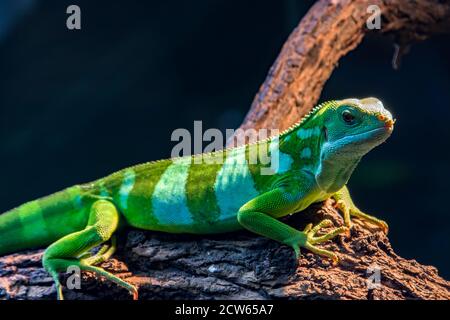
A Mystery: Fiji Island Iguanas’ (2017)

the closeup image of Fiji banded iguana (Brachylophus ...

I’ve been missing my pets lately, including my iguana whom I had for 17 years. What were his kinfolk doing all the way out there in Fiji?

A Mystery: Fiji Island Iguanas

Beautiful creature, isn’t it? I wonder what they look like when they get much older. Our American iguanas develop strong jaws, and their colors fade.

Winding up in Fiji, though–that’s a genuine mystery.

Sand Kittens? Wow!

Jambo, Mr. Nature here–with an animal I’d never heard of till yesterday.

Sand kittens–aka “sand cats” when they’re grown up–live in the Sahara Desert. This video is said to be the first video taken of sand cats in the wild.

You’d think the Sahara would be no place for a cat of any kind, but these little characters do all right. Awfully cute, aren’t they?

Nature Isn’t Always Cuddly

10 Biggest Spiders Ever Encountered!

When I was a boy, I was deathly afraid of spiders. I think it was because of a movie I saw on TV, in which a child ran face-first into a spider web and got bitten by a spider the size of a softball, and almost died. But that was long ago. I have since come to like–sort of–jumping spiders and wolf spiders.

Nevertheless, there are still some big ‘uns out there that I’d cross the street to avoid. I don’t know how genuine that photo is, up there; but something tells me I would very much prefer never to find out.

Maybe it’s a very small toilet bowl? But that’s another kind of problem.

(Not feeling very well today!)