The Saddest Word in the Bible REPRINT

From February 19, 2016

Who spoke the saddest word in all the Bible?

In Acts 26, Paul defends the Christian faith before the Roman governor, Festus, and King Agrippa, son of that Herod who murdered the Apostle James, but a man with a decent reputation in history. Paul has high hopes that Agrippa will listen to him, because he knows the king has been an earnest student of the scriptures.

Paul concludes, “For the king knoweth of these things, before whom also I speak freely; for I am persuaded that none of these things are hidden from him; for this thing was not done in a corner. King Agrippa, believest thou the prophets? I know that thou believest.”

And Agrippa’s answer (verse 28): “Almost thou persuadest me to be a Christian.”

Almost!

Almost got eternal life. Almost got forgiveness of my sins. Almost reconciled to God. Almost entered into God’s Kingdom, and into the joy of Our Lord.

Missed it by that much!

At the risk of sounding like a 1950s TV commercial, don’t let this happen to you.

All right, yeah, faith can be difficult. It wouldn’t be faith, if it weren’t. The substance of things hoped for, the evidence of things not seen (Hebrews 11:1)–and King Agrippa didn’t have it.

He almost believed.

That’s sad.

The Doctor Ate My Day

Scipio Africanus

Well, here it is, 2:30, and I’m back from my 10:30 doctor’s appointment. No bike ride for me today. No work on my new book, either.

But the doctor is very pleased with my progress, vis-a-vis blood pressure. Then he noticed my T-shirt, adorned with a picture of Scipio Africanus, and asked about it. This resulted in my learning he was not a Christian, after all (I thought he was), and his asking, with a show of great interest, about Christianity and the Apostle Paul. He says he wants to learn more, much more. May the Holy Spirit provide him with a good teacher.

Anyhow, this was about the last thing I would have expected, after sitting an hour and a half in the waiting room being tortured by daytime TV. Like, I was there to be ministered to by the doctor, and wound up ministering to him.

And now to run out and do more errands!

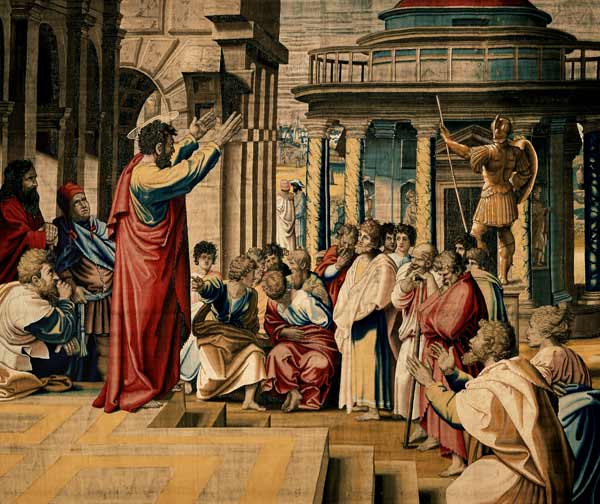
Paul’s Speech to Wise Fools

http://www.art-prints-on-demand.com/kunst/raffael_eigntl_rafaello_santi/die_predigt.jpg

If you had been in Athens around the year 52 A.D., you might have arrived in time to hear an odd little Jewish guy give a speech to the most sophisticated, best-educated audience in the Greco-Roman world. The odd little guy was St. Paul, and this is what he said to them:

“Ye men of Athens, I perceive that in all things ye are too superstitious. For as I passed by, and beheld your devotions, I found an altar with this inscription, ‘TO THE UNKNOWN GOD.’ Whom therefore ye ignorantly worship, him declare I unto you.

“God that made the world and all things therein, seeing that he is Lord of heaven and earth, dwelleth not in temples made with hands; neither is worshipped with men’s hands, as though he needed any thing, seeing he giveth to all life, and breath, and all things; and hath made of one blood all nations of men for to dwell on all the face of the earth, and hath determined the times before appointed, and the bounds of their habitation; that they should seek the Lord, if haply they might feel after him, and find him, though he be not far from every one of us: for in him we live, and move, and have our being; as certain of your own poets have also said, ‘For we are also his offspring.’

“Forasmuch then as we are the offspring of God, we ought not to think that the Godhead is like unto gold, or silver, or stone, graven by art and man’s device. And the times of this ignorance God winked at; but now commandeth all men every where to repent: because he hath appointed a day, in the which he will judge the world in righteousness by that man whom he hath ordained whereof he hath given assurance unto all men in that he hath raised him from the dead.”

And when they heard of the resurrection of the dead, some mocked… [Acts 17:22-32]

Paul made few converts in Athens. They were all too smart to be interested in eternal life.

Some things never change.