Should I… Well, Stop?

The Bell Mountain Series - Reformed Reviews

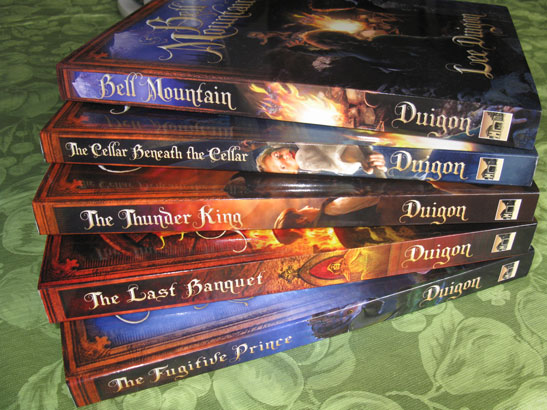
I’m currently working to finish Book No. 15 of my Bell Mountain series, The Witch Box. If my execution lives up to my vision, it’ll be my best book yet.

Edgar Rice Burroughs kept writing Tarzan because the Lord of the Jungle put most of the food on the table; but he complained a lot about having to do it. Agatha Christie came to a point where she was really and truly sick of Hercule Poirot; but she kept on writing him because the readers still wanted him.

I am not tired of writing Bell Mountain. In fact, next time out, I’m thinking I’d like to go back in time 2,000 years to tell the story of King Ozias. But there are some folks out there who think it’s time it was “Lights Out” for Bell Mountain, adios, don’t let the door hit you in the tuchas on your way out…

Of course my books are microscopic, compared to Tarzan or Poirot. I don’t have to worry about angry mobs besieging my publisher because they want Bell Mountain back (which is what happened, literally, when Arthur Conan Doyle tried to kill off his creation, Sherlock Holmes). I have no advertising. Just this wee blog.

My question to readers is, Should I put a cork in it? (One reader says even Wytt bores him, anymore. Good grief.) Have you had your fill of Bell Mountain? Or should I keep on going for as long as the Lord gives me something to write and Chalcedon’s willing to publish it?

Just askin’.
The Lure of the Prequel

The Bell Mountain Series - Reformed Reviews

I’ve been chewing over this idea for years now, and a few readers have encouraged me in it. Why not write a Bell Mountain book about things that happened before the events so far related in the series?

The story that pulls me the hardest is that of King Ozias, who lived 2,000 years before Jack and Ellayne et al. Ozias had a thousand enemies, and a thousand narrow escapes. But he trusted in God, he obeyed the directions of the Spirit, and God delivered him out of all his dangers–and promised that his line of descent would continue down the centuries, and never fail. Yes, I think I’d like to write that.

But there’s also the story–well, there must be one–behind Ellayne’s favorite book, The Adventures of Abombalbap. Was there ever such a person as Abombalbap, who was raised and trained in warrior arts by the Seven Hags of Ballamadda? Were his adventures inspired by real events? What was life in Obann like, centuries after the Day of Fire and centuries before King Ryons?

And here’s me, wondering if I should try to write these books. It would mean departing from the story arc that has so far held together 13 books in a series. It strikes me as a rather large risk to take.

Abombalbap would be on it in a heartbeat.

Dream or Vision? (Who Knows?)

Image result for images of the throne by lee duigon

You know I make use of dreams when I’m writing a Bell Mountain novel.

The Wind from Heaven must be blowing for me, because here’s what I dreamed last night, which I will incorporate into the book as I write it.

It was one of those dreams in which you don’t know you’re dreaming because it starts out so mundane and ordinary. I dreamed it was night-time and I had to walk out to the curb to bring in the garbage cans. There seemed to be no traffic, no engine noise, out on Main Street–which should have tipped me off right there that I was dreaming.

The night was quiet and still, everybody’s lights were out… And as if from some great distance, I heard as it were the sound of many voices chanting:

“King Ozias! King Ozias! King Ozias!”

And just out of the corner of my eye, I thought I saw a great lion pass silently into the deeper shadows. It was Ozias, of course, who composed the sacred “Song of the Lion.” And it was Ozias, the last anointed king of Obann, who is the ancestor of the present king, Ryons–the first to hold the title “king of Obann” for some two thousand years.

I can hardly wait to get out there and write this into the story.

P.S.–If you missed earlier posts, The Wind from Heaven is the title of the new book I’ve just started writing.