Five Favorite Novels

THE CHESSMEN OF MARS by Edgar Rice Burroughs (Mars Book #5)

Bob Abbett’s cover art is only one of many delights!

We’re living in an age of rampant cultural decay; and there are times when we need to NOT have it on our minds. We need escape! It’s as simple as that.

Here are five novels that I can always count on to provide escape.

The Chessmen of Mars by Edgar Rice Burroughs. Not only does ERB provide you with the rules of Martian chess; he also brings on Ghek the Kaldane, one of the most intriguing non-human characters ever created. Any description I might briefly offer would fall short by a long shot.

Freddy and the Ignormus by Walter R. Brooks. The Freddy the Pig books are marketed as children’s books, but they’re full of fun for adult readers, too–maybe even more so. In this outing, the legendary pig and his barnyard friends take on a haunted house. But is it really haunted, or just set up to look that way?

The Lord of the Rings by J.R.R. Tolkien. What can I say? I consider this the greatest fantasy novel of all time. Tolkien’s artistry with words will put you there. And although this tale is full of monsters, good is stronger than evil. Can’t hear a more welcome message than that, can you?

20,000 Leagues Under the Sea  by Jules Verne. A lot of modern readers don’t like this book, but I do–and always have, since I was a boy. It was written well before the invention of SCUBA gear and deep-sea vehicles… but it’s so easy to forget this, once the story sucks you in.

That Hideous Strength by C.S. Lewis. This is the climax of Lewis’ “space trilogy,” but it works just fine as a stand-alone story. Can the world be saved from a cannibalistic alliance of Science and Government? Better hope so! Lewis wrote it some 70 years ago, and it seems prophetic now.

So there’s five books to get you started on a summer of fabulous escape fiction. The idea is to step aside for a moment and take a breather, hose down your brain, and get ready for the next round. In that sense, these books are part of God’s divine, all-foreseeing providence. Be thankful for them.
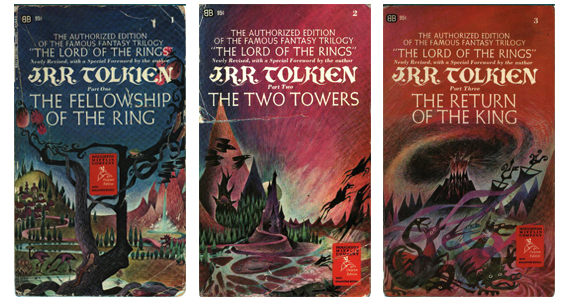
How I Fell in Love with Fantasy

Image result for images of ballantine books fellowship of the ring

Someone around here was enthused enough to prefer my books to J.R.R. Tolkien’s The Lord of the Rings. Well, what can I say?

I first read The Lord of the Rings in high school, and it overwhelmed me. My imagination was already on fire, thanks to Edgar Rice Burroughs–first his Pellucidar novels, and then his tales of adventure on Mars. But Tolkien–!

I was astonished that such a book could ever have been written. Burroughs’ books are short; Tolkien’s was a monumental trilogy. You wind up spending a lot of time in it. The marvelous thing about The Lord of the Rings was that it positively came alive for me: it made me believe in the story that it told. Perhaps it was the mass of detail: Tolkien’s imaginary world is vast. To this day, after many re-readings, I’m sure I could find my way around the Shire, and I’m sure I’d like it there. And I’d know which places to avoid–Mordor, Mirkwood, and the Mines of Moria.

I’ve never seen any illustrations of LOTR which satisfied me. That’s because Tolkien’s art made his people and places real to me, as if I’d actually been there, seen them; and any illustration is, of course, someone else’s imagination, and can never show me anything exactly how I’d already imagined it myself.

It gave me a burning desire to write fantasy. I can’t even guess how many pages I turned out in notebooks, and on my old manual typewriter, trying to imitate Tolkien, trying to match him. But I can say it took several decades for me to realize that the world didn’t need another Tolkien: any fantasies I wrote would have to be my fantasies, and no one else’s. And that took another couple of decades to accomplish.

It’s important to remember that when LOTR came out, there was nothing else remotely like it. Since then, the fantasy genre has been suffocated with Tolkien wannabes, shamelessly ripping off his once-upon-a-time unique creation. I still love Tolkien’s Elves and Dwarves and warriors, etc., but find everybody else’s cheap imitations intolerable. I suspect that if my first reading had been now instead of then, it wouldn’t have had the impact that it did.

Burroughs and Tolkien inspired me, and I doubt my own books would ever have been written if I hadn’t read theirs first. I still stand up and salute The Chessmen of Mars, and in my imagination, search for the road to the forest of Lothlorien.

My All-Time Favorite Half a Dozen Novels

Some folks are going to read this and say, “What a philistine! Why, he has no literary taste at all!” I can’t help that. Anyhow, I enjoy reading other bloggers’ lists of their favorite books, so why not post one of my own?

Here they are, in no particular order.

*The Lord of the Rings by J.R.R. Tolkien. I don’t have to explain this choice, do I?

*The Lion, the Witch, and the Wardrobe by C.S. Lewis. Not only is this, for me, the model of what a Christianity-based fantasy ought to be: but it also features the most fascinating story-start I’ve ever read. It’s been around for going on 70 years, and people will still be loving it 100 years from now.

*20,000 Leagues Under the Sea by Jules Verne. When I’m reading this, I never want it to be over. We’ll never quite figure out what makes Captain Nemo tick, but that only makes him perpetually intriguing. You don’t expect this kind of depth of character in a science fiction novel from the 19th century–or any other century.

*Freddy and the Ignormus by Walter R. Brooks. Fantastic children’s fiction laced with humor that will delight adult readers. Freddy the Pig takes on a terrifying challenge which may or may not be real–and who but Walter R. Brooks would ever describe a beetle as “motherly”?

*Nemesis by Agatha Christie. Miss Marple takes on an investigation without knowing what the crime was, or even if there truly was a crime. More than just a puzzling whodunit, Nemesis explores the deep working of God’s justice in a fallen world.

*The Chessmen of Mars by Edgar Rice Burroughs. More than any other book the creator of Tarzan ever wrote, Chessmen takes you to a place you never imagined, and makes you think it’s real. Plus it offers the most entertaining non-human character you’ve ever met–Ghek the Kaldane, all head, no body, who, in spite of himself, learns how to be human.

So there you have it–books that I come back to again and again, always with pleasure, and which have taught, and continue to teach me, much of what I know about writing.