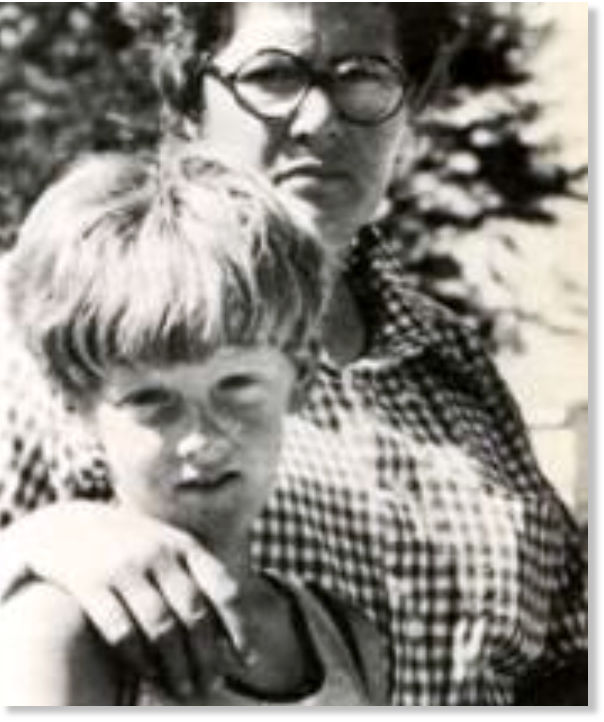
Ruth and her son, Marlon–who was almost carried away by giant birds.
In 1977, in Lawndale, Illinois, children were attacked by a pair of what witnesses called “giant birds.” One of the boys, weighing some 60 pounds, was nearly carried off.
Seven or eight eyewitness accounts tallied closely; but no one had had a chance to take a picture. On rare occasions, an eagle might attack a small child; but no one thought these birds looked like eagles.
The most perplexing aspect of the whole case was the mockery, spite, and anger directed at the target of the birds’ attack. The little boy and his mother practically became outcasts.
Why do you suppose that happened?
Wow, talk about scary.
One huge change in paleontology is the discovery of soft tissue in what had been termed dinosaur fossils. I had been taught, since grade school, that the only remains we have of dinosaurs were fossils which were minerals which had formed in place of the bones of these creatures. Then, they found soft tissue in a large fossil that they had sawn apart in order to transport it. Soft tissue cannot last 65 million years, although they have tried to craft explanations of how it could. This throws off the timeline significantly.
So, perhaps, dinosaurs, and other related creatures have survived longer than we had previously thought. There were reports of “thunderbirds” in the Western US up until the late 19th century. There have been reports of pterodactyls in remote places, even into more recent times. I’m not saying that this is definitely true, but I’m not ruling it out, either.
The fact is, we, as humans, do not know everything. When a species is declared extinct, that presumes that it exists nowhere on the earth, but we do not know everything about every place on earth. Vast stretches of land on the African continent, as well as much of Siberia are essentially unexplored.
The Coelacanth was an ancient fish, long thought to be extinct, until they were found alive near Japan. My personal opinion is that all of the “kinds” spoken of in Genesis remain alive, to our day. Kinds are not species, but more closely match the Family level of taxonomy. Species are varieties within Kinds, and these can come and go, depending upon circumstances. Natural Selection can favor certain species under various circumstances, but it cannot add genetic information.
Let me suggest an example. Suppose a population of humans lives in a place where the winters are cold and dismal, with little sunshine for months on end. I’m describing Scandinavia, and many Scandinavian people are light skinned and tend to have light colored hair and blue eyes. Many of my relatives meet this description. If generation upon generation of people with such features marry and have children, the genetic information for darker pigmentation may be very scarce in their DNA. In such climates, light skin offers an advantage, because it allows the body to make more Vitamin D from the relatively scarce sunlight of the region.
In the Mediterranean region, a more olive skin and darker hair is more common, and lack of sunlight is not a problem.
So, what happens when a person of Italian ancestry with olove skin and dark hair marries a person of Scandinavian ancestry with nearly white-blonde hair and very light skin? Well, this happened in my family, and the result was children of medium complexion. I remember seeing one of the children and remarking on the beautiful olive cast to their skin. Genetic information from the Mediterranean people group had been reintroduced into a lineage of very light skinned Scandinavians, and brought with it a degree of variety which had been lost, or at least made rare, in that particular bloodline.
For the record, I am mostly of Scandinavian and British Isles ancestry, but there is recent Asian blood in the family, so my coloration is somewhat darker than one would expect of someone with so much Scandinavian blood. I have some traces of Asian facial features, but not the epicanthic fold to my eyelids, so few people would see me as Asian at first glance. Honestly, I don’t care all that much, because all humans, no matter what description, are all of one origin and most of the differences between people groups are relatively superficial. My family heritage is interesting, but hardly of earthshaking significance.
But this serves to illustrate that our genetic makeup is sufficiently versatile to adapt to varying conditions and for these conditions to favor certain traits. That is adaptation, not evolution, because evolution would require the addition of genetic information, which cannot happen spontaneously.
So, whatever the case with recent sightings of creatures which may be from species long thought extinct, all of the Kinds created by God persist, to our day. The beautiful little Horned Lizards I occasionally find in my yard look like little dinosaurs to me, and perhaps they are just that. Not all dinosaurs were huge, some were as small as chickens and the average was perhaps the size of a cow. The huge, and fascinating brachiopods were somewhat outliers among a much larger population of great creatures.
Brachiopods? Betcha that’s a typo.
Anyway, thanks for the insight. We really ought to stop taking Darwinism seriously.
Probably. What I meant were the heavy hitters of the dinosaur world, the huge plant eaters we used to call Brontosaurus.
Darwin stated that he expected his transitional species would show up in the fossil record, but it hasn’t come to pass. I wonder what would happen if someone wrote a check based upon money they expected to show up in their account at some time in the indefinite future. 🙂
Good news: we can call it Brontosaurus again, the genus has been rehabilitated.
I’ve wondered about that. There is relatively little information in the Bible regarding the details of the pre-Flood era. Believing scientists have proposed some interesting theories, and some believe that the concentration of oxygen in the atmosphere was greater, back then. That would certainly have supported life much differently than the atmosphere we have now. However, if the oxygen partial pressure was higher, that would also increase the flammability of everything. I don’t claim to know, but it is interesting to think about.
The “more oxygen” scenario seems to be on pretty solid ground. It does account for giant Paleozoic insects.
I’ve thought that if the earth was such before the flood that people could live for 800-900 years, lizards could live much longer also. If they continue to grow they would be much larger.
Most lizards do keep growing as long as they live, albeit slower and slower. They don’t stop like we do.
It makes a lot of sense, and certainly explains some of the large living creatures from those times. I wonder what it was like to live in those days. If the oxygen partial pressure was higher, fire would spread very easily. I wonder how they dealt with that.
I have read this story before, and others just like it. It belongs in the category of Cryptozoology, those who search for and study unknown, legendary, or extinct animals whose present existence is disputed or unsubstantiated.
The Okapi at one time would have fit into that category. The species was not formally recognized until 1901.
It stands 4 ft 11 in tall at the shoulder, its body length is about 8 ft, and weight ranges from 440 to 770 lb. It is endemic to the northeast Congo in central Africa. It kind of looks like a cross between a zebras and a giraffe.
There are many other such stories, with many eye witnesses. I tend to believe this story.
But why would so many mock and ridicule such stories?
I have a friend here, who told me that kind of story, of a creature which he has seen, that has been killing his chickens and small animals. I do not believe he is lying to me. He lives in a place with a lot of dense forest, and a small population. It’s not a large bird, but some kind of mammal like creature, but nothing that I know of matches its description. Whatever it is, I don’t want to come across it during the night, or even the day.
The problem of cryptozoology is that, as soon as a thus-far unknown animal is found… it stops being a subject of cryptozoology and gets shifted to regular zoology.
It is arrogance for the “experts” to declare a species extinct, because they are not able to see every location on earth. I will agree that there is a high likelihood that many species have gone extinct, but it’s really impossible to know for sure.
I do not believe, for even a moment, that the Creator’s work has been in vain, with regard to the kinds He created. Everything that has existed in the past should be able to exist again. God’s work was not only good, it was very good, and His purposes will never be thwarted.
I think it’s up to Him whether we ever get to see Baluchitherium in all its glory.
Exactly.
Its been said, the dodo was extinct by 1681. I have read of recent sightings of that extinct bird. In recent times, Tasmanian tiger sightings have continued: In 2018, a tiger reportedly crossed a road in front of three bicyclists. And in 2019, a government biologist reported spotting the animal from about 100 feet away. Well now, those two creature just may still be alive after all.
A perfect example. Hubris is very fashionable, in some circles.
I don’t find it hard to believe there are still Tasmanian tigers living in the Outback. But the dodo–well, Mauritius is a little island and the bird must have long ago run out of hiding places.
I’d like to hear from someone from Mauritius on this.
Mauritius isn’t the only island in that nation. Now they may have thought, that the dodo only lived on just one island, but isn’t it possible that that island nation has populations of dodos on a few of its other islands?
I can’t believe no one’s searched for the dodo. I mean, these are pretty small islands, aren’t they?
I used to have a regular reader in Mauritius; but haven’t heard from him in a while. That would be useful input.