
The Queen of Suspense has done it again!
Remember, in Chapter DCCCIV of her soul-searing romance, Oy, Rodney, Coldsore Hall being targeted by a herd of woolly mammoths egged on by the June Taylor Dancers?
(What’s that? You don’t remember? Boy, you’re lucky this is not a college course!)
Well, in Chapter DCCCV, romance literature All-Star Violet Crepuscular has sprung her trap! Wow! Blows the reader right out of the water! Who could have possibly seen this coming?
“Lookit that, Germy!” expostulates Willis Twombley, the American adventurer who thinks he’s Sargon of Akkad. He has just shot another dancer off the back of a mammoth. “Them hairy elaphants–they’re retreating! We’ve won!”
“I say, old man, jolly good show!” sputters Lord Jeremy Coldsore. “But what’s that coming up the road?”
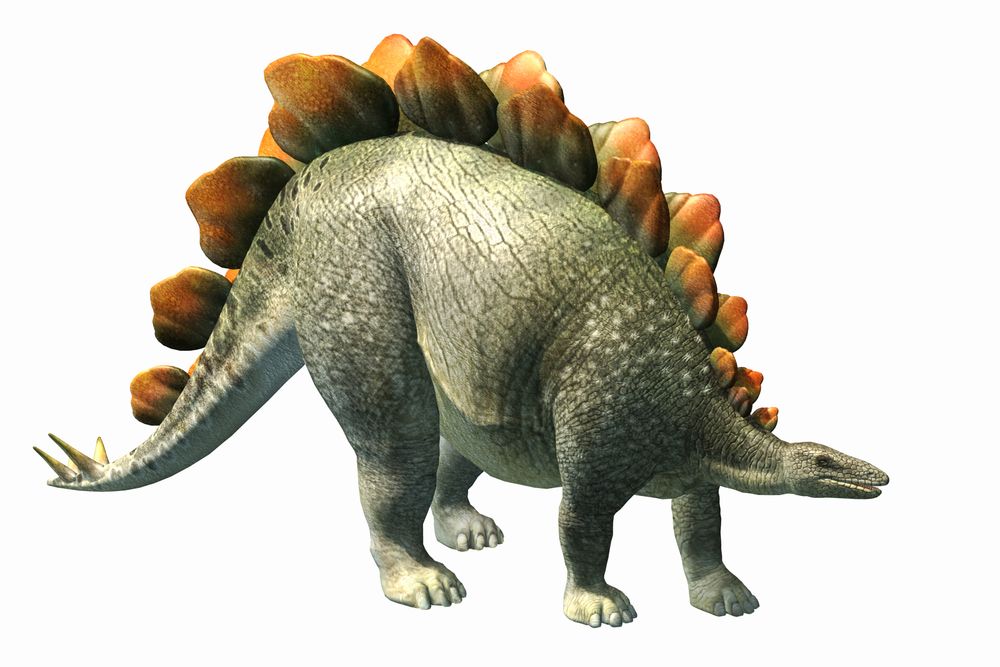
Yes! Constable Chumley’s worst childhood terrors have come true.
Lord Jeremy recognizes the threat. “Blimey! A stegosaurus!” he fanabulates. “I say, the sight of it has rather unmanned poor Chumley.”
“Think I ought to shoot him?” asks Sargon (now he’s got me doing it).
And here, to stack up suspense for the next installment, this chapter endeth.
Wow, what suspense! Is Willis Twomley offering to shoot the stegosaurus or Constable Chumley? Oh, the pronouns, the pronouns! The exclamation points! (Coincidentally, speaking of shooting, in my first career as an editor we used to call exclamation points “bangs.”)
“Bangs?” Never heard that one before.
Bang, for exclamation points goes back to the printing trade. It’s a little known fact, but punctuation wasn’t invented by scholars of language, but actually were developed by printers as a way to clarify in print what had been expressed by vocal inflection.
In some 16th and early 17th century English printings, the question mark (which, by the way, we used to call a “query” when we were doing proofreading) was used for both questions and exclamations. Then the separate exclamation point was developed.
?! 🙂 I’ve heard that there is also an “interrobang”, which combines them back into one symbol.
Yes, I’ve seen a couple of different characters representing the interrobang, but I can’t (yet) find an online depiction of the one that we used in the 1960s.
The one I’ve seen was basically an exclamation point superimposed over a question mark.