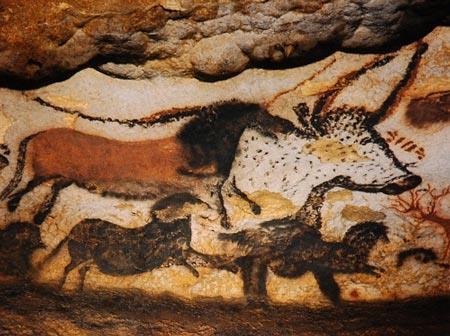
Why would any artist, or group of artists, climb through long, twisting underground passages to find a rock wall to decorate with their paintings? How much light could their lamps and torches provide? How many members of the community ever got to see those paintings?
And why are these pictures–from tens of thousands of years ago–every bit as well-executed as current modern paintings.? Bulls, mammoths, horses, reindeer, lions: the unknown artists’ mastery is astounding.
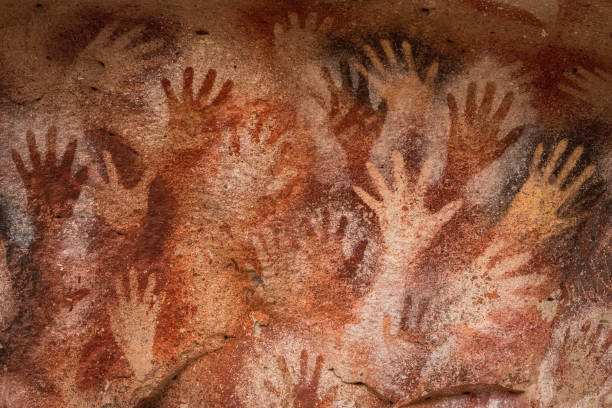
Thousands of self-portraits of… hands. What was that about–“Kilroy was here”?
Why are animals depicted so realistically, while human figures, if we see them at all, are mostly faceless stick figures? There’s nothing here that’s even close to a portrait.
Why are all the animals shown in profile? We don’t have one frontal image.
Were the paintings tied in with religious rituals? Were they expected to ensure good hunting for the people who’d produced them?
We don’t have the answers to any of these questions. I doubt we ever will.
One last question: Why were these “cave men” so much better artists than people who lived thousands of years later?
Chesterton speculates that the reason the cavemen drew all those pictures on cave walls was that it was fun — fun to see how well they could capture the poses and motions of animals, or, yes, hands. Why didn’t they do portraits? Well, Chesterton doesn’t address that, but he’d probably say the same kind of obvious but ignored thing, i.e., that they weren’t interested in doing that. What Chesterton is really getting at in this section of his book is that the human creature is utterly, profoundly different from other creatures, a unique creation, all the way back, not the grunting half-beast that Darwinian stereotypes present. (And maybe those caves were in a different terrain at the time, maybe even housing complexes of a sort, like our apartment buildings — although these are my speculations, not Chesterton’s.)
There’s also evidence that Homo erectus dabbled in artwork–and more evidence that the Neanderthals did, too.
Maybe there was a superstition against portraying a human face.
It’s possible. We just don’t know.
There’s really no way to know, because beyond the artwork and the location, we don’t know anything about the people who did this. Were these the works that represented an entire civilization, or more akin to graffiti?
It seems a lot of trouble to go to, except on an important errand.
Hard to say. I think that it’s easy to underestimate the sophistication of ancient peoples and their respective civilizations.
I’ll start by stating that I’m somewhat skeptical about the various dating methods employed. I’m not saying that these are very old, but just how old is far from set in stone. For example, they could analyze the pigments used and derive that this is a Stone Age cave painting, but it could be someone thousands of years later who just happened to make their own pigment, from the same locally available ingredients used by ancient peoples.
In evaluating anything like this, the beliefs and superstitions of the people involved are significant. It would make a lot of sense that people whom relied on hunting might want some record of their activities, and that makes it worth the bother.
When I was a kid, there was a highway not far from our neighborhood and young people tended to congregate there to sneak a smoke and some made “cave paintings” of their own, usually involving spray paint. My point here is simply about motive; motives can be pretty thin, when it comes to self expression. The kids painting smart Alec graffiti took a bit of risk crawling into storm sewers with a flashlight and a can of spray paint, and if you think about it, it made very little sense.
Crawling into confined spaces without supplemental breathing equipment or at least a large fan to circulate air is dangerous, so the adolescents making their “cave art” apparently felt that it was important enough to them to accept some risk. For the record, I didn’t join in, after my parents explained the risks to me. Years later, I was confined space trained and this was explained in much greater detail. Whether now, or in ancient times, it’s risky. I can’t imagine that an oxygen consuming, smoke emitting torch made it any more safe than it would have been with a D-cell powered flashlight.
One thing I’ve noticed about “historical science” is that it requires a degree of speculation. If we find a cave painting, from the deep past, a modern observer has to make assumptions about what was going on when that painting was made. Frequently, what follows is a speculative narrative which becomes little more than a story. I’ve noticed this, especially, with dinosaur documentaries, where I’ve heard elaborate narratives about the day to day activities of animals whom are known to us only by fossil remains, and in the case of some species, there are few remains to go by. I recall hearing that, for example, there is only one complete Stegosaurus skeleton, and along with other fragments. I’m not challenging the research on the Stegosaurus, but I think that there’s a lot left to be discovered.
Well said kimosabe.
They are not ten thousands of years old. Man started over with Noah who lived centuries, and he had all kinds of skills. Cavemen are an example of man going back to primitive ways. A good example today is tattoos – how primitive can you get than inking your body? Rushdoony said people get tattoos as a form of restitution for their sins – getting a tattoo is painful.
I’ve avoided that so far.
I agree completely. Biblically, mankind has been here for roughly 6000 (if you use the Masoretic timeline) or 7000 (if you use the Septuagint timeline) years. After the Flood, mankind went into high gear, building and developing, but tragically not listening to God’s instructions to spread out and fill the earth, but instead tried to concentrate their population in one place, resulting in a major setback for mankind. I’ve heard this referred to a a mild punishment, but I think it was a pretty significant event, which affects us to this day.
I also think that the Babel dispersion explains the cave dwellers; humans were starting over, pretty much from scratch. The dispersed people groups pursued a wide variety of courses, many of them warlike and ungodly. There’s no telling what some of these things, such as cave paintings, meant to the people that created them.