‘You’ve Got to Read This’ (2016)

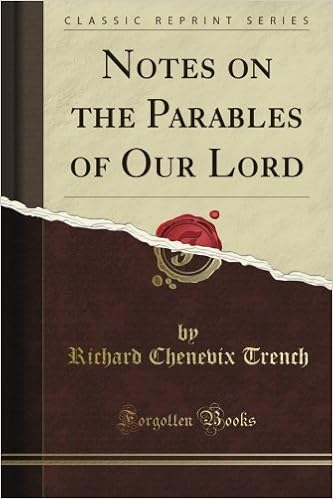
Notes on the Parables of Our Lord

Notes on the Parables of Our Lord, by Richard Chenevix Trench–doesn’t sound all that inviting, does it? But if you’re looking for an after-Christmas present for yourself or someone that you love, this little book is golden.

You’ve Got to Read This!

The thing about Our Lord’s parables, as John MacArthur observes, is, you’ve got to study them. Devote some thought to them. The more, the better. And you’ll be amazed by the unexpected treasures you discover.

Rev. Trench, speaking to us out of the 19th century, can help us make discoveries in Scripture.

What better way to start the year?

‘You’ve Got to Read This’

See the source image

Notes of the Parables of Our Lord, by Chenevix Trench, provides us with unexpected insights. Don’t let its 19th century pedigree fool you. Christ spoke his parables for all times.

You’ve Got to Read This!

This is the book that made crystal-clear to me the parable of the wheat and the tares. You don’t have to be a farmer to understand it.

Tares take note: you don’t have a future.

You’ve Got to Read This!

This morning I was reading Notes on the Parables of Our Lord by Richard Chenevix Trench, a dean of the Church of England in 1864. In particular I read his chapter on the Parable of the Wheat and the Tares (Matthew 13:24-30 and 36-43)–and it turned on a very bright light bulb in my head. I can’t wait to make it the subject of my weekly Newswithviews column when I write it on Tuesday.

What did it teach me? That the Son of Man, Jesus Christ, sowed good seed in the world–sowed His word–but His enemy, the devil, sowed bad seed, tares.

There are innumerable species of this bad seed, but they all belong to the same genus: the enemy’s ancient lie to Eve, that she and Adam and all their descendants, by disobeying God, should become as gods themselves, defining good and evil as they pleased (in Genesis 3).

The Lord does not let His servants, His people, gather up the tares and burn them, lest they inadvertently pull up some of the good with the bad. That job will be done by His angels at the end of days, when He is ready: when both the good and the bad have fully grown and their fruits, good and evil, are plain to see.

Boy, are there tares growing in this field! All planted by the Enemy–atheism, unbelief and misbelief, Evolution, transgender and “gay marriage,” the crackpot notion that Big Government can control the natural processes of the earth, the incessant redefining of the basic institutions of human life–oh, so many! These are the bad seeds sown by the Enemy.

But it’s critically important to remember that the good seed is growing, too–faith, hope, and charity, belief and trust in God, belief in Jesus Christ and His redemptive power, and the truth itself. These will be gathered by the angels and safely stored in barns; the fruit of the bad seed will be uprooted and cast into the fire.

If we can’t see the  truth of this parable manifesting itself in our time, now–well, we’d better learn to see it.

Two Fine Books About the Parables

I sort of stumbled into this assignment, and wound up reading two books for review: Parables by John Macarthur (2015) and Notes on the Parables of Our Lord (1861) by Richard Chenevix Trench.

I’m not done with them yet, but I can hardly wait to review them. You don’t have to be a theologian to enjoy these books–which is good, because I’m not. What you have, in both of them, is good, solid common sense guided by God’s word and the Holy Spirit.

This morning I read what they had to say about the parable of the laborers in the vineyard (Matthew 20:1-15). It’s the one about the rich landowner who hires men to work in his vineyard. He keeps going back to the employment center, throughout the day, hiring more workers, until, “at the eleventh hour,” with only one hour of daylight left, he hires the last of them.

Then he does something unexpected: he pays all the laborers exactly the same amount, the ones who worked for one hour getting the same as those who worked for twelve.

Hard to understand? Well, yeah–until you read about it in either of these books, each author explaining it so clearly that I couldn’t help saying to myself, “Now why didn’t I think of that!”

Jesus Christ Our Lord wished us to understand his parables, but we also have to put a little effort into it. He wants us to think.

If you get a chance to read either of these books, go for it. You’ll be glad you did.