The Art of Reading

The Original Art of Narnia (article and pictures) Pauline Baynes  (illustrator) | Las cronicas de narnia, Ilustraciones de cuentos, Narnia

“I only read non-fiction.”

“I only read comics.”

“I don’t read at all.”

The story-teller’s art is as old as humanity itself; and since the invention of the printing press, the story-teller’s audience has grown by leaps and bounds. Until now.

If you love a movie or a TV show, be it known that somebody had to write it before anyone could film it. And someone had to read it. But fewer and people are reading. Fewer and fewer are getting the stories.

Reading is one of those things you get better at, the more you do it. I can tell you that as a person trained to teach developmental reading. Even without someone to coach you, if you keep at it, reading will come easier and easier to you. And for a good reader, with the right kind of book, it’s like having a movie playing in your mind.

How much the poorer I would be, without reading! Never to have stepped through the wardrobe into Narnia, never to have watched Lord Peter Wimsey solve a mystery, never to have roamed the dead sea bottoms of Barsoom, nor visited The Shire, nor explored the ocean’s depths with Captain Nemo–oh, but I could go on all day!

Just to show you I’m not trying to trick you with a stealth commercial, let me say it out in the open: yeah, you ought to read my Bell Mountain books.

Now, what good does it do to fill our heads with stories that are not true? Always bearing in mind that the parables of Our Lord Jesus Christ were not about real people, real events, and so, strictly speaking, “untrue.”

For one thing, these fictional stories do contain abundant truth. They can serve as parables. They can teach moral truths.

For another, stories, like sleep, can knit the raveled sleeve of care (borrowing a line from Shakespeare). When your life begins to look like the lyrics of the Car 54, Where Are You? theme song, you can escape into your favorite books–or into new stories altogether, to see what you might discover.

The more you read, the more you’ll retain; and the more of your reading you retain, the better you’ll be at expressing your own thoughts. I realize that applies to all reading, not just reading fiction. But it certainly doesn’t not apply to reading fiction.

Reading is good for you! Period. Civilization would never have gotten anywhere without it.


‘You’ve Got to Read This’

See the source image

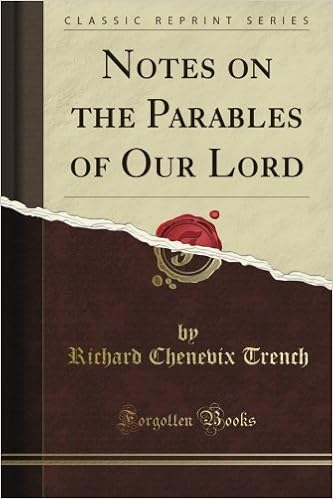
Notes of the Parables of Our Lord, by Chenevix Trench, provides us with unexpected insights. Don’t let its 19th century pedigree fool you. Christ spoke his parables for all times.

You’ve Got to Read This!

This is the book that made crystal-clear to me the parable of the wheat and the tares. You don’t have to be a farmer to understand it.

Tares take note: you don’t have a future.

‘Behold the Power’ (2016)

Image result for images of christ enthroned

We sing “All Hail the Power of Jesus’ Name,” and so we should. But it would do us good to pause and think about that power–because we are flat-out lost without it.

https://leeduigon.com/2016/10/23/behold-the-power/

Don’t believe me? Look at places, look into people’s lives, where that power is explicitly denied. Look at the shambles we’ve made of our world. I glanced at the news for just two or three minutes this morning and got sick to my stomach.

We and our world wouldn’t last another 15 minutes without the power of God’s grace.

A Parable Comes to Life

Image result for images of embezzling

In Luke 16:1-13, Jesus tells the story of a crooked steward who has been wasting his master’s money and is going to be fired. To cover himself, the steward quickly meets with certain individuals who owe his master and arranges for the debts to be greatly reduced. After he loses his job, these men will owe him favors. He won’t starve. And the master, surprisingly, commends the dishonest steward for his shrewdness.

That parable came to life this weekend.

Suddenly the click-bait was on fire with allegations that Paul “The Weasel” Ryan, about to retire as Speaker of the House, has been getting together with a lot of fat cats to get an illegal alien amnesty passed before he leaves, providing the fat cats with cheap labor and the Republican Party with a one-way ticket to oblivion. The idea is that the fat cats will make Ryan a generous payoff and “welcome him into their houses” for years to come. Like, he’ll screw America to feather his own nest.

To understand this in light of the parable, simply substitute the American people for the master who’s being cheated.

I don’t believe, for a minute, that any amnesty will happen. But a lot of people do. I can’t imagine how angry the people would be if this were actually to be attempted. Sounds like a good day to stay indoors!

I’m in no position to say as a matter of fact that yes, Paul Ryan has met with some greedy rich SOBs to cook up a plan to sell out our country.

But if the parable ever were to come to life, that’s what it would look like.

A Real-Life Parable (With Dental Floss)

Image result for images of prisoner escaping by rope

Reading this morning, in John MacArthur’s Parables, about Jesus’ parable of the crooked steward (in Luke 16) reminded me of a news story from back in 1994: a prisoner escaped from jail in West Virginia by painstakingly braiding dental floss–dental floss, complete with minty flavoring!–into a sturdy rope which he used to get over the wall and out to freedom ( http://articles.latimes.com/keyword/prison-escapes-west-virginia ).

Remember that? I never forgot it. Imagine the labor of fashioning bits of dental floss into a rope sturdy enough to hold a full-grown man! That’s like something out of The Count of Monte Cristo. Imagine the patience, the self-discipline required!

You’d think that with such a combination of ingenuity, boldness, persistence, and attention to detail, a man could accomplish almost anything. He ought to have come up in the world, big-time.

But five weeks after his incredible escape, he robbed a drug store and wound up back in prison: this time, I presume, with only a limited supply of dental floss.

The crooked steward in Christ’s parable had all those qualities, and successfully used them to evade the worldly consequences of his crimes. But he was, like that mug in West Virginia, totally incapable of using his resources to accomplish anything good in God’s service or his fellow man’s. So he escaped for the time being… but I think we can guess where he wound up for all eternity.

You’ve Got to Read This!

This morning I was reading Notes on the Parables of Our Lord by Richard Chenevix Trench, a dean of the Church of England in 1864. In particular I read his chapter on the Parable of the Wheat and the Tares (Matthew 13:24-30 and 36-43)–and it turned on a very bright light bulb in my head. I can’t wait to make it the subject of my weekly Newswithviews column when I write it on Tuesday.

What did it teach me? That the Son of Man, Jesus Christ, sowed good seed in the world–sowed His word–but His enemy, the devil, sowed bad seed, tares.

There are innumerable species of this bad seed, but they all belong to the same genus: the enemy’s ancient lie to Eve, that she and Adam and all their descendants, by disobeying God, should become as gods themselves, defining good and evil as they pleased (in Genesis 3).

The Lord does not let His servants, His people, gather up the tares and burn them, lest they inadvertently pull up some of the good with the bad. That job will be done by His angels at the end of days, when He is ready: when both the good and the bad have fully grown and their fruits, good and evil, are plain to see.

Boy, are there tares growing in this field! All planted by the Enemy–atheism, unbelief and misbelief, Evolution, transgender and “gay marriage,” the crackpot notion that Big Government can control the natural processes of the earth, the incessant redefining of the basic institutions of human life–oh, so many! These are the bad seeds sown by the Enemy.

But it’s critically important to remember that the good seed is growing, too–faith, hope, and charity, belief and trust in God, belief in Jesus Christ and His redemptive power, and the truth itself. These will be gathered by the angels and safely stored in barns; the fruit of the bad seed will be uprooted and cast into the fire.

If we can’t see the  truth of this parable manifesting itself in our time, now–well, we’d better learn to see it.

Two Fine Books About the Parables

I sort of stumbled into this assignment, and wound up reading two books for review: Parables by John Macarthur (2015) and Notes on the Parables of Our Lord (1861) by Richard Chenevix Trench.

I’m not done with them yet, but I can hardly wait to review them. You don’t have to be a theologian to enjoy these books–which is good, because I’m not. What you have, in both of them, is good, solid common sense guided by God’s word and the Holy Spirit.

This morning I read what they had to say about the parable of the laborers in the vineyard (Matthew 20:1-15). It’s the one about the rich landowner who hires men to work in his vineyard. He keeps going back to the employment center, throughout the day, hiring more workers, until, “at the eleventh hour,” with only one hour of daylight left, he hires the last of them.

Then he does something unexpected: he pays all the laborers exactly the same amount, the ones who worked for one hour getting the same as those who worked for twelve.

Hard to understand? Well, yeah–until you read about it in either of these books, each author explaining it so clearly that I couldn’t help saying to myself, “Now why didn’t I think of that!”

Jesus Christ Our Lord wished us to understand his parables, but we also have to put a little effort into it. He wants us to think.

If you get a chance to read either of these books, go for it. You’ll be glad you did.