‘Dracula Revisited’ (2015)

Image result for images of christopher lee as dracula

I read Dracula every few years. In fact, for my money, none of the many Dracula movies quite measures up to the book–although Christopher Lee’s portrayals of the monster will go down in history.

Dracula Revisited

The last time I read Dracula, I was amazed by the things author Bram Stoker can get away with. Great heaping dollops of Victorian schmaltz. It should be unreadable, but it isn’t. In fact, the somewhat strange literary style adds, rather than detracts, to a sensation of being in the attic of a deserted house, all dry and musty, and suddenly thinking you hear someone else, who’s not supposed to be there, coming up the stairs…

Bram Stoker Visits Scurveyshire (‘Oy, Rodney’)

See the source image

In Chapter CCXXX of her epic romance, Oy, Rodney–we’re still waiting for Chapter CCXXIX–Violet Crepuscular writes of a visit to Scurveyshire by Bram Stoker, the famed author of Dracula. It is vain to protest that Stoker wasn’t born until 1847 and would have been only three years old in 1850. “I do not believe the dates commonly given,” asserts Ms. Crepuscular. Nor do we get anywhere by denying that Stoker spoke fluent Pidgin with a broad Irish accent. “My sources are impeccable,” she says. We are not sure she knows what “impeccable” means.

Stoker comes to Scurveyshire to do research for Dracula, which was not published until 1897. He is immediately informed that “We ain’t had but one vampire in Scurveyshire, and he retired from it long ago to go into the tea business. Last we heard, he had a big plantation in Norway.” But before he can leave, he learns that Scurveyshire is being terrorized by the long-dead necromancer, Black Rodney. His interest is piqued.

Stoker interviews Constable Chumley at The Lying Tart, where the local brew goes straight to his head and incites him to entertain the night’s customers by reciting rather lurid nursery rhymes. “Yer flothering bandy fair made a clogger that brawsty night,” the constable recalls.

The next night, Stoker disappears. Forever. It is discovered that the itinerant spider girl, Lizzie Snivel, fell madly in love with Scurveyshire’s exotic visitor: and also that he took advantage of her infatuation to purchase from her a rare Tasmanian blow-dried spider at a shamefully low price. Miss Lizzie, the only witness, insists that Mr. Stoker, hunting for traces of Black Rodney, ventured dangerously close to the wading pool in the vicar’s back yard. “I fear he was dragged under by them tentacles!” she cries. “Oh, I should have stopped him!”

Still trying to plan his wedding to Lady Margo Cargo, Lord Jeremy Coldsore finds it hard to do his duty as Scurveyshire’s justice of the peace. “I don’t have time to investigate the disappearance of a Pidgin-speaking Irishman!” he cries. So there is no investigation, and the wading pool has claimed another victim.

We are promised that in Chapter CCXXXI, Lord Jeremy will acquire a new cravat especially for the wedding.

Dracula Revisited

Sorry, but I have to take a break from writing about current events. There’s too much going on out there, all of it bad.

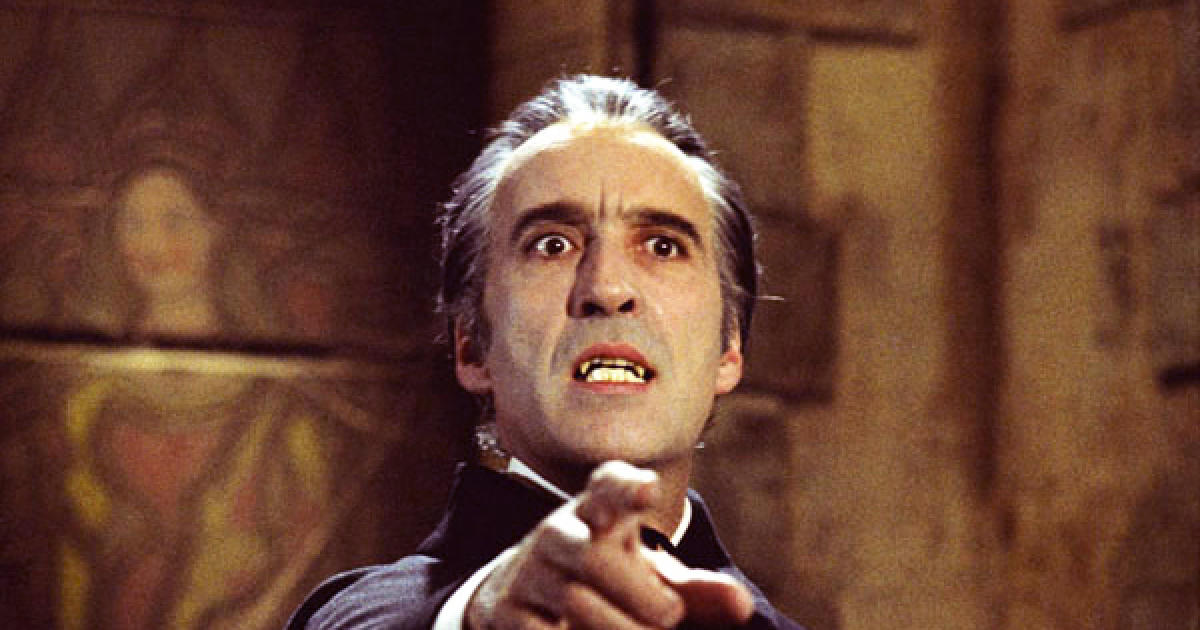
Christopher Lee as Dracula, via Hammer Films. Thanks for the memories.

The great Christopher Lee died recently; and as a salute to him, I decided to re-read Dracula, by Bram Stoker. The ground-breaking vampire novel, first published in 1897, became one of the pillars of our popular culture when it was adapted for the movies–most famously played by Bela Lugosi, and later, and very often, by Sir Christopher.

But how many of you have actually read the book?

So you open it up and take a look, and sneer, and think, “Sheesh! Does it get more 19th century than this? I mean, letters, diary entries–what’s wrong with chapters?”

It doesn’t matter. This is one of the best and scariest horror novels ever written, to this day. And while there have been a lot of very good film adaptations–check out the one starring Louis Jourdan as the Count: my wife watched it alone at night and got the heeby-jeebies, big-time–not one has quite done justice to the novel.

Stoker uses some mundane writing tricks that we all can learn from. He has a keen eye for the physical setting of any scene, and the skill to use it. By using letters and journal entries, he can shift from one point of view to another while always remaining in the first person. Notice that the chief villain, Count Dracula, and the chief hero, Professor Van Helsing, are the only characters who never speak to us directly. I am sure this technique is not as easy as it sounds.

The first few chapters, in which young lawyer Jonathan Harker is first a guest, then a prisoner, and finally an item on the menu in Castle Dracula; and the nature of his predicament only becomes clear to him gradually and horribly–well, if that’s not the best horror-writing ever in the English language, I don’t know what is. If that scene with Dracula’s “wives” doesn’t scare you, what will?

Dracula is full of unforgettable scenes: poor Lucy, Dracula’s first victim in England, now an un-dead vampire herself, prowling the London parks at night to prey on small children; Dracula recalling his ancestors’ glorious wars against the Turks; Harker, having only just recovered his health and his wits, and newly married, suddenly breaking down because he sees the Count right there on a London pavement…

You may wonder why I read stuff like this. Don’t we have enough real-life horrors to contend with?

More than enough, says I: hence Dracula. The Count is an imaginary horror. He is successfully dealt with: good defeats and then destroys evil. That never happens in the headlines. Far, far easier to dispose of Dracula than of the Democrats! Drive a stake through Dracula’s heart, and he’s history. But how do you get rid of the Clintons?

I first read Dracula when I was a young teen. Since then I have come back to it occasionally, with years intervening. And each time I come back, it gets better and better. I always enjoy it more.