If I Could See What You See

There’s something I would love to be able to do, which no writer can do–and that would be to get inside the reader’s head, as it were–and “see” the people and places and scenes I write about as the reader sees them. Ever since I announced the Bell Mountain Movie Contest, I’ve been thinking about that.

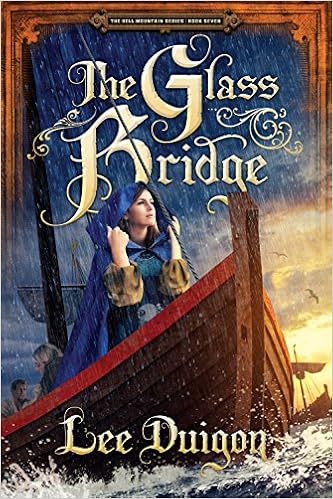
On two occasions–and even just one is extremely rare–my cover artist, Kirk DouPonce, working from live models who are just kids in his neighborhood, painted one of my characters exactly as I imagined her: Ellayne, on the cover of The Cellar Beneath the Cellar, and Gurun, on the cover of The Glass Bridge. It is as if these two fictional characters that I created were real people, after all: so much so, that somehow the words “I created” seem rather silly. I can’t create real people!

It would be eerie, to meld my own imagination with the reader’s and look with his or her mind’s eye on some place in Lintum Forest, or on the great Temple of Obann, or the cloud on the summit of Bell Mountain. What if they looked to the reader exactly as they “look” to me?

I hardly know what to make of that!
Making Fantasy Real (Sort Of)

See the source image

(As long as my head’s still full of Novocain, I might as well just keep on writing.)

The girl in the boat is named Gurun. She originated as the central character in a dream I had one night. I made her a character in my books; and then cover artist Kirk DouPonce brought her to life. Almost alarmingly so! He painted her exactly as I saw her, first in a dream, then in my mind’s eye as I wrote about her. I don’t know how he does that.

People ask me how real the world of my fantasy novels is to me, its creator. “Unknowable” was wondering about that today. Well, Gurun seems real to me; and she was also real to Kirk.

I have to be able to “see” it and “hear” it as if it were a movie playing in my head; that if I don’t, I can’t write it. In that sense it’s real to me. While I’m writing it, I have to be, as it were, in the scene I’m writing about. As if I were standing there in person, watching and listening. I don’t imagine this comes to any writer except with many years of practice and literally by the grace of God: it is a gift of God, so I can’t brag about it. I’m grateful He has allowed me to do this!

I can hardly wait to see what ideas He’ll give me for the next book.

So yes, in a way, it is like really being there. I lose track of the time, once I really get going.

And then I close the legal pad and put down my pen, and I’m back in New Jersey.

How Good Should Your Heroes Be?

The Glass Bridge (Bell Mountain #7) by [Duigon, Lee]

Fantasy fiction is awash with “heroes” who make everything look easy–especially the writing of fantasy. The Clever Thief With the Heart of Gold, The Roistering Barbarian, and the ubiquitous Invincible Female Warrior: please, No mas, no mas! I mean, what kind of a chucklehead do you have to be, to believe in such protagonists?

I would rather pattern my heroes after the heroes of the Bible, like Moses and Abraham, Peter and Paul–heroes who had to accomplish some exceedingly difficult things, and who keenly felt the difficulty, but nevertheless did what they had to do because they had faith in God and tried their level best to obey Him, whatever the cost.

They weren’t supermen. They couldn’t rely on really great kung-fu, powerful magic, super-powers, or any other kind of unlikely boons the writer might bestow on them. And their own personal flaws created more difficulties for them. Think of Moses pleading with God to get someone else to lead the Israelites out of Egypt, and losing his temper when God had him strike the rock to bring out water. No, these weren’t supermen at all. But they got the job done in the end.

When I had the girl, Gurun, in the opening chapter of The Last Banquet, swept down from the north by a storm, to land in a country that was very strange to her, I had no idea that she would go on to be a queen–and a most reluctant one, at that. She can’t even ride a horse without the fear of falling off in front of everybody. None of this was her idea. She wants to go home, but can’t. But what she does is to follow the path upon which God has placed her, in spite of homesickness, and fear, and the very strangeness of it all–without the slightest idea of what her faithfulness and perseverance have come to mean to those around her.

It’s not what Gurun does, but what she is, that matters.

So if you’re writing fantasy, lay off the cliches and let your heroes and heroines be ordinary, believable people who aren’t showing off, aren’t acting like caped super-heroes in a comic book, but are just doing what they do because they have to.

Let your heroes be what we should be–and would be, and will be, if we only keep the faith.

Makin’ It Real

The thing about writing a fantasy story is, you’re trying to get the reader to believe in people, places, and things that aren’t real. And not just to believe in them, but also to see and hear and have certain feelings about them.

I have been told that reading one of my books is kind of like watching a movie, which I consider high praise. It only took me almost 50 years to learn how to do that kind of writing.

Knowing that some of you have already tried to write a fantasy, or would someday like to try it, is there anything I can share with you to help you on your way?

Only this: before your reader can believe in it, you have to believe in it. If you can’t see it, they won’t be able to see it. If the story doesn’t stir up your emotions, it won’t arouse any feeling in your reader.

And the tricky part is, if you try to tell the reader too much, if you give him too much information, you might as well not tell him anything at all. This is where the writer’s art comes in–knowing when you’ve said enough, and knowing when to say no more.

Believe in your characters as if they were real people whom you’ve seen and talked to. Even the villains. Believe in their places and settings as if you’ve visited them yourself.

In The Glass Bridge, for instance, when God works through Gurun–without her expecting anything remotely like it–to perform a miraculous healing, she, who so far has been brave and uncomplaining, bursts into tears and gives way to a spasm of homesickness. I wish I could tell you why I wrote it that way, but it’s not something I can intellectualize about. It was just Gurun being herself. Being real. Because by then I knew her so well, all I had to do was step aside and let her respond to the experience as she was bound by her character to respond. Because by then she had become real to me.

Confusing, isn’t it? Well, if it was easy, it wouldn’t have taken me so blamed long to learn how to do it. Maybe in another 50 years I’ll be able to explain it better.

How ‘The Last Banquet’ Was Born

As I try to prepare myself to write another book, once the Lord provides me with a beginning of some kind, by re-reading all the previous books in my Bell Mountain series, I’ve just about finished Book No. 4, The Last Banquet.

That book had its genesis in a most unusual and vivid dream that I had, one night.

I dreamed of a teenage girl living in Iceland, a thousand years ago, who one fine morning had a desire to go fishing. She took her father’s boat and went out on the water. She caught a couple of nice cod, but then something very big and very strong bit down on her hook and made a fight of it. She needed all her strength and all her skill just to keep it on the line, and was concentrating so hard on doing it that she never noticed the sky filling up with storm clouds.

Finally her line broke, and so did the storm. Darkness and heavy rain blinded her. Ferocious winds seized the boat and made it race across the waves. There was nothing she could do to turn it. At any moment she expected to be sunk and drowned.

How long the storm held her, I couldn’t say. But just when it seemed it was going to go on forever, it stopped. The sea grew still as glass. Thick fog covered everything. The boat was full of water, having sprung several leaks. She fought to bail out the water, but it was a losing battle.

And then the fog was whisked away, and the sun came out.

And the girl stood up in her boat and looked on wonders that she never could have imagined–great, towering buildings all along the shore.

Modern buildings.

***

And that dream, with very few details of it modified, became the first chapter of The Last Banquet; and the girl, Gurun, is featured on the cover of Book No. 7, The Glass Bridge.

I just absolutely love this aspect of my work!