A Little Toy Bank That Scared Children

Image result for hand crank toy savings bank

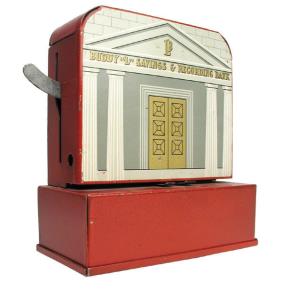
When I was a little boy, there were all sorts of savings banks available to teach children how to save money. They came in all shapes and sizes: see the photo for one example of many.

My brother and I had cash register banks. The catch with those was, you couldn’t open them until you had $10 inside–wealth almost beyond my imagination. There was a little slot in the back, though, and if you shook the bank long enough, a nickel might find its way out.

Image result for images of uncle sam's 3-coin bank

My Aunt Louise (my father’s aunt, actually) had no children of her own, but she liked to keep nice things on hand for her many nieces and nephews. One of the toys she had for us was a “Ben Franklin Savings Bank” with a crank. You put a coin in, turned the crank, and it would say, “Thank you! A penny saved is a penny earned.”

Well, it did say that, but I think it was supposed to sound like a kindly old man. In fact, the voice coming out of the bank sounded like Gollum in the Lord of the Rings movies. Had I been just a little younger, it would’ve scared me but good.

Then we learned that if we turned the crank really, really fast, the voice would get all high and squeakity–like one of The Chipmunks. Richly amusing! That was what passed for a high-tech toy in those days, circa 1958–and boy, did we enjoy it.

Memory Lane: The Sears Roebuck Christmas Catalogue

Vintage 1959 Sears Roebuck & Company Christmas Wishbook Catalog

When I was a boy, one of the sure signs that Christmas really was coming at last, honest, was the annual Sears Roebuck Christmas Book, better known as the Sears Catalogue.

How I loved to pore over this enormous thick book! It was as thick as the phone book, but with dozens of captivating pictures on each and every page. Of course, I rushed through the long and tedious sections on clothes and bedding and the like, lingered over the guns–real guns, not toys–and then, aaah! The toy section. El Dorado!

My favorites were the play sets, consisting mostly of little plastic figures of animals and people. Pictured in the catalogue, all set up and ready to go, I could just groove on these for hours–imagining myself imagining all kinds of adventures for these little characters, once I got them. The farm set! The circus! The African safari! Not to mention pirates, army men, cowboys and Indians, and, one of the best ever, Cape Canaveral with spring-launched rockets that made a gloriously loud “bonk!” if you shot them into the ceiling. And the sheer ecstasy of finding the dinosaur play set under the tree on Christmas morning–!

Image result for images of marx dinosaur playset

Some of the gang from the dinosaur play set

I understand, now, what it meant: that my mother and father, grandparents, aunts and uncles, loved the living dickens out of me and all the other child-kin and delighted in seeing our faces light up when we got those gifts.

In that sense, those gifts continue to give, to this day.

And if love and giving and joy are not the way to celebrate Our Savior Jesus Christ, I don’t know what is.

Memory Lane: My Erector Set

Vintage Erector Set Gilbert No. 6 1/2 Metal Case Many Pieces Working Motor 1950s

One of the joys of staying home from school sick–well, not really all that sick–on a cold, rainy winter’s day was my very own Gilbert Erector Set, complete with electric motor. That’s the blue thing with the black band around it, directly over the little metal pump-house. At least I always thought of it as a pump-house, without exactly knowing what a pump-house was.

Ah! Take this into bed, open the metal box, and get busy building things! All kinds of things: whatever you could imagine. But this was an old-fashioned set, so you had a lot of screws and nuts and had to use a screwdriver and a wrench. And the pieces, instead of being shaped for you, were metal plates and girders in assorted sizes–plus wheels and gears, as needed. The motor was for making things turn, which it did quite handily. The pump-house had no obvious purpose, but no way would I have ever parted with it.

And it was amazing how the time went by, as you put together towers and improbable flying machines, enclosures for your plastic dinosaurs, and more. Before you knew it, it was suppertime.

Of course, you had to have an imagination, to do this. True, the set came with an instruction book for making this or that; but it was more fun to invent things that weren’t in the book. The best part was this: until you actually finished putting something together, it never looked like anything. Just a bunch of girders, big and little wheels, and screws and nuts. It all came out of your imagination, by way of your hands.

Erector sets still exist, for those who want them. You can still get old sets like mine on eBay, if you want them. I comfort myself with the thought that they wouldn’t be selling them unless someone were buying them.

Memory Lane: Play Sets

The Marx Ben-Hur play set from 1959

What did you do if you were nine years old, and you’d already been to church or Sunday school today, and your father wasn’t going to take you to the movies–oh, and it’s 1959, or so?

Throughout the 1950s, America’s toy companies met that need with play sets. You got a big box, some kind of background you could set up, and a whole bunch of little plastic figures. If you had the Ben-Hur play set, pictured above, you could set up the arena and re-enact the chariot race from the movie.

There were all kinds of play sets. I had the dinosaur set, the farm, and a Cape Canaveral set with rockets and missiles you could send flying from spring-powered launchers, and a circus set with a tin big top.

The Cape Canaveral set (“You’ll put your eye out!”)

With all of these, you had to use your imagination. So we made up stories and acted them out with the little plastic figures–dinosaurs take over the space program, the farm animals decide to run the farm themselves, and so on. Every day was different.

Not like now, when well-meaning (we are being charitable) adults spoon-feed and control everything that a child might take into his head, completely unaware that such a thing is impossible to perform and letting a lot of really dark stuff get in that ought to be kept out.

We were better off with the play sets.

Memory Lane: Golden Stamp Books

Vintage Golden Book

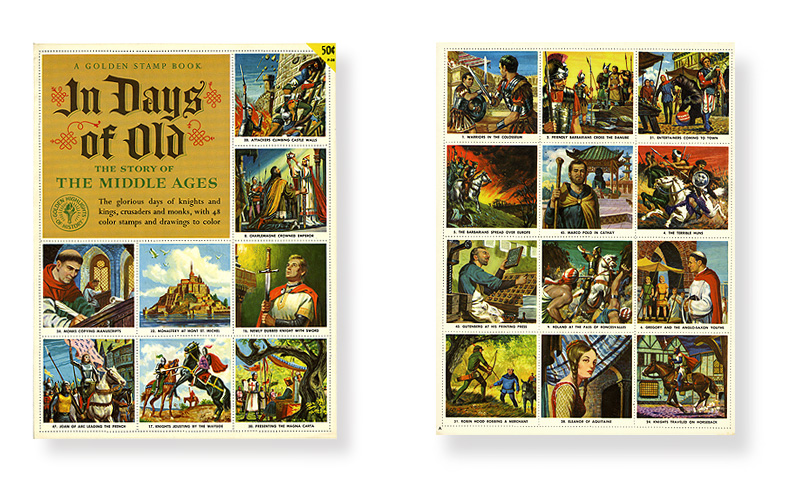
Hey, remember these? Golden Stamp Books, from the 1950s–one of my all-time favorite toys.

These books were a three-way delight. Each page had a short article or story for you to read, a line drawing for you to color–and, best of all, these brightly-colored stamps, pictured above, that you could paste on to the appropriate page. The one you see here, In Days of Old: The Story of the Middle Ages, was one of my favorites.

Golden Books published a whole series of these, and I had quite a few of them–stamp books on African animals, pirates, dinosaurs, and whatnot.

A kid could learn a lot from these books. They were “educational” without sacrificing any fun. Of course, you had to be able to sit quietly and contentedly for a little while, reading and coloring and pasting in stamps, and you had to be able to use your imagination: but I suppose that’s what made these so out-and-out wonderful. As you can see, I’ve never forgotten them, although it’s been going on 60 years since I’ve seen one.

I think there’s a lot to be said for being able to sit quietly and use your imagination. And it would be a better world if more people know how to do it.

Memory Lane: Crazy Ikes

Wow! Remember this toy from the 1950s–Crazy Ikes? Snap the pieces together, and build just about anything you can imagine, including people and animals.

I have a fond memory of sitting outside on a summer day with my friend, David. He had Crazy Ikes, too, so we could pool our sets and build bigger and more complicated things. I was five years old, at most.

Keep your video games, and give me back my Crazy Ikes!