Why Do We Crave Fantasy?

Image result for tunneling out of german prison camp

Why do people read fantasy–or science fiction, romance, Westerns, or what have you?

For escape, of course.

Now the whole idea of escape is to go to a better place, from a worse. People don’t tunnel into prison camps. So the fantasy reader has always the desire to seek a better world, an imaginary world, and escape into it, if only for as long as it takes to read the book.

How are we able to imagine a world that seems better to us than the one we live in? If you imagine yourself in Tolkien‘s Middle-Earth, for instance, you have monsters and dragons to deal with, not to mention a terrible Dark Lord. But you don’t have politicians’ lies to listen to, enormous taxes sucked out of your paycheck, race hustlers, militant sodomy, squawking idiot liberal churchmen, or natural beauty spots torn down to make way for “smart growth.” You don’t have any of that. So you escape to Middle-Earth for a few hours and are all the better for it.

How is it, asks Puddleglum in C.S. LewisThe Silver Chair, that a few children playing a game can imagine a play-world that licks the supposed “real” world hollow?

Because the God who made us built into us an unfailing desire for something better.

Our worldly leaders, from Mao Tse-tung to Eliot “Love Client No. 9” Spitzer, are great fantasists. They promise us a better world, but can’t deliver. Our Science with one hand gives us air conditioning and youtube, but with the other gives us nerve gas and Darwinism. Our worldly philosophers give us what can only be described as dreck.

God gives us salvation and a promise to regenerate His whole creation, but many of us don’t seem very interested in that.

Tolkien said that Christianity is the one myth that is true. We should be hearing that from our theologians and our pastors, but in all too many cases, we don’t.

Never mind. We’ve got the Bible, and it tells us the truth. That’s where the thirsting fantasy writer found the water of life–because that’s where it is.
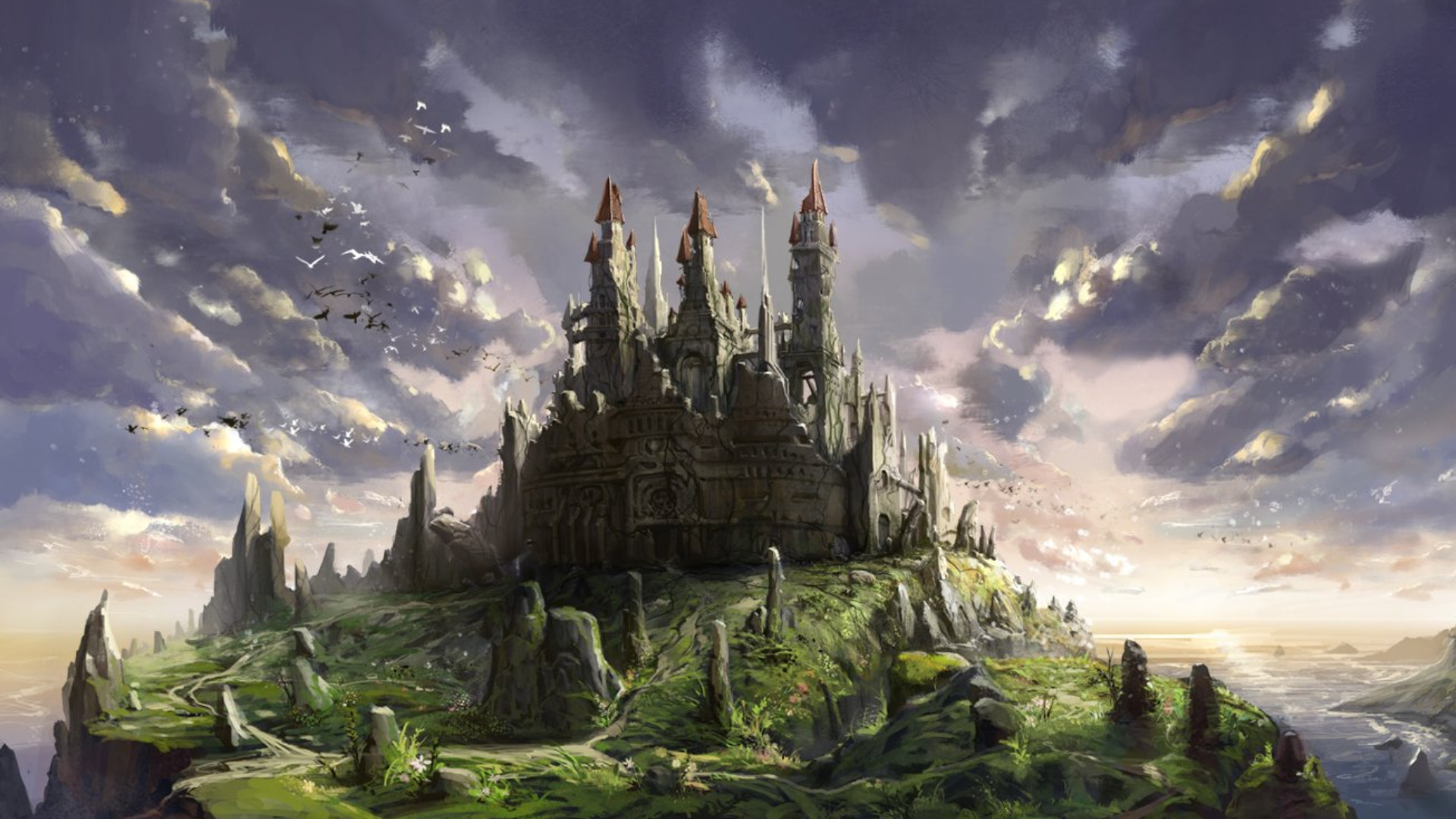
Why Is It So Hard to Write Good Fantasy?

I’m always looking for more fantasy fiction to read, to inspire my own work and, hopefully, to teach me how to do it better.

I’ve read hundreds of mystery novels of all kinds, and can count on my fingers the ones that have been truly awful. It’s not hard at all to find a good mystery. But with fantasy it’s the other way around.

Why should that be? There are authors who have made prodigious amounts of money writing fantasy that is at best half-baked. And there are lesser fantasy writers who produce stuff that’s hardly fit for the bottom of a bird cage.

Good fantasy fiction, obviously, will have things in common with quality fiction in any genre: an interesting plot; well-drawn characters who have some depth to them; situations that engage the reader’s emotions; a smooth flow of the language. But in fantasy–and in science fiction, too, by the way–books that lack those features are, well, plentiful.

In addition to those indispensable qualities mentioned above, what should a fantasy have that would make it a really good fantasy? I can’t write a monograph here on this blog, but quickly glancing at a few of the greats in the field:

C.S. Lewis, in his Chronicles of Narnia and in his science fiction trilogy (Out of the Silent Planet, Perelandra, and That Hideous Strength) had a vision–a deeply Christian vision–underlying all these stories: that is, they have something very important to say to the reader. As an artist, Lewis was able to deliver his message without clubbing the reader over the head with it. As one of the visitors to this site has observed, Lewis drew his readers in because he left so much unsaid. The reader finds himself building on what he has read–you can’t help it.

In The Lord of the Rings and other works, J.R.R. Tolkien, too, built his stories on a foundation of faith. The stories mean something. Nor did it hurt that he literally spent a lifetime exploring and charting his fantasy world. He believed in it, and that’s why millions of readers wound up believing in it.

E. R. Eddison wrote one great fantasy novel, The Worm Ourobouros. Its outstanding feature is a unique and creative writing style: no one but a fool would try to imitate it. He has a great story to tell, populated with interesting and multi-dimensional characters–but the thing that makes it work is his wild and crazy use of English. If you can get into his language, it’s like getting into Shakespeare’s language. If you can’t, the book probably won’t work for you.

I’m sure I’ll want to return to this topic more than once. This time I really want to receive feedback from my readers. What makes a fantasy speak to you? What in a fantasy turns you off? I really want to know!

Tolkien Was Deeper Than I Thought

I am reading a book which I discovered accidentally and which is blowing me away. It’s Secret Fire: The Spiritual Vision of J.R.R. Tolkien, by Stratford Caldecott (2003). The author with the unusual name is Director of the Chesterton Institute for Faith & Culture in Oxford, England.

This book explores the deep Christian roots of Tolkien’s fantasy writings. You hardly need to be told that fantasy may often serve as an indirect approach to truth. Sometimes you can see truth more clearly if you look at it from a funny angle.

This morning I read how, sometime after the publication of The Lord of the Rings, Tolkien was visited by a man, a stranger, who showed him “certain old pictures that seemed almost designed to illustrate The Lord of the Rings, but which Tolkien had never before seen. The man remarks after a silence: ‘Of course you don’t suppose, do you, that you wrote all that book yourself?'”

I read this to my wife and she said, “Hmm! Sounds like another fantasy writer I know.” Meaning me, of all people.

But it’s true. On one level I suppose we can’t deny that we “make up” the stories that we write. But on another level, we simply can’t shake the sense that the stories were there all along, somewhere, and that we have been shown them and given the privilege of writing them. Shown by whom? By Our Lord the Living God–who else?

I’ve only just started on this book, and can hardly wait to see what else is in it.

Ripping Off Tolkien

I have been reading a self-published novel described by a publicist as “Tolkien with a twist.” The kind of twist you give a bird when you wring its neck.

Because I don’t pick on the defenseless, I won’t give you this author’s name. I won’t give you the book’s title, either, because I don’t want anyone buying this and then coming after me with a broken bottle. I don’t like to think of how much they charged him to publish his 500-page monstrosity. They’re supposed to provide “editorial services,” but there’s no evidence they did: the book is littered with typos and weird sentences. An elf queen, for instance, is described as “statuesque” and having “a slight figure” in the same sentence. Not even an elf can be statuesque and slight at the same time. No editor should allow something like that.

But the real crime here is larceny. “Thou shalt not steal” applies to ideas and concepts as well as to cars and cash. I haven’t even finished the first chapter of this book, and the author has already transported wholesale, into his own fantasy world, the entire population of Tolkien’s Middle-Earth–elves and dwarves and orcs and dragons and even the poor hobbits. He has shanghaied the whole works. And not content with that, he has also robbed C.S. Lewis, Lord Dunsany, and Anne McCaffrey. The only thing he couldn’t manage to steal was a creative spark.

If you only saw this in publications by vanity presses, you could laugh it off. But I’ll bet there was never a writer who got ripped off more than J.R.R. Tolkien. In the wake of his success, every fantasy writer was populating his world with elves and dwarves–and then you’ve got the figurines, the role-playing games, and even amusement park rides. All of it without a by-your-leave from the estate. And as for paying for the privilege of battening off Tolkien’s creation–well, dream on. If the estate tried to sue everyone who ripped them off, they’d never do anything else at all–and they’d still never get around to all the offenders.

Half the fun of writing fantasy is making up stuff. Why would you want somebody else to do that for you?


Yet Another Narnia Error?

A visitor to this blog, “Miraz‘s Son,” has nailed an error in the Chronicles of Narnia that slipped right past me.

In Prince Caspian, C.S. Lewis tells us that the human inhabitants of Narnia, called Telmarines, are afraid of the sea and never go near it. But in the next book, The Voyage of the Dawn Treader, Caspian is just a few years older and we find him aboard ship on the high seas, with officers and men who’ve been sailing all their lives. Not only that–Caspian is combing the seas for seven lords, loyal to his father, who took ship and fled into exile after the rightful king as murdered by the usurper, Miraz. So… That happened when Caspian was still a baby, maybe even yet unborn–at a time when the maps show the Narnia seacoast overgrown with woods: a time when Caer Paravel on the seashore lay in forgotten ruin, and nobody ever went near the ocean.

Huh?

I can think of no way to resolve these contradictions, and no answer to them but this: I still love Narnia and the Chronicles of Narnia. Slip-ups and all.


Should I Write It???

A visitor to this blog has suggested that I write the missing Narnia story.

First I would have to get permission from the estate of C.S. Lewis. I have no idea what would be the chances of that. Supposing I got it, I’d have a tremendously hard act to follow. There would be plenty of Narnia fans who wouldn’t be pleased no matter what I did.

Obviously the story would have to be about redemption–Queen Susan’s, and ultimately our own. As you’ll see when you read The Fugitive Prince, I’m not afraid to write about redemption. It’s an overarching theme of the whole Bell Mountain series. But I am afraid of trying to imitate C.S. Lewis, so I would have to write a Narnia story in my own way, without trying to imitate one of the least imitable writers I have ever read.

It doesn’t seem to me that Susan committed any gaudy, eye-popping sins. She just sort of drifted away from Aslan–as so many of us, at one time or another in our lives, just drift away from Christ. You don’t have to commit any big sins to do that; a lot of little ones will do as well. Individually, they might not even look like sins. Is there really anything all that sinful about “nylons and lipstick and invitations”? It would be easier to write the story if Susan became an adulteress, a counterfeiter, or an atheist. But I don’t think Lewis would have been interested in anything that obvious. No–this would have to be a story about being delivered from bondage to a lot of sneaky little sins that imperceptibly add up to the great sin of forgetfulness. Come to think of it, that’s the same sin committed by Obann as a nation in the Bell Mountain stories.

Regardless of whether I decide to stick to my own matter of Obann, etc., and not take up this challenge, I still think someone ought to do it. But I’ll think about it until, as Sir Bors once said, “a better knight shall come along to do this battle.”


The Missing Chronicle of Narnia

I’ve mentioned before that there is one Narnia story that remains to be written. C.S. Lewis ought to have written it himself, and I think he would have, if he’d lived longer.

Narnia fans will remember that, in The Last Battle, all the children and adults who visited Narnia return as kings and queens. They’ve all come back to stay–all of them, that is, except for Susan. As Lewis wrote:

“…Has not your Majesty two sisters? Where is Queen Susan?”

“My sister Susan,” answered Peter shortly and gravely, “is no longer a friend of Narnia.”

“Yes,” said Eustace, “and whenever you’ve tried to get her to come and talk about Narnia or do anything about Narnia, she says, ‘What wonderful memories you have! Fancy you still thinking about all those funny games we used to play when we were children.'”

“Oh, Susan!” said Jill. “She’s interested in nothing nowadays except nylons and lipstick and invitations. She was always a jolly sight too keen on being grown-up.”

“Grown-up, indeed,” said the Lady Polly. “I wish she would grow up. She wasted all her school time wanting to be the age she is now, and she’ll waste all the rest of her life trying to stay that age…”

The odd thing about this conversation is that all the speakers are dead. They have passed on into the afterlife. So apparently Susan has not yet died, and is lost to Narnia forever.

But what did Aslan do to Susan, her brothers, and her sister in the first Narnia book, The Lion, the Witch, and the Wardrobe? He made them kings and queens of Narnia. And what did he say?

“Once a king or queen in Narnia, always a king or queen.”

To those who understand the stories, it’s inconceivable that Aslan could be wrong. That he could have made an error in judgment in making Susan a queen. That he could have said “always” when he really meant, “for a little while or so.”

To be sure, Susan has been sidetracked by the cares and seductions of her life in the “real” world.

And so the story that needs to be written is, How does she get back to Narnia? How does Aslan rescue and redeem her?

We have all gone astray, at one time or another in our lives. We have all kept the Good Shepherd busy. But if He means to save you, He will. Period.

I would very much like to know Susan’s story, after her brothers and sister have died and been brought back to live eternally in Aslan’s country (of which Narnia and England are but parts).

Isn’t it about time someone wrote it?

A Truly Creepy Horror Story

Patty and I stayed up too late last night, listening to a BBC radio production of a dramatic reading of H.P. Lovecraft’s novelette, The Shadow Over Innsmouth.

This is one of the creepiest horror stories ever written. The narrator takes a side trip to a decaying Massachusetts seaport, Innsmouth, and winds up in a world of hurt. The whole place is rotting away, and the people are gradually turning into monsters as a result of certain pagan “religious” practices. His innocent interest in local history and architecture results in his being stalked by beings that are no longer quite human. And then it gets worse.

The BBC added a brooding musical background, and behind that are noises that you can’t quite make out, but it’s probably the inhabitants of Innsmouth chanting.

But now I know they weren’t chanting to their idols. They were merely participating in “cultural sensitivity training”!

I also understand, now, how Massachusetts came to be the way it is today.


Fantasy Cliches I Have Tried to Avoid

Note: I am purposely not commenting on current events. God sees what’s happening in this country, and He knows who’s doing it. When it pleases Him, He will put a stop to it. One way or another.

As I wait for the Lord to give me the cue to start writing a new book, I’ve been browsing among fantasy novels and movies. When I read a good book, it pumps me up to write.

Based on what I’ve read and watched, it’s really, really hard to write a good fantasy. By “good” I mean a story that the reader can believe in, that captures his imagination, that takes him out of the here-and-now, and that gets him to thinking about things that maybe he’s ignored, so far.

The biggest obstacle to writing good fantasy, it seems to me, is the powerful temptation to fall back on cliches. There is a subtle difference between a cliche and a familiar motif. Many fantasy novels, for instance, are set in worlds that resemble the Middle Ages. It’s only when you begin to populate your sort-of medieval world with musclebound priapic heroes, lusty hot-to-trot wenches, incredibly wise wizards with long, white beards, with a sprinkling of elves and dwarfs, that it turns into sheer garbage.

I’ve also avoided writing about Real Magic (but fake magic is okay), helpless swooning damsels, nerds from our world who get swept into the fantasy world and become heroes, sex with vampires, antiheroes who beat up on the good guys because that’s what make the author look cool and worldly, and thieves with hearts of gold. I gave up writing about thieves with hearts of gold years ago when someone stole my outboard motor.

You wouldn’t believe how many of the above cliches can be jammed into a single fantasy novel or movie, with appalling results. Those writers ought to get out of fantasy and into political speech-writing, where their talents will be properly appreciated.

Tolkien’s Son Doesn’t Like the Movies

Christopher Tolkien, now 87, has made it his life’s work to bring to light the immense body of unpublished work left by his father, J.R.R. Tolkien. Although Tolkien was most famous for The Hobbit and The Lord of the Rings, those were only the tip of the iceberg. He left behind some 70 box-loads of unpublished work–all of it having to do with his fantasy world of Middle Earth! Thousands and thousands and thousands of pages of it.

In a recent (and rare) interview with the famous French newspaper, Le Monde, Christopher Tolkien voiced dismay over what our popular culture has done to his father’s work. He thinks they’ve dumbed it down (gee, ya think?) and tried to turn it into a money machine. He finds Peter Jackson’s Lord of the Rings movies particularly obnoxious and is not looking forward to the newest installment, The Hobbit.

I haven’t seen the movies because I don’t want any of my money to wind up in Ian McKellan‘s pocket. The actor who plays Gandalf is a homosexual who brags about defacing Bibles. So there’s not much I can say about the movies. But I can say that Tolkien’s books, as written, especially Lord of the Rings, strike a note of stateliness. It inclines the reader to take them seriously.

What vexes Christopher Tolkien is the way the movies changed public perception of his father’s work, and spun off into video games, cartoons, imitators, figurines, amusement park rides… Dreck is not stately.

Well, Chris, what do you think your father’s dear friend, C.S. Lewis, would say if he were alive today and saw the mess the movie mob made of his Narnia tale, The Voyage of the Dawn Treader? I think one or more persons would get punched right in the nose. That bit in which Lucie, a pre-teen little girl, kung-fus a bunch of grown-up male villains who attack the heroes, just whups the tar out of them… barf-bag, please.

Hint to fantasy fans who really don’t like dreck: never mind the stupid movies. Read the books!

If you’re as tired as I am of superheroes and movies made of comic-books, read the books as the authors wrote them.

Hang in there, Christopher. Believe it or not, there are still some of us who like your father’s books just the way he wrote them.