A Potboiler With a Vision

Every now and then–especially in his books about “Barsoom” (Mars)–Edgar Rice Burroughs would have a penetrating, almost prophetic vision that would go unrecognized because it was decades ahead of its time.

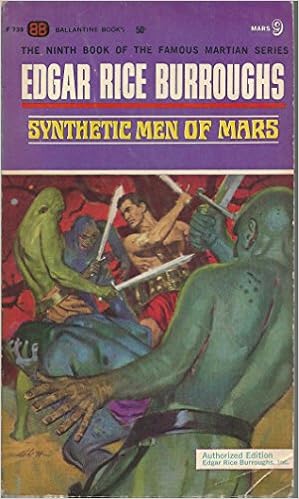
In Synthetic Men of Mars (1939), Ras Thavas, the Master Mind of Mars, embarks on a project to create artificial human beings. He grows them out of culture vats. These creatures, called “hormads,” very seldom seem to turn out quite right. In fact, some of them are such a mess as to be of no use at all. But Ras Thavas, like John Hammond in Jurassic Park, is convinced he can impose his will on nature if only he tries hard enough.

Well, something goes horribly wrong in Vat Room #4. Instead of producing individual hormads, the vats have begun to pump out a solid mass of writhing, hungry, ill-assorted body parts; and no one is able to stop it. It just grows and grows and grows, shooting forth monstrous heads and clutching hands, disconnected legs, undifferentiated tissue like a gigantic amoeba… yech! And if something isn’t done about it soon, it’ll take over the whole lab complex, then the whole island, and, theoretically, could keep on growing until it covers the entire planet and devours everything.

Now that’s what I call a vision. Not only did ERB anticipate cloning, and all that stuff. More importantly, his image of the all-consuming mess in Vat Room #4 is right on target as a metaphor for all-consuming statism. You know–the kind that aspires to a world government that can direct planning and land use for every little village on the planet, and, under the pretext of doing what’s best for us, swallow up every last one of our liberties. The kind of mess that Hitler, Stalin, and Mao did so much to pioneer. The kind that listens in on everybody’s phone calls.

The kind of hell you get after “progressive” thieves and murderers get through with “fundamentally transforming” your country.

In Synthetic Men of Mars, John Carter comes along with his air force and fire-bombs the hideous mass out of existence.

I don’t think our hideous mass will be quite so easy to get rid of.

A Truly Beautiful Film

One of the gems of our video collection is The Secret Garden (1993), directed by Agniezka Holland and based on the 1910 children’s literature classic by Frances Hodgson Burnett.

It’s a simple story. A little girl whom nobody wants takes over an abandoned garden that nobody wants, and shares it with a little boy whose widowed father is afraid to want him. Out of this comes love, and healing, and redemption.

Those are the things that God does. Throughout the Gospels, most of the actions performed by Jesus are acts of healing. In time, the Bible teaches us, God through Jesus Christ will heal this entire fallen world. We are privileged that, in many cases, God allows us to work with Him and for Him.

This film yesterday brought me to tears. The cinematography is gorgeous, the music score gentle and soul-stirring. Although there is no overt mention of Jesus Christ or Christianity, and even some bits of mumbo-jumbo or “magic” engaged in by the children, the message of the story could hardly be more Christian if it tried.

We are all in need of healing, many of us more than we know. All of Creation is in need of it–and will get it. God has so promised. Meanwhile, there are smaller healings and redemptions all around us. These are, as it were, small down-payments on the larger project: signs that God is nigh, that God is working in His world. He has not forgotten us. He never will.

It’s a rough ride, a lot of the time; but the day of regeneration is at hand and will not be delayed. God has already marked it on His calendar.


‘The Fugitive Prince’ Now on Sale

The author is always the last to know, but now I know: Book 5 of the Bell Mountain Series, The Fugitive Prince, is now on sale.

You can order it here by clicking “Books” or “The Fugitive Prince” and putting it in your cart; or from the Chalcedon Store at http://www.chalcedon.edu ; or from amazon.com .

Will one of you be the first to review it on the amazon.com page?

A Lost Movie That Maybe Better Stay Lost

In 1927 Tod Browning made a silent movie called London After Midnight, starring Lon Chaney Sr. as an evil character returned from the dead as a predatory monster. The film, considered a horror classic, no longer exists. The last known copy was destroyed in an accidental fire in 1967. If you happen to have a copy, you could sell it for a fortune.

In 1928 a man on trial for murder offered as his defense the claim that Chaney’s performance in London After Midnight made him temporarily insane and drove him to kill someone. The jury didn’t buy it.

So, okay, one movie did not drive one individual to commit murder.

But what about a colossal, endless flood of sleazy and unwholesome movies, TV shows, novels, comic books, video games, political speeches, and public education? Could such a deluge of filth, going on without interruption for 70 or 80 years, tear a big chunk of Western society loose from its moral moorings? Or  can we just wallow in this muck forever without being in the slightest bit affected by it?

Just asking…

How Did C.S. Lewis Do It?

I was all set to rail against the government scarfing up tens of millions of Americans’ private phone, email, and Facebook records–but Sen. Dianne Feinstein has like totally set my mind at ease about that. She says they do this in case someone might become a terrorist in the future. Well, now I feel a lot better. Don’t you?

While our country melts into a boiling mass of corruption, I’ve just reread The Lion, the Witch, and the Wardrobe, the first of C.S. LewisChronicles of Narnia (the first one he wrote, I mean). It’s good to get away for a little while, when I lie down in bed.

Every time I read the chronicles, I stand in awe of Lewis’ technique. He makes it look so easy, you just might fail to notice it. The story just flows; and in one paragraph, without even a hint of skimping on the details, he gets more action done than any other writer can accomplish in two or three whole pages. For me, looking at it with the eye of a writer, it looks like magic! All of this stuff happens, or a character is introduced and you learn to know everything about him that you need to know–and yet only a few sentences have gone by. And yet, incredibly, nothing has been left out, either. Pure wizardry!

It’s so simple, any reasonably intelligent child can read it and enjoy it. It’s so deep, any receptive adult can dive into it headfirst without having to worry about cracking his skull on the bottom.

The fact that it was written in Christ’s service doesn’t hurt it, either.

Big Brother is Listening

Get over to the Drudge Report today and check out the stories at the top of the page: under the leadership of our First Voter Fraud President, the federal government is hauling in millions of telephone records a day.

They say they’re doing it to protect us from terrorists.

The only problem with that is, this bunch in Washington thinks we are the terrorists, and those guys over in the Middle East, with the turbans, and the bombs strapped to their bodies, are their friends. We know that because cadets at West Point are taught to view Baptists and Catholics as every bit as bad and dangerous as al-Qaeda, and the “president’s” adviser on “religious diversity” in the military, one Mikey Weinstein, is on a jihad to purge Christianity from the armed services. We know it because they’ve got the IRS harassing non-progressives and demanding to know the content of our prayers.

Now they’re studying our phone calls.

Because I don’t believe it’s possible that there might really and truly be “millions” of potential terrorists hiding in our midst, I’ve got to believe Big Brother is spying on a lot of us who aren’t terrorists. And we just let him go on doing it.

You can be sure that, hundreds of years from now, when people look back on the history of the United States, they will most certainly not say, “This was their finest hour.”


Now That’s Writing!

Who is the most prolific novelist of all time? Do you know? Can you guess?

I always thought it was John Creasy. Born 1908, died 1973, Creasy wrote under 28 pseudonyms and had over 600 of his novels published–mystery and crime novels, spy thrillers, romances, and westerns. His first book was published in 1930, and he was only 65 when he died. So that’s 600 books in 43 years, for an average of almost 14 novels per year.

And lest you think he just cranked out a lot of rubbish, in 1962 he won an Edgar Award for Gideon’s Fire, and in 1969 was voted a Grand Master Award by the Mystery Writers of America.

But I was wrong. The most prolific novelist ever was not John Creasy.

It was Barbara Cartland.

Dame Barbara (1901-2000) lived longer than Creasy and had a longer career, and more than 700 (!) of her novels were published, starting in 1922. She started with flashy, controversial, “sex among the rich and famous” novels, then settled down to write historical romances.

In fact, her career is still going on–she left at least 160 unpublished novels, which ought to be enough to hold her fans for the next few decades.

In 1983 Barbara Cartland wrote 23 novels.

I must remember this, the next time I feel moved to describe myself as a productive and prolific writer.

Back to Narnia!

Today I don’t care to write about any of the disgusting things that are being done to our country and our culture. We get it by now, don’t we? Good is evil and evil is good, the bad guys always win, boys should want to be girls and girls should want to be boys… Yeah, yeah, we get it.

I have a book to write, and I don’t need the kind of inspiration provided by the headlines. And having just returned from another visit to Middle-Earth, I have decided to pass on to Narnia. This time I’ll read the books in the order in which Lewis wrote them.

I don’t know quite how to say this, but there’s something realer about the great castle at Caer Paravel than there is about this week’s Gay Day at Fenway Park in Boston. To know my own imagined world of Obann better, I visit C.S. Lewis‘ world of Narnia. To know my own Lord better, I kneel before Aslan. I have learned that this, for me, is a way to get closer to my Savior and my King, Jesus Christ. Through these imaginary doors I get entry to the heart of what is real.

Open up the wardrobe, Lucy…

Teaching Kids to be Cowards

A Greegie Award this week, for egregious stupidity in government, goes to the dolts who run Sir John A. Macdonald Jr. High School in Calgary, Canada.

As reported in the National Post, May 31, a 13-year-old boy saw two of his fellow students having an altercation. When one kid pulled a knife, the boy charged into the fray, knocked down the Jack the Ripper wannabe, and disarmed him.

For which he soon found himself in trouble with the school officials. Instead of saving someone from a knifing, school officials said, he should have run off and hunted up a teacher, explain the situation, yatta-yatta… and meanwhile some kid is doing a Ginsu demonstration on his classmate’s abdominal cavity. But the school, said school officials, “doesn’t condone heroics.”

Yes, this is the spirit of the Ecole Polytechnique Massacre of 1989, Montreal–in which a crazed gunman invaded a college campus with the loudly announced intention of killing women. He permitted the male students to flee for their lives while he shot the females: and flee they did. Perhaps the Ecole Polytechnique didn’t condone heroics, either. They certainly didn’t get any.

Please bear in mind that Canadian public educators do teach children that, potential fatal stabbings notwithstanding, when they see something really awful going down, like gender-stereotyping language or homophobia, they’re supposed to swing right into action.

You don’t have to be a president or a prime minister to destroy Western civilization. Every public school vice principal can do his bit .

The Book of Judges

Once again my daily Bible-reading program has brought me around to Judges, and through it. I don’t know how many times I’ll have to revisit it before I can truly say I understand it.

There are a lot of stories in Judges that really aren’t very nice: the book is a history, so that’s what we should expect. Ehud smuggles a weapon in to a private audience with the king of Moab, and assassinates him. Sisera takes refuge in Jael‘s tent, and after she lulls him to sleep, she drives a tent-spike through his head. The tyrant Abimelech murders his brothers, puts down a rebellion, and comes to a shameful and violent end. We read of the tragedies of Samson and Jephthah.

And then at the end come two truly awful stories. A man named Micah steals his mother’s silver, then restores it to her–so, naturally, they melt it down and make it into an idol! And of course a wandering Levite agrees to become their personal household priest, ministering to the idol. And sure enough, a big gang of Danites, seeking a new homeland, steal Micah’s graven and molten images, threaten to kill him if he tries to get them back, and the Levite is more than happy to go along with then and be their priest–complete with idols.

The last incident in the book tells the story of a gang-rape committed by the inhabitants of a town belonging to the tribe of Benjamin, and how all Israel went up against Benjamin. And Benjamin refused to surrender the guilty parties, and fought against all the 11 other tribes of Israel at once, and was almost made extinct.

Is any of this any way for God’s people to behave?

They must have known better. They had the Ten Commandments. The Ark of the Covenant was among them. Note: the actions of Ehud and Jael, although they may seem to us unsavory, are presented as righteous actions to deliver Israel from oppression. And Samson and Jephthah, while they had their faults, fought mightily against God’s enemies.

But what are we to make of these last two stories in the book?

Pray, ponder, and meditate…