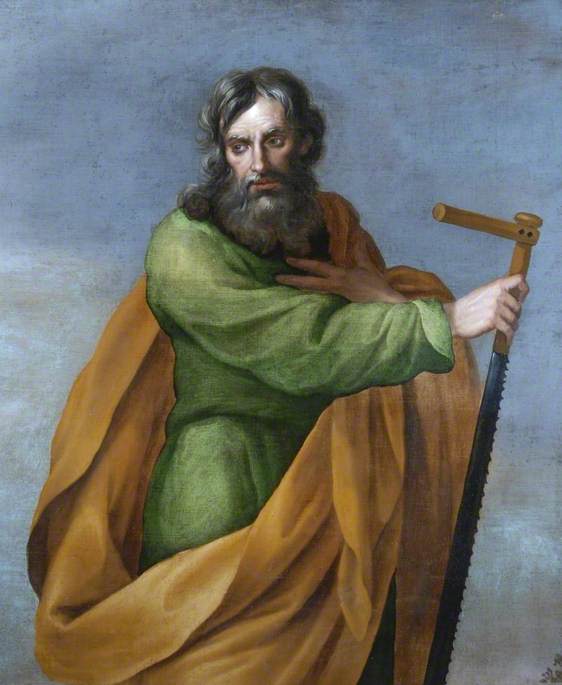
There’s a tradition that he was martyred by a saw… but who knows?
In Luke 6:15 and Acts 1:13, he’s called “Simon Zelotes.” In Matthew 10:4, he’s “Simon the Canaanite”–which seems a rather odd nickname for a First Century Jew. But either way, he’s one of Christ’s original 12 disciples and therefor an apostle. But the Bible tells us almost nothing about him.
And get this: he was neither a Zealot nor a Canannite (whatever a “Canaanite” was at that late date in history). He is tagged by a Hebrew word that sounds like “Canaanite,” and another word that means not “a Zealot,” but simply “zealous.” The Zealots didn’t really pick up steam until some decades after the Crucifixion; and their movement culminated in the Romans destroying the Temple and leveling Jerusalem.
There are church traditions, etc., involving St. Simon, but there’s really nothing outside the Bible. He has no lines to speak, no teachings to impart. But he was a disciple, a companion of Our Lord Jesus Christ–isn’t that enough?
I learned in Sunday school that Simon was a Zealot. This was almost certainly wrong. The Zealots were an organization similar to the French Resistance in World War II, dedicated to freeing their country from Roman domination…“by any means necessary.” Their policy proved to be suicidal.
My pal Pastor Mark once said to me, “The Bible tells us everything we need to know, but it doesn’t tell us everything we want to know.” Guess he was right.