A Writer’s Resource: Other Writers

Tolkien and Lewis: A friendship | Angelus News

J.R.R. Tolkien and C.S. Lewis

I was in a jam last year, trying to write The Ocean of Time. I knew it would require a double climax, but I didn’t know how to pull it off.

For no conscious reason, I began to reread Tolkien’s The Lord of the Rings. Not that I was trying to follow him, or imitate him–but suddenly my own book got very much easier to write! I managed the double climax, and by the time I was done, I thought I’d written my best Bell Mountain book ever.

Now I’m writing Ozias, Prince in Peril–and it looks like the guide that has emerged is C.S. Lewis’ trilogy (Out of the Silent Planet, Perelandra, That Hideous Strength). This conviction has been strongly reinforced by a study of the trilogy, Deeper Heaven by Christiana Hale. So while I’m writing my own book, I think I need to be reading these four books.

Not to copy them in any way–that’s not how it works. A writer who tries to do that will damage his art. Actually, I’m not quite sure how this works. Somehow Lewis’ stories are giving me a clearer vision of my own. Writing novels is kind of weird, that way. I sort of wanted to revisit Edgar Rice Burroughs’ Martian novels, but the pull of Lewis’ trilogy is too strong to resist. Something’s telling me just to go with it. I was temped to call it “my instinct,” but that gives me too much credit. I do ask God to guide me in my work; and I think my prayers are answered.


Writing in Good Company

Why is Tolkien Scholarship Stronger than Lewis Scholarship? Part 2:  Literary Breadth and Depth | A Pilgrim in Narnia

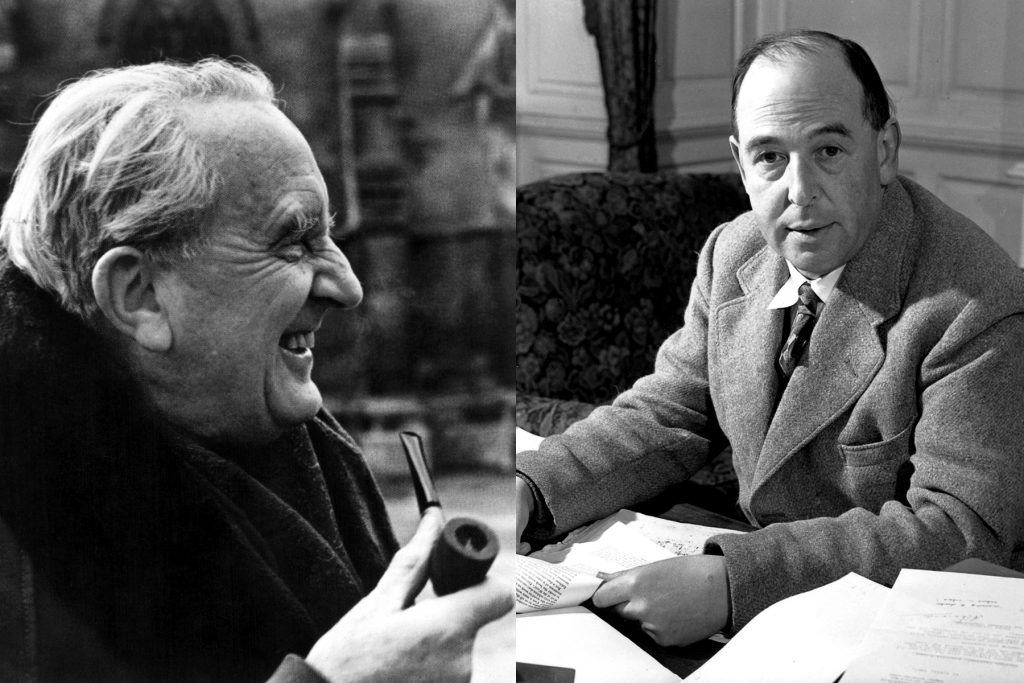
J.R.R. Tolkien (left) and C.S. Lewis (right)

If there’s one thing that anyone who wants to be a writer ought to do, it’s read. A lot. Every day. Don’t stop.

As I race the calendar to finish writing The Witch Box, I find Tolkien’s The Lord of the Rings to be just the company I need. I’ve grown out of consciously trying to imitate him or anybody else (imitating C.S. Lewis really is a fool’s errand); but what helps me in my own journey is the tone of Tolkien’s epic fantasy.

There are books that I love but dare not read while I’m working on a book of my own. That’s because a little bit of those books will inevitably trickle into mine. I can’t help it. I don’t read Thomas Malory, for instance, because it will tempt me to say things like “Now turn we unto Helki…” It just happens, “if you take my meaning” (as Sam Gamgee, the hobbit, likes to say). I can’t stop it, so I have to find a way to use it.

Reading Tolkien as I write my book–or Eiji Yoshikawa, for another: they’re more like each other than you’d think–helps me to have a clearer vision of the scenes I’m trying to write. He reminds me to add details like trees, animals, weather, you name it, that will help me to make the scene come alive for my readers. And one of the great things about Tolkien’s style is, he never loads the reader down with too much detail–which leaves ample scope to the reader’s own imagination. I admire that, and strive to do the same.

This is what seeps into my own writing, done in my own way. And a bit of seasoning always comes in by way of other favorite books. Welsh folklore from The Mabinogion, for instance, plays its part in spicing up my writing. And in juggling the various subplots that go into any novel, who could guide me better than Edgar Rice Burroughs–or Charles Dickens? Sir Walter Scott also springs to mind.

So what I have going for me here is a whole platoon of writers whose work shows me, reminds me, and tutors me in what good writing ought to be. They are my backup, my supply line, my companions on the journey. I couldn’t do without them–

And I’m not about to try.

‘Bell Mountain’… and Mars

See the source image

Remarking that for some reason my character, Tughrul Lomak (one of King Ryons’ chieftains), reminds her of Tars Tarkas in Edgar Rice Burroughs’ Martian novels, Heidi has asked to what extent, if any, those books by ERB have influenced my Bell Mountain books.

Tars Tarkas is a green Martian, a member of a race that has brutalized itself by practicing communalism–especially the communal raising of children: these guys take “It takes a village” to its logical extreme. But he has broken the law by loving his own daughter, which has made him capable of sympathy, friendship, and self-sacrifice. But he’s one of my favorite characters in the series, so thanks, Heidi, for mentioning him. Good old Tars Tarkas!

As to your question: Edgar Rice Burroughs has been one of my favorite authors since I first opened a paperback copy of Pellucidar back in high school. Over time, the Mars novels have become my favorite Burroughs stories. It’d be very unusual if I weren’t influenced by them.

But I’m old enough now to have learned not to try to imitate other writers, except in very general ways.

From Edgar Rice Burroughs I’ve learned everything I know about juggling sub-plots without dropping any, pacing, and moving the story continually forward, not letting it bog down anywhere along the way. No one ever did those things better than ERB.

Another thing I’ve learned from his example is that when the imagination wants to rip, let her rip! This is especially evident in one of my all-time favorites stories, The Chessmen of Mars, in which he created a place that’s weird and eerie even by Martian standards–and made it totally believable.

And I think it’s obvious to Tarzan fans that Wytt owes some of his inspiration to Tarzan’s easily-frightened little monkey, Nkima.

As a storyteller, I’m always on the lookout to learn from other storytellers. Self-education never stops. Something of all my favorite authors has gone into all of my Bell Mountain books. Sir Thomas Malory, Homer, The Mabinogion; Burroughs, Agatha Christie, Walter R. Brooks, H.R.F. Keating–and everyone else whose work I’ve enjoyed. Not forgetting Ross McDonald, who taught me how to write sentences that make themselves easy to read.

I could go on like this all day. But to sum it up–

If you want to be a writer… read!