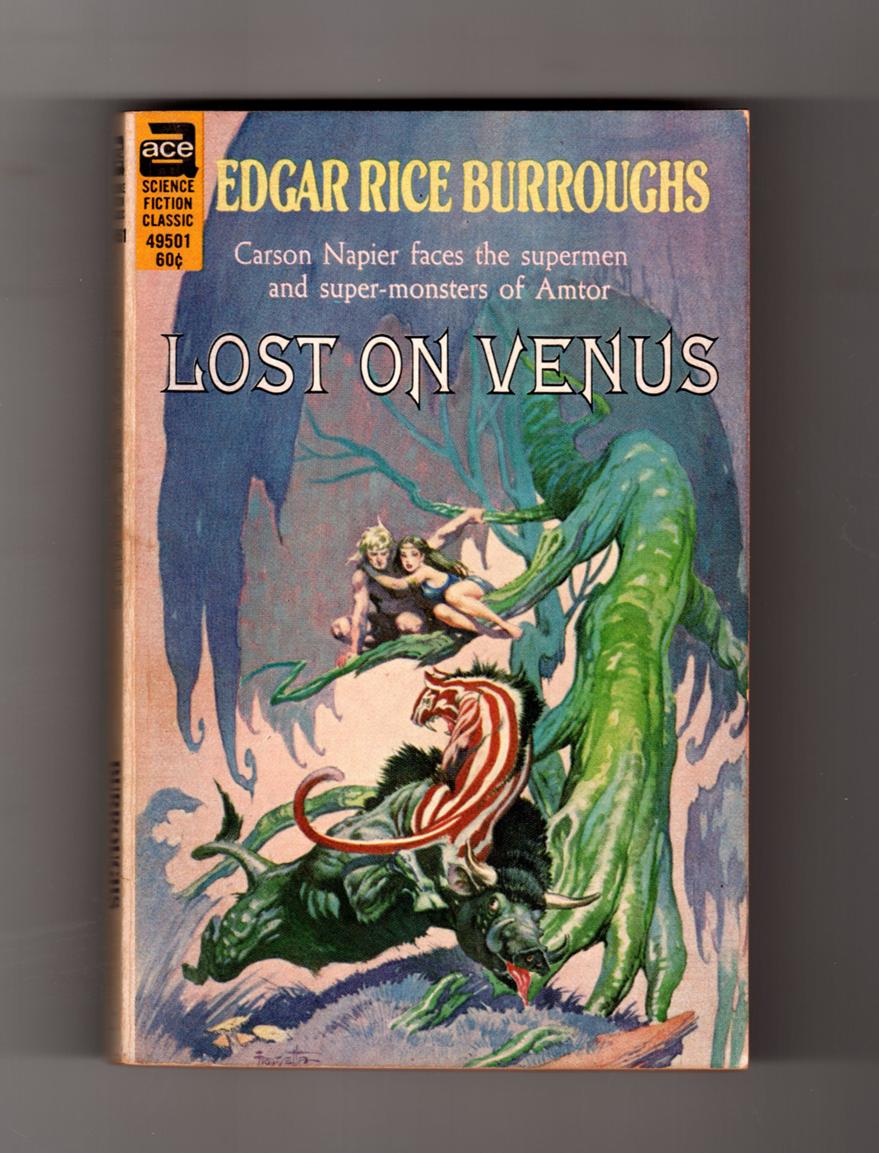
I’ll never outgrow Edgar Rice Burroughs–best known as the creator of Tarzan, but that was only one part of his achievement. Still when you write as many novels as ERB did, some of them are bound to turn out… well, not so good as others.
Lost on Venus–which first appeared as a magazine serial in 1933, and as a book in 1935–is full of stuff that reminds us that a lot of loopy ideas were floating around in the culture, back then. You can’t say they were spawned by the Depression, because they all have roots easily traceable into the 19th century.
Burroughs swallowed ’em all, hook, line, and sinker.
I’d say the biggest howler in the book is a single line: “Nothing is impossible to science.” It is spoken by an official in the city of Havatoo, a utopia created by rigorously breeding human beings, like farm animals, to yield a better product. This is the now-discredited pseudoscience of eugenics. Back in the 1930s, all the smart people believed in it. You were a real ape if you questioned it. But it kind of fell into disrepute when Heinrich Himmler took it literally and became the eugenics poster boy.
On Venus, as Burroughs followed the Progressive will-o’-the-wisp, there’s no religion because all the people are way too smart to believe in God, and anyhow they don’t need God because their Science has given them an immortality serum and they all get to stay young and beautiful and healthy forever. Yeah, right.
The best thing about the Venus books (Lost is No. 2 of 4, with a posthumously published novelette tacked on) is the physics and cosmography cooked up by Venusian scientists who have never seen the heavens, the sun, stars, etc., because of Venus’ impenetrable cloud cover. Absent these observations, what they come up with is simply astounding: and all of its contradictions can be resolved by multiplying all the numbers by the square root of minus one: an imaginary number, and a wonderful little joke by Burroughs.
Hey, wait a minute! Was he the sucker, or am I? Like, didn’t he just show that the whole Venusian system of science was based on a completely erroneous model of the universe? Was he having a long, long laugh at all the wise men of his day?
P.S.–If you don’t see what I’m getting at, try it yourself. Multiply any number by the square root of minus one and see what you get.