Memory Lane: ‘We Belong to a Mutual Admiration Society’

Going back, way back, all the way to 1956–remember this? Teresa Brewer had a big hit with We Belong to a Mutual Admiration Society. I was only a little shaver at the time–in fact, I didn’t shave at all–but I never quite forgot this song.

Dopes like to speak of the 1950s as a cultural dead zone: but check out this song. Actual music provided by actual musicians. Clever, witty lyrics. An absence of rancor.

I’m posting stuff like this for those of us who remember what it was like, and for those who are too young to have experienced it: to deliver the message that once upon a time, and not so long ago, things used to be a great deal better than they are now–and that it is, after all, possible to have a relatively clean popular culture that’s still a lot of fun.

Memory Lane: ‘A Swingin’ Safari’

Do you ever get a tune in your head from way, way down at the bottom of your memory jar, and then it drives you nuts because you can’t remember what it’s called or where you heard it?

I’ve had this one going round and round. I kept thinking it was from a TV game show, The Match Game, and it turned out I was right–it was the theme song for the first edition of The Match Game, 1962-69. And I used to hear this at my friend’s house after school, because his mother never missed the show.

Nothing like an old TV theme to take you back! Hey, where were you in ’62? I think Paul Lucas asked that once. Of course, he had us all behaving like teenage sitcom characters, which wouldn’t be even close to describing my pals and me. I have a vision of two or three of us just sitting down to play Mille Bornes when we heard this music coming from the living room.

Bert Kaempfert, Billy Vaughn, you made great music! Don’t let anybody say you didn’t.

Memory Lane: How Not to Build a Raft

Image result for homemade raft

Hey, it’s cold outside today! Which for some obscure reason has raised up a summer memory.

Once upon a blistering hot summer day, my friends and I decided to build a raft, a la Huckleberry Finn. This we did at one of those places that’s since been paved out of existence: a sluggish little stream that flowed through woods and meadows that some of the people living nearby used as a dumping ground for junk.

But for us, the discovery of an old wooden pallet, and some discarded tires, this was a treasure trove. I had recently seen, in Popular Mechanics, a plan for building a nice raft buoyed up by a tire under each corner. Actually, the raft floated on inner tubes; but some dumb kid–me–could only remember “tires. Yeah, tires!”

So we toiled in the heat, using scrap lumber to strengthen the pallet, and laboriously attaching an old tire to each corner under the raft. This was going to be great! Like, who knew where this stream would take us, once we were afloat? And of course anyone who chanced to see us would be torn between applause and envy.  We were going to have adventures!

At great cost in labor and sweat, we wrestled our glorious new raft into the water.

And it sank. Immediately. The old tires instantly filled with water and dragged our raft straight to the bottom before any of us could even set foot on it.

We were mystified! Tires are supposed to float. These just made a horrible glug-glug-glug noise and went straight to Davy Jones’ Locker.

And that’s how I learned the difference between a tire and an inner tube.

It was fun, though–enormous fun while we were building the wretched thing, our minds on fire with imagination. And we did get it built, albeit on a false premise of design. Dreams that don’t come true are still dreams.


Memory Lane: Soldiers Path

We lived next door to the playground, and beyond the playground lay the woods. All gone now, of course–playground, woods, and all. Everything paved over. But come along with me, I know a way back in.

Deep in the woods, a little ways past Hangman’s Tree, was Soldiers Path. Now of course any woods visited every day by children is bound to be full of paths leading all over; but this path was different.

For one thing, it didn’t really take you anywhere: it just sort of petered out. If you traced it back to its origin, you found the same thing. This was a path from nowhere in particular to nowhere in particular.

But even more unusual, this path was made of  cinders. Someone, Heaven knows how long ago, meant for this path to last for many years. Certainly it outlasted whatever it was going to, and whatever it was coming from.

Kid legend invested Soldiers Path with all kinds of improbable stories. This was the official path by which criminals were taken to Hangman’s Tree and strung up. No, it was a path made by the Hessians so they could march quickly through the woods. I heard that story long before I had the foggiest idea what a Hessian was: I don’t know why, but I somehow got the idea that a Hessian was a kind of gigantic insect.

We also believed that if you went out there late at night, you could see condemned criminals or Hessians marching on Soldiers Path; but I never heard of anyone who was brave enough to make that experiment.

What I wouldn’t give to tread that path again! But if C.S. Lewis was right, when he speculated that all the places that we love on earth are only facsimiles of the real places in Christ’s Kingdom–well, I may. I may.

Memory Lane: How We Played Baseball–Without Adults

Believe it or not, children used to play baseball–without Little League, without uniforms, without coaches, umpires, a scoreboard, sponsors, a crowd of parents in the stands, and perpetual supervision of our every move.

My first baseball glove was my father’s old Larry French model, vintage 1940. More often than not, our baseball was wrapped in tape because we’d long since knocked off the cover. Some of our favorite bats were kind of patched together, too.

We never had 18 kids to play full teams, and sometimes our bases were trees, stones, or squares drawn in the dirt. Because we were always so short-handed, we had a plethora of playground rules that allowed us to play baseball with as few as four kids to a team. Here are some of the rules we used.

Pitcher’s hand: So who needs a first baseman? If the ball got thrown back to the pitcher before you got to whatever base you were going to, you were out.

Invisible man on base: One thing about imaginary baserunners–they never got hurt.

Call your field: Sometimes we had to make do with only two outfielders, or even one. So before the pitch was thrown, the batter had to announce which field he intended to hit to, and the outfielders were positioned accordingly. If you hit to some other field, you were out.

Imaginary outfielders: If no one was available to play the outfield, we decided on whether a batted ball was a hit or an out, and what kind of a hit it was, based on whether a fielder, had one been out there, would have ordinarily been able to catch the ball. This could lead to a lot of debate, but that was sometimes half the fun.

Four foul balls, or two, and you’re out: Nobody wants to chase foul balls, one after another. This rule saved a lot of time.

There were other rules in addition to these, and we decided which ones to use and then started playing. Those discussions helped to teach us arts not generally associated with baseball, like compromise, negotiation, and sweet-talking.

Thanks to these innovations, we were able to play baseball every day, for as long as we liked.

And if that wasn’t more fun than Little League, I am very much mistaken.
A Day in the Fall, Long Ago

Image result for people raking leaves

I have lived in the same small town all my life: and the biggest difference between the way it was then and the way it is now is… you don’t see many people outside.

Zooming back to 1958 or so, it’s Saturday, a sunny day in the fall, and there just might be a high school football game today. You can always tell, once you hear the band tuning up. So everybody on our street flocks over to the football field to watch our team try to get the square root of the other team’s score. Drums, tubas, people cheering, referees’ whistles: I know the tune by heart.

But if it’s just a sunny day without a football game, then you’ve got adults outside raking and gathering leaves, and the delicious autumn aroma of burning leaves. Men tinkering with their cars. Women playing with small children. And the rest of us kids with a pickup game of football, either on the playground or in someone’s back yard. Or riding around on our bikes.

Now they’ve got these great big houses on little tiny lots and you never see anybody. The only people outdoors are out there because they have to go somewhere. As for kids just playing in the neighborhood–free ranging, making our own fun: but in reality all those adults outside were discreetly watching over us without making like guards on a chain gang–oh, perish the thought!

Give me the smaller houses with the bigger yards, and neighbors yakking with each other as they raked their leaves–what kind of conversation can you have, with leaf blowers roaring in your ears?–and maybe your folks might have a few friends over for cards that night; and you’d be up in bed, pretending to be asleep, but listening to the muffled talk and the not-so-muffled laughter downstairs and wishing you were old enough to join in.

Yeah, give me that. I’ll take it.

Memory Lane: The Widow Next Door

I grew up on a dead-end street–a dirt road at first, then coarse gravel, then fine gravel, and finally paved–adjacent to the neighborhood school and playground, the high school football field, and a wonderful big woods.

Let me focus in on our next-door neighbor, Mrs. Thomas, an elderly widow. I say “elderly” because I was just a little kid and she looked elderly to me. Probably she was younger than I am now.

Mrs. Thomas had a dog, Old Brownie, who had the run of the neighborhood because he could be trusted never to abuse his freedom, and who was always available to listen to your troubles with a sympathetic ear. She had a large, tree-less back yard, ideal for our football games, and a hedge out front that served us for a volleyball net

You’d think she’d be unnerved by all these kids playing on her property, but no–she liked it. If you got cold or wet and didn’t feel like going home just yet, she had you in to warm up with some cookies. And there were always a couple of us available to run an errand for her: we had a little grocery store just around the block, and Mrs. Thomas didn’t have a car. We kids shoveled her walk when it snowed, and one or another of our fathers mowed her lawn. I think it’s safe to say that everybody loved her.

It was a long time ago, and it was a good time: I’m here to tell you it was better than the times we live in now. Old Brownie would surely agree.

P.S.–Thanks to Marlene, whose eloquent comment yesterday inspired this.

(If this called up happy memories for you, and if readers are interested, I can expand this into a series of sketches. There’s just no way I can summon up the whole neighborhood in just one blog post.)

Memory Lane: A Night at the Drive-In

One of the amenities of American life that I really do miss–and I’m sure I’m not the only one–is the drive-in movie. Wasn’t that great! Especially that somewhat horrible intermission bumper, “Let’s all go to the Lobby!”

Once upon a summer night, on one of those extremely rare occasions when a babysitter just wasn’t available, my mother and father went to the drive-in to see Psycho. They must’ve really wanted to see it, because they took me along. I guess they expected me to fall asleep in the back seat. Fat chance of that!

Yup, when Vera Miles tapped ol’ Momma Bates’ shoulder, and Mrs. Bates turned around, and she was a mummy, this dreadful ghastly mummy–Yee-ow! It just about went through the roof of the car. You can imagine how I slept that night. I was ten years old, I wasn’t used to stuff like that!

Hooked me on horror movies for life, though.

Maybe someday the drive-ins will come back. And then we can all go out to the lobby and scuttle back with popcorn in time for the next feature.

Memory Lane: Play Sets

The Marx Ben-Hur play set from 1959

What did you do if you were nine years old, and you’d already been to church or Sunday school today, and your father wasn’t going to take you to the movies–oh, and it’s 1959, or so?

Throughout the 1950s, America’s toy companies met that need with play sets. You got a big box, some kind of background you could set up, and a whole bunch of little plastic figures. If you had the Ben-Hur play set, pictured above, you could set up the arena and re-enact the chariot race from the movie.

There were all kinds of play sets. I had the dinosaur set, the farm, and a Cape Canaveral set with rockets and missiles you could send flying from spring-powered launchers, and a circus set with a tin big top.

The Cape Canaveral set (“You’ll put your eye out!”)

With all of these, you had to use your imagination. So we made up stories and acted them out with the little plastic figures–dinosaurs take over the space program, the farm animals decide to run the farm themselves, and so on. Every day was different.

Not like now, when well-meaning (we are being charitable) adults spoon-feed and control everything that a child might take into his head, completely unaware that such a thing is impossible to perform and letting a lot of really dark stuff get in that ought to be kept out.

We were better off with the play sets.

Memory Lane: Golden Stamp Books

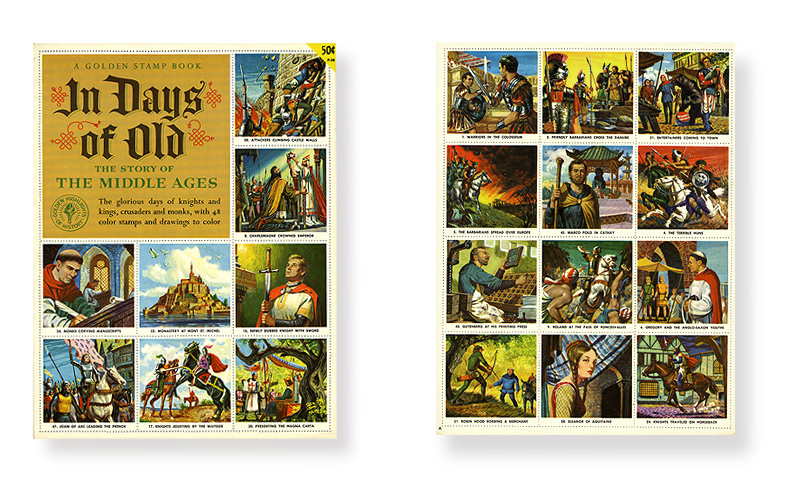
Vintage Golden Book

Hey, remember these? Golden Stamp Books, from the 1950s–one of my all-time favorite toys.

These books were a three-way delight. Each page had a short article or story for you to read, a line drawing for you to color–and, best of all, these brightly-colored stamps, pictured above, that you could paste on to the appropriate page. The one you see here, In Days of Old: The Story of the Middle Ages, was one of my favorites.

Golden Books published a whole series of these, and I had quite a few of them–stamp books on African animals, pirates, dinosaurs, and whatnot.

A kid could learn a lot from these books. They were “educational” without sacrificing any fun. Of course, you had to be able to sit quietly and contentedly for a little while, reading and coloring and pasting in stamps, and you had to be able to use your imagination: but I suppose that’s what made these so out-and-out wonderful. As you can see, I’ve never forgotten them, although it’s been going on 60 years since I’ve seen one.

I think there’s a lot to be said for being able to sit quietly and use your imagination. And it would be a better world if more people know how to do it.