‘Baseball Without the Little League’ (2018)

Image result for images of pickup baseball game

I grew up in a time when most kids played what they wanted to play and didn’t require full-time adult supervision–to say nothing of scoreboards, uniforms, sponsors, etc., etc.

Baseball Without the Little League

I think one of the wisest things my parents ever did was not to let me join the Little League. They said I’d hate it: the coach’s favorites play while everybody else just sits on the bench.

So much nicer to play with patchwork rules (hit the ball past the swing set, it’s a home run) and only four or five kids on a team. You get up to bat 50 or 100 times instead of not at all, you play as many innings as you please, and you don’t have to waste time undermining your teammates.

But then who sees free-range kids playing outside anymore?

Memory Lane: Russian Bulldog

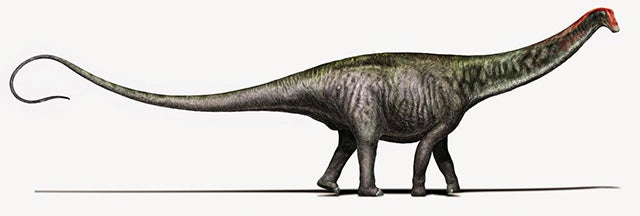
The Brontosaurus Is Back - Scientific American

I couldn’t find a picture that was even close to what I want to write about here–the once-upon-a-time children’s game that my friends and I called “Russian bulldog.” Just try to find a picture of kids playing without uniforms, without coaches, without every single ethnicity self-consciously included. It can’t be done. Look, I’ve got a picture of a Brontosaurus. But no Russian bulldog.

The game was simplicity itself. No equipment needed. No supervision. No freakin’ sponsor! Somebody’s back yard would do for a field. And you needed was five or six kids.

One would be the Russian bulldog. I have no idea how it got that name. He’d stand in the middle of the field and the others would try to run to the opposite end of the field. He would try to tackle somebody; and whoever he succeeded in bringing down would remain on the field with him as Bulldog No. 2. The rest of the kids would then run down the field again, this time trying to avoid two tacklers. The game would go on until there was just one kid left untackled, and he’d be the Russian bulldog in the next game.

We were really into this game, in my neighborhood, at around the ages of 12-13. We played it a lot. And although it consisted of tackling, and running into each other at top speed, nobody ever got hurt. Maybe because we didn’t wear any equipment.

Did you play Russian bulldog with your friends? And if you did, what did you call it?

P.S.–Patty found this antique photo of English schoolboys playing a game called British Bulldog–very similar to Russian bulldog, only the kids get tagged instead of tackled. Here’s the picture.

We'll bring back British Bulldog | British bulldog, Bulldog game, My  childhood memories


Memory Lane: Football for Kids–Without Adults

Image result for images of children throwing football

Riding my bike this morning, after a solid week of rain, I saw kids playing football–flag football, organized by adults and under adult supervision.

Ain’t the way we played football.

Yes, we followed the sports seasons; so about now, at this point in the year, the kids in my old neighborhood would be changing over from baseball to football.

Without uniforms, without a scoreboard, without coaches, helmets, parents in the stands, or sponsors. Without having to try to get our names in the sports section of our local paper. Just kids playing football, with only three, four, or five kids to a team. And five was a lot. Three was more likely, and sometimes we played with just two.

We played for as long as we pleased. The best yard for it was Mrs. Thomas’ yard, which had no trees, and she didn’t mind us playing there. The only hazard was her oil tank, up against the back of the house. I remember one time when my friend Ellen caught a pass for a touchdown, but couldn’t stop. Boom! Right into the tank. But kids were tough in those days, and after a few brief moments, she was able to continue.

Sometimes we played tackle, sometimes two-hand touch. We had no goalposts, so field goals were out. We had special rules. “No dumping the hiker,” otherwise hiking the ball to the quarterback would be a thankless job that no one wanted. If we were playing touch, we made a rule that you could lateral to yourself and the touch wouldn’t count if the ball was in the air. We would have loved to try a flying wedge, but there were never enough kids for that. Usually we ruled that the defenders, or defender, would have to count to three or four before charging across the line of scrimmage to grab the quarterback. And we had to be careful of the rose hedge that separated my yard from Mrs. Thomas’.

There was no adult to lay down rules, so we made up our own, kept the ones that worked, and forgot about the ones that didn’t. The games went on for hours and hours, and I don’t remember anyone ever getting hurt, beyond a scrape or a bruise or two.

Playing on our own taught us innovation, cooperation, negotiation and compromise–none of which are to be found in organized sports. I’m afraid it didn’t teach us to be docile citizens awaiting the decisions of authority. My parents only laughed when I mentioned joining the Pop Warner league. “You’d hate it!” said my mother. And I see now she was right.

We played as our parents played when they were kids, and it was golden.

I’ll bet they let you play like that in Heaven.

Baseball Without the Little League

Image result for images of pickup baseball game

I am so glad I had my childhood in the 1950s, when you were allowed to play without some adult ordering your every move.

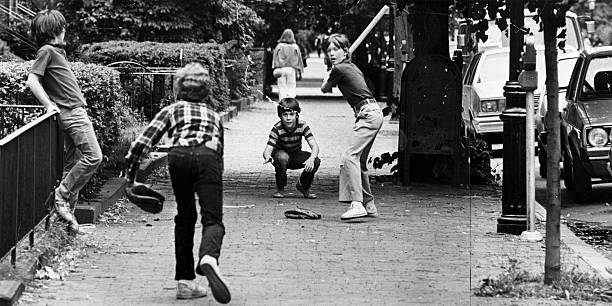
In the summer we liked to play baseball. We did not have 18 kids for two teams, a scoreboard, umpires, adult coaches, uniforms, sponsors, bleachers full of parents, and all the rest. We didn’t have bases. See, in the picture–somebody’s mitt is serving as home plate. And they’re playing on the sidewalk.

But what we did have was games that could last all day if we wanted, in which it was possible to come to bat 100 times and get 50 hits.

So how do you play baseball with only six or seven kids and no sponsors?

Simple–you just use however many of these special rules you need.

*Pitcher’s hand–If any fielder can get the ball back to the pitcher before the batter reaches first base, the batter is out. This makes up for a shortage of infielders.

*Invisible men on base–When the team at bat has only three or four players, one or more can be replaced on the bases by imaginary baserunners. If you hit a double with an invisible man on second, the invisible man scores. If you hit a single, he stops at third.

*Call your field–If you don’t have three outfielders, the batter must declare which field he intents to hit to. If he calls left field and hits to right field, he’s out. This makes up for a shortage of outfielders.

*Special ground rules as needed–What to do if the ball caroms off a tree or any piece of playground equipment, rolls into a mud puddle, etc.

Way back when, we invented new rules as needed, and refined our game so that baseball could be played one-on-one–just a pitcher, just a batter–as long as both players agreed to the imaginary parameters.

Later in life, in the men’s softball league, I found players who came up through Little League to be whiners, complainers, prima donnas, always trying to build themselves up by undermining their teammates–and none of them could hit worth a damn. But when you have 24 kids on a team with room in the lineup for only nine at a time, and some adult deciding whom those nine shall be… it’s a great inducement to concentrate more on politicking than on hitting.

Memory Lane: Skating in the Woods

Image result for images of frozen pond in woodland

It’s cold today, and it’s been cold for a week. If I were ten years old, I know where I’d be headed, right about now.

With my ice skates in my hand–yes, come on, grab your skates and come with me–I would go to the little swamp behind Mrs. S’s back yard. An enormous weeping willow tree hung over it, and beyond it was a palatial estate like a movie star’s. They had an in-ground swimming pool: in those days, a sign of fabulous wealth.

The swamp is frozen over. We walk out onto the ice and follow a stream leading deeper into the woods. It opens into a little round pond, and some of the other kids in the neighborhood are already ice-skating there. Off with the shoes, lace up our skates, and join in the fun: it’s just big enough for half a dozen kids to play crack-the-whip.

You could, if you liked, follow the stream all the way into the middle of the woods, until it grew too narrow for any proper skating. But the pond is more fun. It’s only a stone’s throw into the woods, but it seems much farther because it’s so quiet–except, of course, for the noises made by all of us playing and whooping it up because it snowed last night, heavily, and there is no school today.

We are unsupervised. We are free. We are having a blast! And if the need arises, we’re only three minutes’ walk from the nearest house with adults in it. We’ll skate until we’re too cold to skate anymore, and then it’s back indoors to warm up and maybe play a little Monopoly. It’s about a hundred times better than the best day you would ever have in school.

And the day, at least for now, is ours.

I wouldn’t trade that little frozen pond for all the fancy indoor skating rinks on the planet.

Memory Lane: How We Played Baseball–Without Adults

Believe it or not, children used to play baseball–without Little League, without uniforms, without coaches, umpires, a scoreboard, sponsors, a crowd of parents in the stands, and perpetual supervision of our every move.

My first baseball glove was my father’s old Larry French model, vintage 1940. More often than not, our baseball was wrapped in tape because we’d long since knocked off the cover. Some of our favorite bats were kind of patched together, too.

We never had 18 kids to play full teams, and sometimes our bases were trees, stones, or squares drawn in the dirt. Because we were always so short-handed, we had a plethora of playground rules that allowed us to play baseball with as few as four kids to a team. Here are some of the rules we used.

Pitcher’s hand: So who needs a first baseman? If the ball got thrown back to the pitcher before you got to whatever base you were going to, you were out.

Invisible man on base: One thing about imaginary baserunners–they never got hurt.

Call your field: Sometimes we had to make do with only two outfielders, or even one. So before the pitch was thrown, the batter had to announce which field he intended to hit to, and the outfielders were positioned accordingly. If you hit to some other field, you were out.

Imaginary outfielders: If no one was available to play the outfield, we decided on whether a batted ball was a hit or an out, and what kind of a hit it was, based on whether a fielder, had one been out there, would have ordinarily been able to catch the ball. This could lead to a lot of debate, but that was sometimes half the fun.

Four foul balls, or two, and you’re out: Nobody wants to chase foul balls, one after another. This rule saved a lot of time.

There were other rules in addition to these, and we decided which ones to use and then started playing. Those discussions helped to teach us arts not generally associated with baseball, like compromise, negotiation, and sweet-talking.

Thanks to these innovations, we were able to play baseball every day, for as long as we liked.

And if that wasn’t more fun than Little League, I am very much mistaken.
A Day in the Fall, Long Ago

Image result for people raking leaves

I have lived in the same small town all my life: and the biggest difference between the way it was then and the way it is now is… you don’t see many people outside.

Zooming back to 1958 or so, it’s Saturday, a sunny day in the fall, and there just might be a high school football game today. You can always tell, once you hear the band tuning up. So everybody on our street flocks over to the football field to watch our team try to get the square root of the other team’s score. Drums, tubas, people cheering, referees’ whistles: I know the tune by heart.

But if it’s just a sunny day without a football game, then you’ve got adults outside raking and gathering leaves, and the delicious autumn aroma of burning leaves. Men tinkering with their cars. Women playing with small children. And the rest of us kids with a pickup game of football, either on the playground or in someone’s back yard. Or riding around on our bikes.

Now they’ve got these great big houses on little tiny lots and you never see anybody. The only people outdoors are out there because they have to go somewhere. As for kids just playing in the neighborhood–free ranging, making our own fun: but in reality all those adults outside were discreetly watching over us without making like guards on a chain gang–oh, perish the thought!

Give me the smaller houses with the bigger yards, and neighbors yakking with each other as they raked their leaves–what kind of conversation can you have, with leaf blowers roaring in your ears?–and maybe your folks might have a few friends over for cards that night; and you’d be up in bed, pretending to be asleep, but listening to the muffled talk and the not-so-muffled laughter downstairs and wishing you were old enough to join in.

Yeah, give me that. I’ll take it.