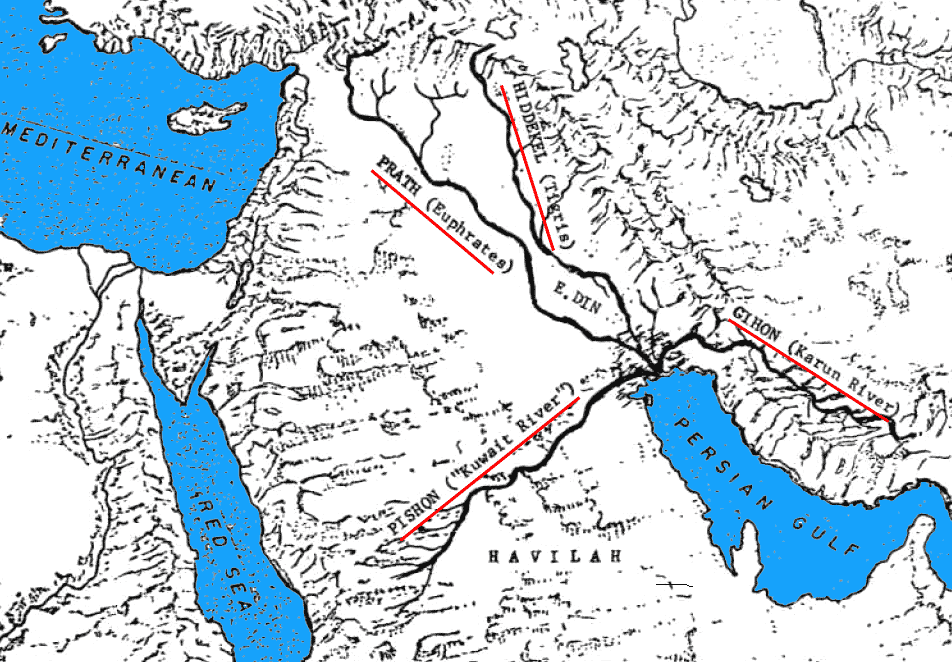
The Bible preserves the memory of an ancient river that flowed across Arabia many thousands of years ago.
God speaks to us in many ways.
I was raised in a close-knit Christian family, but came out of four years of college with the kind of precious know-it-all attitude for which the university is the ultimate greenhouse. And in that wilderness I wandered for 30 years or so, until the Good Shepherd brought me back.
One of His tools was an article in Biblical Archaeological Review, Vol. 22 No. 4, July/August 1996, “The River Runs Dry.” This told of the discovery, via satellite photo analysis, of a long-vanished river that ran across Arabia into Mesopotamia. (I can’t figure out how to navigate the BAR site, but this will help you, http://kata-aletheia.blogspot.com/2007/01/ancient-geography-lost-river-of-eden.html )
The Bible preserves much ancient knowledge which would otherwise be lost. In Genesis 2, the “four rivers of Eden” are described. Two we know today as the Tigris and the Euphrates, in Iraq. But in verse 11 we read, “The name of the first is Pison [or Pishon]; that is it which compasseth the whole land of Havilah, where there is gold…”
“Havilah” refers to what is now the western part of Saudi Arabia. Geologists for years wondered about the presence of certain kinds of pebbles and stones in Kuwait which were not original to that country. But as satellite photos revealed the bed of a mighty river now buried under the Arabian desert, it became clear that these stones and pebbles came from far away, carried there by a river which dried up and disappeared thousands of years ago.
So there is information in that chapter of Genesis that has no business being there unless it is an accurate record of truly ancient things. Never mind the Reputable Bible Scholars Inc. who say the whole Bible is just a bunch of fables and stories invented by priests in Babylon after 500 B.C. to wile away the time spent in captivity.
Geologists estimate that the Kuwait/Pison River ceased to exist by, at the latest, 2,000 B.C. So then they talked about it for 1,500 years?
Reading about this lost river of Eden, now found again, shocked me deeply: shocked me with the revelation that Genesis is true. It got me started back on the road to the Bible. It continues to fascinate me 20 years later.
It’s God’s Word, it’s true, and we can trust it.
