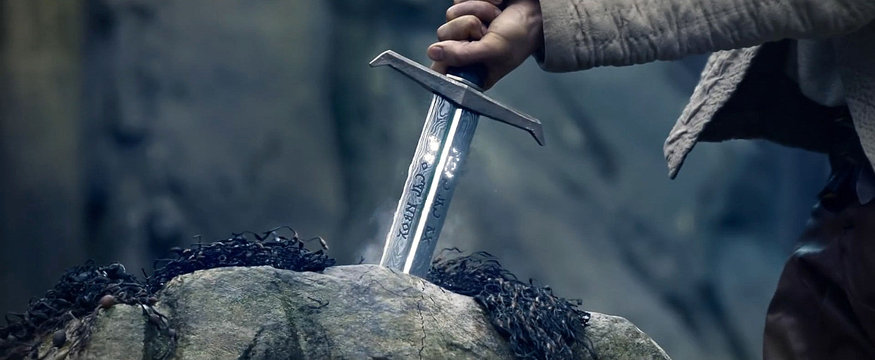
‘The Sword in the Stone: True Story’ (2017)

See the source image

I like to post this essay now and then because we need a hero like King Arthur, blessed by God and able to win impossible victories to deliver us from our pagan enemies.

The Sword in the Stone: True Story

It’s been some years since I came to this conclusion, that the sword in the stone was a true story. It’s become very vivid to me now. Yes, it could have happened that way. In my mind’s eye, I can very clearly see the stunned expressions on the faces of the Sarmatian cavalrymen, veterans and youngsters alike, when they see this nobody, this young man out of nowhere, pull out the sword that they’ve been worshiping, flourish it over his head for everyone to see, and call upon them to rise up against the invaders of their country.

No one does a thing like that without God’s guidance.

see him! I see him on a great horse galloping, leading a desperate uphill charge that will break the pagans’ shield-wall and insure the future of Britain as a Christian land.

It’d make quite a novel.

‘The Sword in the Stone: True Story’ (2017)

See the source image

When all seemed hopeless, along came a young warrior to lead the British people to unlooked-for victories that ensured their survival. And his career started with him pulling a sword from a stone.

The Sword in the Stone: True Story

Some years ago, my own researches led me to believe that the story of Arthur and the Sword in the Stone was… well, true. Arthur was a real person and his dramatic event really happened.

There’s more to history than we can learn from the textbooks.

‘The Sword in the Stone: True Story’ (2017)

See the source image

I’ve always wondered how much of King Arthur’s story is historically true. I’ve been studying it since I was a boy, and my conclusion is: probably most of it.

Like, for instance, that bit about the sword in the stone.

The Sword in the Stone: True Story

Alas, I had no idea where to publish my research, and who was going to publish Arthurian research by some guy in New Jersey whose only claim to fame was some short stories in Mike Shayne’s Mystery Magazine? So of course someone beat me to it.

But that only shows that the theory I came up with was both sensible and even obvious–if you knew where to look.

The Sword in the Stone: True Story

See the source image

Marge has asked me to explain how I figured out the story of young King Arthur drawing the sword from the stone, and thus becoming king, was a true story. Here’s my argument:

Herodotus said the nomadic peoples of South Russia, who had no real temples, used to worship their gods by heaping up a pile of stones and thrusting a sword into it. Among these peoples were the Sarmatians.

The Romans stationed Sarmatian cavalry in Britain. When the Romans abandoned Britain in 415 A.D., some of the soldiers chose to stay. The Sarmatian cavalry stayed.

All the old sources portray Arthur as a war-leader who won victories all over Britain. He must have relied on cavalry; foot soldiers couldn’t have reached such widely-separated battlefields in the time allowed. Hence the tradition of Arthur and his mounted knights.

Now imagine a young Christian war-leader, desperate to defend his homeland from invaders, casting his eyes on the Sarmatian cavalry troops, pagans, but also the best and most experienced cavalry in Britain–and seeing them praying to a sword thrust into a pile of stones. What would happen if he walked up and pulled the sword out of the stones, and called on these horse-soldiers to rise up and follow him?

I think they would have either killed him on the spot, or else been swept away by his boldness and become his men.

It could’ve happened that way.

I had this figured out early in the 1980s but hadn’t a clue as to how to publish it, or where. A few more years went by; and then, alas, I discovered that someone else had since come along with the same theory, published it in an academic journal, and left me twiddling my thumbs.