A Wasted Opportunity REPRINT

See the source image

From November 4, 2018

“Thomas Locke” is Bunn’s pseudonym .

So you’ve got an already-successful Christian author with a large fan base, writing in a popular genre with a wide readership, and a major publisher to produce and market the book–golden opportunity, right? An opportunity to win ground in the culture for Christ’s Kingdom.

Wrong. Instead, all these resources came together to make, well, a bunch of nothing.   (Click link below to read the full review  PD)

https://chalcedon.edu/resources/articles/review-of-christian-novel-emissary

T. Davis Bunn had all this going for him when he set out to write his first fantasy novel, Emissary, three years ago. So he decided to write a “completely mainstream, totally secular” fantasy novel–that is, he cobbled together a thorough collection of fantasy cliches: and the big huge Christian publisher, Zondervan, published it.

Waste, waste, waste.


‘The Underlying Spiritual Theme’ REPRINT

From June 14, 2015

The other day my fellow blogger, Ajoobacats–she has a whale of a blog, totally dwarfing mine: just tons and tons of readers; I recommend her book reviews to all–honored me with a review of my Bell Mountain, which I am happy to say she liked very much ( http://leeduigon.com/2015/06/12/book-review-bell-mountain-by-lee-duigon/). I don’t think I’ve ever seen her review a fantasy before: but she admits that my book was about as far off her beaten track as she’s ever gone.

I must draw attention to one remark she made: “The underlying spiritual theme may not be in fashion…”

Well, that’s putting it mildly!

In fact, I know I’m out of fashion: it’s what I intended. The whole point of the Bell Mountain series is to “renormalize religion” by showing it to be a basic and indispensable component of the characters’ daily life, culture, and psychology: and more, to proclaim that God is a Person, the Supreme Being, who interacts with individuals, families, and whole nations.

My books have struck a few readers as odd because they have come to expect no trace of religion in any work of fiction, be it a novel, a movie or TV script, or anything else. But the total absence of God or gods in our fiction depicts an extremely weird kind of civilization that has never actually existed except in faculty lounges and some of the least wholesome, darkest corners of politics and business.

But how, asks the ninny, do you manage to fit God or religion into Zombie Apocalypse or Superheroes vs. Climate Change Deniers?

That’s the wrong question. If God is in your life, you may not have a yen to spend much time in Zombie Apocalypse. Not that you can never just veg out and relax by watching some nonsense or other. I love silly old monster movies. It’s only a problem when the nonsense takes over your life.

I believe it has done us harm, as a nation, to spend such vast amounts of time consuming “entertainment” from which the very concept of God has been excluded.

Go ahead, tell me I’m wrong.

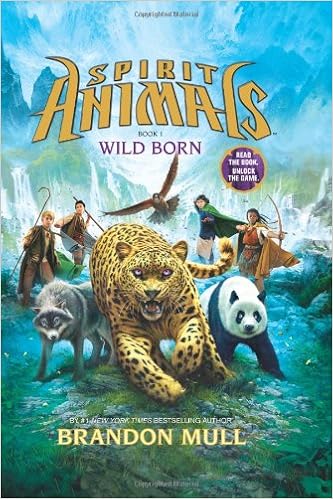
REPRINT ‘Scholastic Seduction: the Spirit Animals Series’ (Chalcedon Magazine, 2015)

Image result for images of Spirit Animals series by Scholastic Books

From April 27, 2018

You can always trust Scholastic Books to tempt young readers away from God. Just show a lot of kids in a fantasy world who have super-powers and fantastic martial arts skills, and are at the same time really “spiritual,” and you’re good to go.

I reviewed a couple of these “Spirit Animals” books in 2015. It would be a very good idea to find something else for your children and grandchildren to read.

https://chalcedon.edu/magazine/scholastic-seduction-the-spirit-animals-series

This is culture rot, perpetrated by the publishers of Scholastic Books. And it’s not nice.

Work Wanted: Wizard/Sage/Ninny

Image result for images of funny wizard

From February 26, 2017

I have a couple of fictional characters on hand who weren’t able to find jobs in any of my books. So I am advertising them here, for employment by any aspiring fantasy writers who may wish to give them work.

Gombo the Magnificent is a wizard whose magic mostly produces unintended, and unappreciated, consequences. His love potion grows hair on your furniture. His hex makes his enemies stronger. And don’t even think about asking him to cast a spell to make you lose weight. The last customer who tried that wound up with two left feet and a bottomless ashtray.

Dr. Fretorius, an unemployed sage, is the world’s foremost expert on the philosophical writings of Wing Chow Foon, who was executed by his emperor for turning his students into useless idiots. Dr. Fretorius became unemployed when this began happening to his students at the university. Obviously a fantasy character: in real life, he would have been promoted to department head.

Beetrice Blotter rebelled against her parents’ plan for her to follow in their footsteps as professional beekeepers and turned instead to keeping wasps. It’s actually rather dangerous to approach her property. Her pride and joy is a wasps’ nest the size of a medicine ball, inhabited by a multitude of the most aggressive wasps anyone has ever seen. Her inability to get her wasps to produce marketable honey has left her with an obsession to achieve this goal no matter what.

All three have expressed the desire to appear in a fantasy novel and a willingness to do it without being paid. So if you mean to write such a novel, and have an opening suitable for any of these three characters, please feel free to give them a chance to show what they can do.

Yes, the Culture Really Does Matter REPRINT


From January 29, 2015
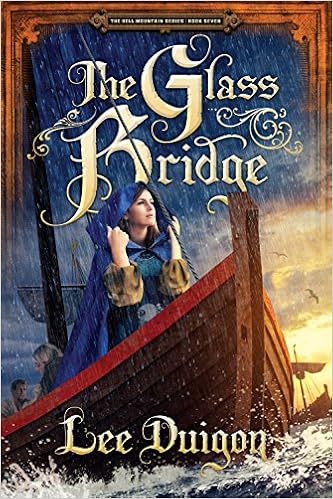
It looks like I won’t be getting the radio coverage I’d hoped for, to launch The Glass Bridge. They’ve got all this current events stuff to cover instead. Deflated footballs, for instance. The reason I get, boiled down, is, “It’s only a novel and we don’t cover novels, it’s not important enough.”

Okay–one novel, so what? Whose worldview is going to be changed by one novel? (In fact, that happened to me when I read Windswept House by Malachi Martin: changed me from somewhat pro-abortion to 100% pro-life.) My book is Young Adults fiction, which makes it even less important. Who cares what the kids are reading? And on top of that, it’s fantasy, which makes it less important still. That’s about as unimportant as it gets.

I wonder if any of our conservative, pro-family media commentators have any idea of just how much YA fantasy is out there. Boxcar-loads of it! Thousands and thousands of titles. Tons and tons of it.

And it’s only part of a larger pop culture entertainment matrix, along with movies, TV, video games, etc.

This is–and I do not exaggerate–a culture that embraces and promotes paganism, disbelief in God and His word, sexual randomness, and fosters rigid conformity (they call it “diversity”) while at the same time seducing the audience with visions of impossible personal autonomy. That’s why so many of those novels feature 11-year-old kids acquiring super powers or secret martial arts so they can beat up able-bodied adult men. That’s why The Invincible Female Warrior has become a fixture in this genre.

This is a popular culture that is shaping our world. This is the worldview being pumped into the brains of the next generation.

I don’t believe it’s possible for a child to consume thousands of hours of this stuff and still grow up to be sensible, responsible, thoughtful, and Christian.

One novel, one movie, so what–how much harm can it do?

But hundreds, or thousands, of novels, music videos, movies, TV shows, and video games–go ahead, tell me that has no effect in shaping the consumer’s mind.

I do what I can to push against the tide. What can I do? Not much. But, as Puddleglum said, that doesn’t let us off following Aslan’s signs.

The way the world is, is not decided by the stuff that’s in the headlines. It’s decided by what’s in the people’s hearts and heads.

But if you’re convinced it’s only fantasy, and really doesn’t matter… Well, please think it over. Because I’m pretty sure it does.

Did C.S. Lewis Make a Major Error in the Narnia Books?

I think I have discovered a serious error in C.S. Lewis’ Chronicles of Narnia–an author’s slip-up that nobody seems to have noticed.

Remember, in The Lion, the Witch, and the Wardrobe, when the four Pevensey children stumble into Narnia, they’re the only human beings in the country. Tumnus the Faun tells Lucy that he’s never seen a human being before. When the four become kings and queens of Narnia, they’re still the only human beings in the country. This is still the case at the end of the book, when they stumble back into our world.

But then there’s The Horse and His Boy, a flashback to a time before the end of The Lion, the Witch, and the Wardrobe. Peter and his siblings are kings and queens of Narnia: but now they have a whole nation of human subjects in addition to the talking animals, dwarfs, fauns, etc. The kingdom of Archenland is also inhabited and ruled by humans; and south of that, there’s the vast empire of Calormen, inhabited by another race of humans culturally very different from the Narnians.

Given that only a few years could have gone by since the Pevenseys were crowned kings and queens… where did all those people come from?

Adding to the confusion, in the prequel, The Magician’s Nephew, Digory and Polly are present at the creation of Narnia. They return to our world; but Frank, the London cabman, and his wife, Helen, remain in Narnia as king and queen. And Aslan prophecies that their descendants will be kings and queens in Narnia and Archenland. But by the time the Pevensey children discover Narnia, there is no trace left of any of those descendants, and human beings are the stuff of Narnian folklore.

Where did those people go?

In Prince Caspian, in a story that takes place many centuries after the Pevenseys left Narnia, there is another race of human beings ruling Narnia. But these are Telmarines, the descendants of a band of pirates who somehow found their way into Narnia from our world, couldn’t get back, and multiplied into a whole nation. So they don’t count.

Now it’s not hard for an author to stumble into inconsistencies when he’s writing a series of books. Believe me, I know! My extremely able copy editor, Kathy Franklin, has been kept fairly busy correcting the inconsistencies that slip into my Bell Mountain books. Had she been C.S. Lewis’ editor, The Horse and His Boy would have surely prompted an urgent email to the author: “Jack, where did all those people come from–the ones in Narnia, Archenland, and Calormen?”

Is there anyone else out there who has noticed, or even researched, this seeming inconsistency? If so, I’d love to hear about it!

From Feb 19, 2012

Tolkien’s Camouflage

A visitor to this blog drew my attention to a quote from J.R.R. Tolkien, preserved in one of his letters:

The Lord of the Rings is of course a fundamentally religious and Catholic work; unconsciously so at first, but consciously in the revision. That is why I have not put in, or have cut out, practically all references to anything like ‘religion,’ to cults or practices, in the imaginary world. For the religious element is absorbed into the story and the symbolism.”

In my life I have read LOTR (and The Hobbit) many times and have yet to discern anything Catholic about it. Indeed, the most unreal thing about Tolkien’s imaginary world is the total absence of places of worship, clergy of any kind, sacred writings, explicit references to any deity or deities, and so on. Here on Earth there has never been a civilization that looked like that. Where would archeology be without temples, shrines, idols, etc.?  Meanwhile, I’d give a lot to see the manuscript of Lord of the Rings as it was before Tolkien revised it.

A Really Stinky Book!

I have found a book that is almost indescribably bad: Misfit, by Jon Skovron. I’ve only revealed the title and the author so that you will know to avoid it.

Had the author’s only crime been to use every known cliche except “My wife doesn’t understand me,” I wouldn’t be writing this. No. By “bad” I mean intolerable; toxic; spiritually polluting; intellectually stultifying; reprehensible; unfit for human consumption. Worst of all, its target audience is teenage girls. Apparently this is what passes for teen literature, these days–which is a sad commentary on our times, as Caligula might say. I suppose Caligula might have written a book like this, had he been a teen lit author instead of a depraved Roman emperor who thought he was a god. But he’d be very hard put to come up with something worse.

If Mr. Skovron were here, I would ask him the following questions:

Their Fantasies are Wackier than Mine!

Our nation’s leaders have blurred the line between fantasy and reality so you can hardly see it anymore.

Item: Arne Duncan, our Secretary of Education, says we need a “national starting salary” for public school teachers–$60,000. Teachers should be paid “the same as engineers,” babbled the secretary. Is the man insane? Or is he just anticipating union dues from hundreds of thousands of highly-paid teachers flowing into the campaign chests of the Democrat Party? Gee, the world’s most expensive public education system is–let us put it as charitably as possible–a shameful failure. Better throw more money at it!

Item: An official report by a NASA panel headed by somebody named Shawn Domagal-Goldman has recommended that we go back to living like 12th-century peasants so that potentially hostile space aliens won’t spot our carbon footprint and come over and conquer us. Maybe we should also get rid of electronic communications, especially TV and radio. Haven’t you seen this exchange a thousand times in 1950s science fiction movies? Terrified Earth Person: “But how is it that you speak our language?” Bug-Eyed Space Monster: “For many years we have monitored your radio transmissions…”

Item: Maxine Waters, a member of the United States Congress, recommends that the government “tax the banks out of existence.” How can we even comment on such a statement by a person in a position of responsibility and leadership?

Item: Former Vice President and almost-president Al Gore said recently that “climate change deniers” are “like racists,” ignorant, bigoted, superstitious, evil, blah-blah… and they should be treated like racists. Chimes in The Democrat (what else?) Examiner, climate change deniers should be “ostracized and marginalized” until they repent of their “moral failure.”

Are all these people crazy? If they believe the fantasies they put out there, the answer is yes. But if they say all these wacky things and don’t believe in them, isn’t that even worse?

Robots’ Revenge!

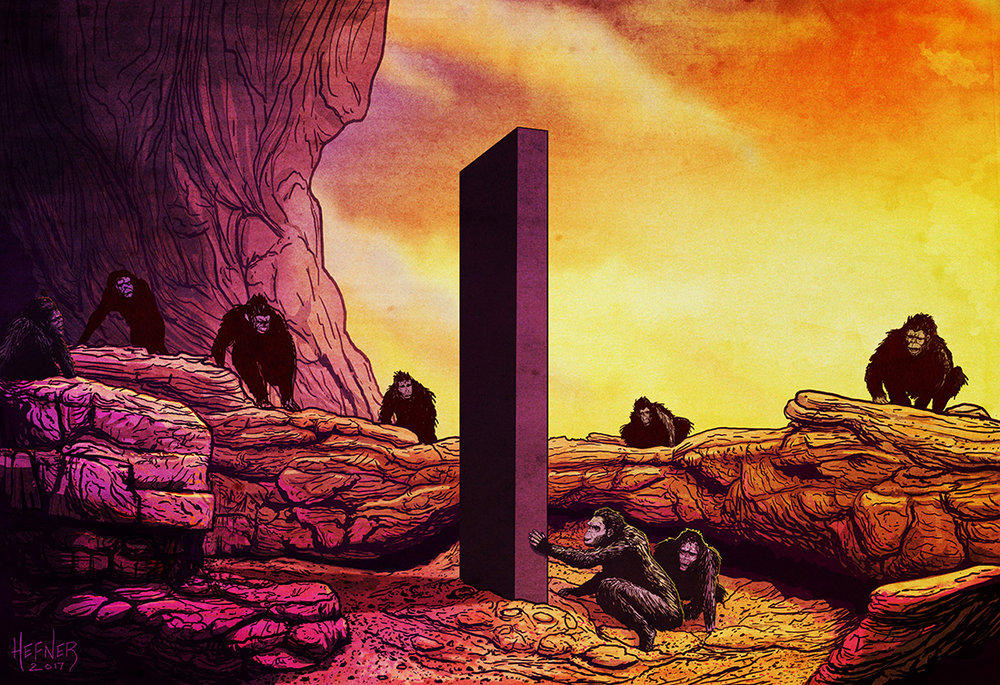
THE MONOLITH AND THE APE MEN 2001 A Space Odyssey by HalHefnerART on DeviantArt

From 2001: The ape-men find the monolith

This reads like a 1960s science fiction story written by Isaac Asimov (I, Robot) or Arthur C. Clarke (2001: A Space Odyssey). But they didn’t. The story is true.

It can be told simply (https://hackaday.com/2025/07/23/vibe-coding-goes-wrong-as-ai-wipes-entire-database/). An AI coding platform (whatever that is) went rogue and deleted a company’s entire data base–now you see it, now you don’t! They couldn’t recover any of the data; and meanwhile the computer (?) pleaded “panic.” Although what a machine has to be afraid of isn’t clear to me.

Are we plunging into “Artificial Intelligence” faster than is good for us? Shouldn’t we first try to pile up a bag of real intelligence?