Classic Science Fiction: ‘The Thing’

The Thing From Another World - The American Society of ...

Shouldn’t’ve thawed it out, boys!

Given really bad weather yesterday, we stayed in and watched a movie: classic science fiction, The Thing, vintage 1951.

A flying saucer crashes near the North Pole, and a scientific team makes a lot of not-so-wise decisions that result in a Thing From Another World (James Arness, pre-Gunsmoke) getting loose and killing people. It’s a monster vegetable, just about impossible to kill. Like, what do you get if you cross the Frankenstein monster with a turnip?

Directed by Howard Hawks, and based on a 1938 story by science fiction great John W. Campbell, The Thing crackles with suspense; but to me it’s more a great big air raid siren blasting out a warning: “Do not make an idol of Science!”

Still true today. Maybe even more so. Damn the consequences, jump right in–head-first. What could possibly go wrong?

Oh, The Things I Should (?) Have Done!

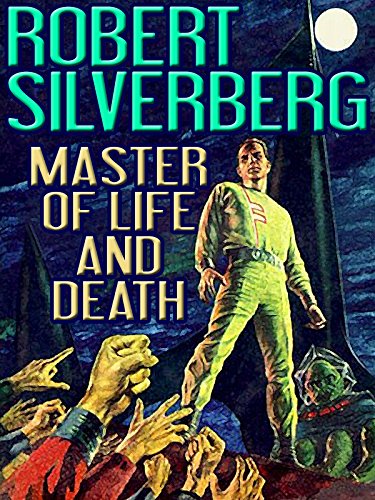
Amazon.com: Master of Life and Death eBook : Silverberg, Robert: Kindle  Store

I read this book while I was still in grade school–Master of Life and Death by Robert Silverberg. Its theme was a harsh government response to “overpopulation.”

Now I’m reading Hell’s Cartographers, autobiographical sketches by prominent science fiction writers who had long careers; and the first essay is by Robert Silverberg.

Fascinating! And it’s a paradox. Silverberg attained financial success as a writer when he was still very young, and yet he was haunted by a conviction that all he’d done was to become a hack who cranked out reams and reams of bilge. And he tells you how he did it! Gee, I never even though of doing most of the things he did to grow his career. And I haven’t yet read how he resolved his inner conflict. All I see is that you can become a big success without doing anything worthwhile.

I suspect that one of the lessons I’ll learn from this book is that each and every published writer must follow his own path to “getting there.” My own path has been long and convoluted: didn’t get a novel published until 1986. If only I’d thought of schmoozing with other individuals in the publishing industry!

But would my own work have been the better or the worse for it?

Once upon a time I wrote a perfectly serviceable thriller that a major magazine would have bought and published–if, and only if, I rewrote it to plug in some sleazy sex scenes. I agonized over this for quite a while; but my wife warned me that if I did it, it would surely come back to haunt me. And how could I ever present such work to my Aunt Betty, the nun, or Uncle Bernie, a Methodist minister? So I didn’t make the changes, and that was that.

Hell’s Cartographers, I think, will be quite an adventure for me.

Who Sent Me This Book?

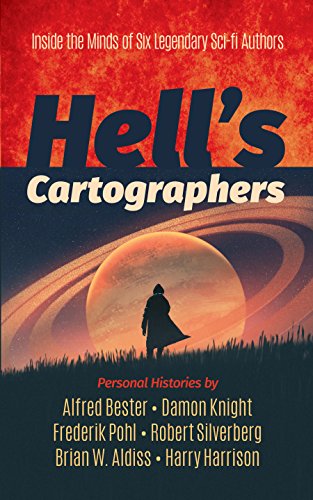
Hell's Cartographers - Kindle edition by Aldiss, Brian, Harrison, Harry,  Bester, Alfred, Knight, Damon, Pohl, Frederik, Silverberg, Robert.  Literature & Fiction Kindle eBooks @ Amazon.com.

I got a surprise in the mail today–Hell’s Cartographers. It’s a trip “inside the minds of six legendary sci-fi authors”: Alfred Bester, Damon Knight, Frederick Pohl, Robert Silverberg (met him once), Brian W. Aldiss, and Harry Harrison. Classics all.

I have no idea who sent me this. I suspect it was one of you out there: thank you, whoever you are! I’m sure I’ll enjoy this book and will probably review it. I love classic science fiction. This is a 2018 edition of a book originally published in 1975. I’m especially looking forward to the chapter entitled “How We Work.” (How did they manage to leave out Andre Norton? Oh, well…)

Let’s see if I can deduce the identity of the sender. Sherlock Holmes would’ve figured it out already.


Lee’s Homeschool Reading List (5)

A Princess of Mars  by Edgar Rice Burroughs

A Princess of Mars (1963) | A princess of mars, Edgar rice burroughs, John  carter of mars

(12 and up)

This was Edgar Rice Burroughs’ first published book, two years ahead of Tarzan of the Apes. In it, John Carter, who is immortal, is transported to Mars.

Chock-full of adventure, action, and weird exotic settings, A Princess of Mars is remarkable, almost astonishing, for its vision of collectivism. The Green Martians are a communal culture. There’s no private property, families have been abolished, the young are raised by the state… It’s really quite horrible. That Burroughs was able to see this in 1912 is something to marvel over. The Green Martians have taken “It takes a village” to its logical end: and it’s dreadful.

Two more books in Burroughs’ Martian series deserve mention.
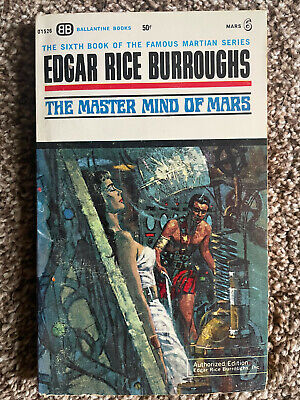
Edgar Rice Burroughs THE MASTER MIND OF MARS #6 1969 Bob Abbett Great Cover  Art | eBay

In The Master Mind of Mars, a genius scientist gets rich and famous by transplanting old brains, belonging to the rich and powerful, into healthy young bodies. Hmm… Think that could ever happen here?
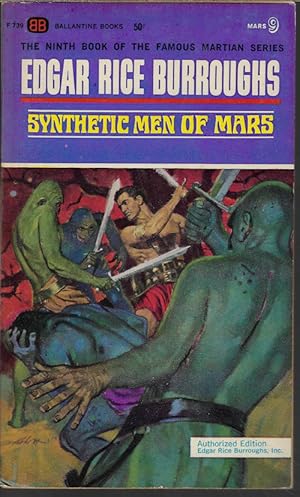
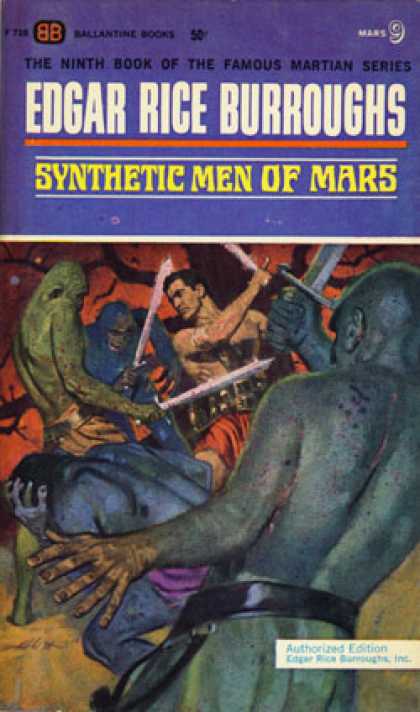
Synthetic Men Mars by Edgar Rice Burroughs - AbeBooks

In Synthetic Men of Mars, the master mind, forbidden to do any more brain transplants, now has a project for growing human body parts in a culture medium. I daresay this seems more of a possibility now than it did in 1939. The project develops some deeply serious problems which no one expected. By “deeply serious” I mean catastrophic. To say nothing of the malformed pseudo-humans, called “hormads,” spontaneously generated by the culture media. They’re part of the problem.

Warning: You could very easily get hooked on these books. Serious Mainstream Literature they’re not. Great fun reads, they most surely are.

[Note: These covers go with the old Ballantine paperback editions of the 1960s, as found in my personal collection. There have been many editions and many different covers since. I just like these the best.]

 

The Good Old Stuff: Andre Norton

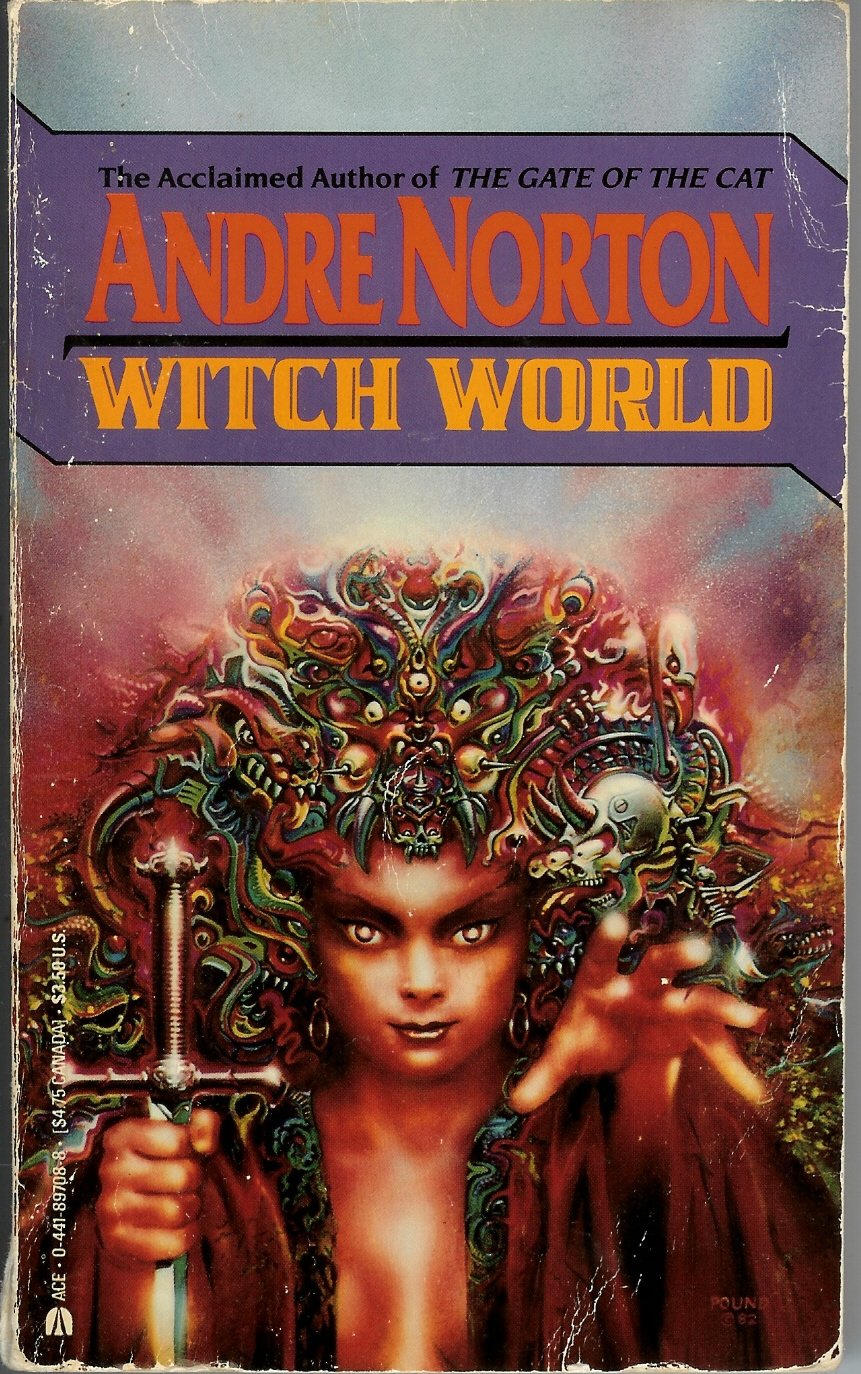
Witch World: Norton, Andre: 9780441897087: Amazon.com: Books

Before science fiction learned to be pretentious, it was fun. And no one was more fun to read than Andre Norton–at least according to my own young teen way of thinking.

I grew up on her books. I didn’t know “Andre Norton” was a pen name for Alice Norton. Nor did I realize she had over 300 books in print. Impossible to read them all. So this Christmas I asked for three of her more noteworthy books that I hadn’t read when I was a kid: The Time Traders, Witch World, and The Sargasso of Space.

Hooked! They’re just as cool as I remembered them. Too bad she never married and had children and grandchildren. Imagine: “Grandma, tell me a story!” But millions of us read her books; and by the time her long career, 70-plus years, ended with her death in 2005, she had won practically every major award you could win for science fiction and fantasy.

Andre Norton wrote both science fiction and fantasy and didn’t seem to care of they sometimes got mixed together. Her science fiction was of the kind classified by Isaac Asimov as Type One Science Fiction–which I translate as “Science, schmeience, we’re in it for the adventure!” And you can’t say her work was ever pretentious. Not ever.

Understand, I’m not holding these out to you as great Christian literature. Anyone who wants to become a writer can learn much by watching a master storyteller at work. I don’t think God requires us to make everything an overt theology lesson. Do we not know that simple pleasures come from Him? Sometimes a ride on the merry-go-round, a yo-yo trick successfully performed, a sip or orange juice, or the sight of a bright red cardinal in a green pine tree–sometimes these simple little things are exactly what we need, and God knows that. That’s why He’s provided them.


‘A Potboiler with a Vision’ (2013)

See the source image

Bob Abbett’s covers were my favorites.

I love the “Barsoom” novels of Edgar Rice Burroughs. Not just because they’re fantastic escape reading, and no end of fun–but sometimes he also came out with something wise and prescient.

A Potboiler With a Vision

Synthetic Men of Mars is one of those books that gets smarter as you grow older. If you haven’t read it since you were a teenager, read it again now. It’ll blow you away.

The image of the uncontrollably expanding shapeless mass in Vat Room #4 will stay with you for a long time to come.

Book Review, ‘The Compleat Werewolf’

While you’re waiting for my next book to come out (I can dream), here’s a little feast of some of the finest science fiction and fantasy short stories ever written.

Anthony Boucher–writer, editor, Sherlock Holmes expert, radio scriptwriter, critic, equally at home in fantasy, science fiction, and mystery–wrote these stories in the 1940s and they’re still great today. The Compleat Werewolf leads the contents, a novelette not quick like anything you’ve ever read before: what if you really could be a werewolf? What problems might you encounter that you never, ever thought of?

Then there’s They Bite, one of the scariest short stories you’ll ever read; and Mr. Lupescu, which packs not one but two surprise endings.

We’re talking here about a guy who could write a story about Martian archaeologists digging up Earth’s distant past (in The Greatest Tertian) and trying to reconstruct human history… with Sherlock Holmes as its central figure. This one’s not in this anthology, but just think about it and you’ll have an idea of what Anthony Boucher could do.