Memory Lane: The Ancient Games My Mother Taught Me

Image result for images of children playing mother may i

We’ve been talking about games kids used to play. Not video games. No–ancient games, most of which involved running or hiding. Games like Red Light-Green Light, Mother May I?, Hide and Seek, Duck-Duck-Goose, and Huckle-Buckle Beanstalk.

We had a lot of kids in our neighborhood and my mother taught us how to play all these games. She was by far the coolest mom on the block. Although Huckle-Buckle Beanstalk was played mostly at school. Remember? Someone–it can be several kids, or just one or two–goes outside the classroom to wait while “It” hides the box of paper clips. Then the others come back in and try to find it. The object must be hidden in plain sight! And spectators are allowed to shout “warm, you’re getting warmer!” or “colder, colder, freezing cold!”, etc., to help the searchers along.

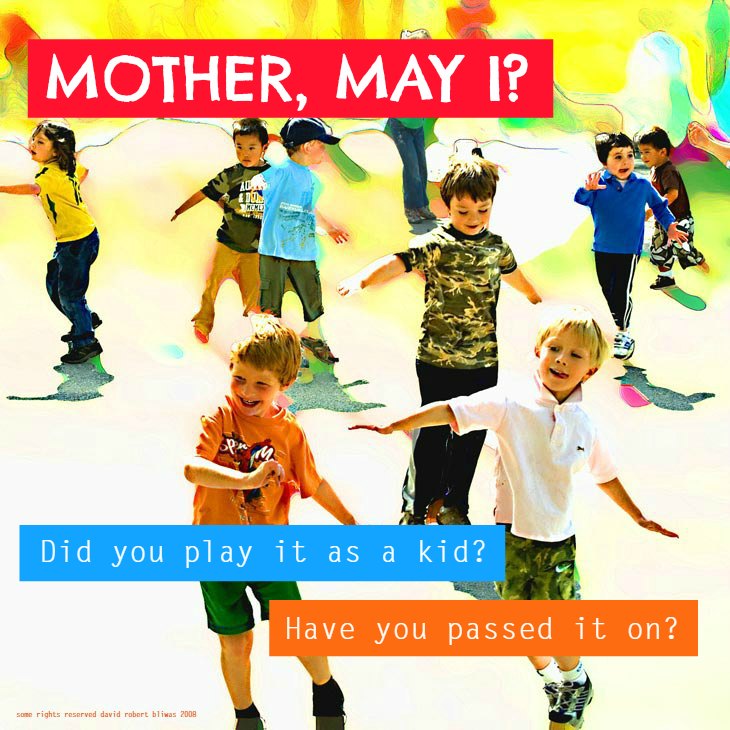
Mother May I? had the other kids asking “It” questions like, “May I take two baby steps?”, or else “It” would volunteer a command, “Johnny, take one giant step.” There were umbrella steps, scissors steps, spinning steps, crab steps–probably as many local variations to this game as there were localities.

These games were folklore, genuine folklore, handed down from one generation to the next. You wonder how far back in time some of them go. One expects to see a picture by the Limbourg Brothers showing peasant children in the background playing a game we’d recognize as Red Light-Green Light. Only of course they wouldn’t have called it that in the 14th century.

I wonder how much longer we can keep this lore.

Oh, I almost forgot–Statues! Players advance stealthily toward “It,” but have to freeze instantly whenever she turns around. Anyone she catches moving has to go back to the starting line. I really enjoyed Statues.

Bonus Post: The White Horse of Uffington

See the source image

Hi, this is Mr. Folklore. Mr. Nature dragged me out of the broom closet to tell you about this.

The Uffington White Horse adorns a hilltop in Oxfordshire, England. It’s some 300 feet long (sorry, I don’t go in for that metric stuff), and was made by digging its shape about three feet into the earth and filling the trenches with crushed chalk. And the people in the area, for hundreds of years, periodically clear it of vegetation and replenish the chalk.

Legend has the White Horse connected with King Alfred, but it was already a thousand years old when Alfred came along. No one knows who created it, or why. Boundary marker? Propaganda? Religious symbol? In the absence of written records, it’s anybody’s theory. All that can be said for sure is that the horse has been there since long before the Romans came to Britain. Its artistic style, though, resembles the somewhat abstract depiction of horses on pre-Roman British coins.

Before there were airplanes, the best way to see the horse was from another hilltop. No one has yet suggested that the horse was carved into the top of a hill so that aliens could see it from their spacecraft. I will not be the first to make that suggestion.

A Clumsy Attempt to Explain Away the Jackalope

Don’t you love it? They show you all these pictures of the jackalope, and then they say there’s no such thing!

Everybody knows there’s a conspiracy to cover up the existence of the jackalope.

Next thing you know, they’ll be telling us there are no centaurs, either.

When everybody knows that centaurism is caused by Global Warming.