Setting the Scene

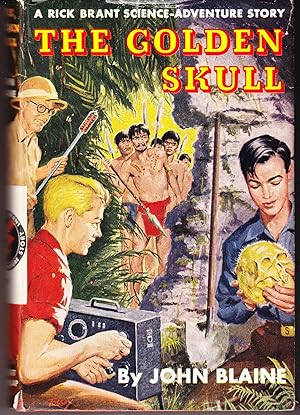
The Golden Skull: Rick Brant # 10 by Blaine, John: Very Good - Hard Cover  (1954) First Edition. | John Thompson

My allergies are annihilating me today. Maybe if I sit outside with a cigar and read The Golden Skull, I’ll find some relief–or at least the illusion thereof.

I don’t know how many times I’ve read this book since I was a boy. I started re-reading it yesterday–and the author’s ability to set the scene just blew me away! He wants you to imagine you’re in the Philippines, and so he puts you there. Effortlessly! Without slowing down the story, without any sense of padding, he smoothly introduces one detail after another… and next thing you know… you’re there.

This is technique of a very high order. Few storytellers can match it.

“John Blaine” was a pseudonym for Hal Goodwin, whose “Rick Brant science adventure” stories helped light up my childhood. And I still admire them today.

If you want to write novels, you can learn a lot from these books. I stand in awe of Goodwin’s ability to seamlessly insert details of the scene into the plot. His book is like a smoothly-running conveyor belt.

I keep on studying these. I learn from my favorite authors. That’s where the learning is.

Raping Your Mind

RICK BRANT #12 "THE ELECTRONIC MIND READER" by JOHN BLAINE | eBay

Remember, ten years ago, a number of TV “reporters”–and Judge Judy, too–suddenly started talking gibberish? On camera, in fact. They couldn’t help themselves. And as far as I know, nobody ever found out what was wrong with them.

In 1957, in a Young Adult “science adventure” novel by Hal Goodwin (dba John G. Blaine), The Electronic Mind Reader, the bad guys get hold of a new technology that enables them to stop scientific projects by scrambling the scientists’ brains. The victims are reduced to spouting gibberish.

Hal Goodwin was in the loop. He’d worked for quite a few different government agencies, traveled the world, and knew a lot of people high up on the ladder.

So what had he heard of, or glimpsed, in 1957 that inspired him to write that book? Which seems a particularly scary little book today, now that big-name Scientists are talking about hatching a new technology that will allow them to put stuff into someone’s brain without cutting him open. Or take stuff out. And–get this!–they describe it as “reading” the subject’s brain. As in The Electronic Mind Reader.

Using technology wisely, we can all become sock puppets. The only question to be asked is… whose?

Are they, uh, daring God to intervene? Does that ever turn out well?

I think they are. Whether they know it or not.

‘When TV Personalities Spout Gibberish’ (2015)

Once upon a time, in 2011, a number of TV nooze reporters, live and on the air, uncontrollably spouted gibberish. It also happened to Judge Judy while she was taping a show. They rushed her to the hospital for extensive testing, but could find no cause for why, for a brief interval, nothing would come out of her mouth but nonsense.

https://leeduigon.com/2015/01/21/when-tv-personalities-spout-gibberish/

This happened to different people in different locations. The only thing they had in common was that they were all on television at the moment. But then that was what made it so visible. If it happened to somebody at home, who would ever know?

To this day, the mystery has not been solved.

Aging Your Characters

As my Bell Mountain books go on, I find myself forced to acknowledge the fact that my characters are getting older. It just snuck up on me. I remember when the kid who starred in Lassie had to leave the show because he was growing a mustache and talking like Steve Reeves.

Well, I’m stuck with it now, and my two original protagonists, Jack and Ellayne, are just going to have to keep on getting older until they grow up (if the series runs that long). I missed my chance to dodge the issue.

What are my options now?

1. Stay with all the original characters and let them age naturally–at the risk of losing a big part of my small audience. I could let them grow up physically while remaining completely immature, but I don’t think my publisher would like it.

2. Replace these kids with other young protagonists as needed. Yeah, that would work. Only I’m attached to my original characters and would hate to part with them. But yes, new kids are going to have to come along.

I missed my chance to go with characters who never age, no matter how many books wind up being in the series. There are a few ways of doing that.

In his “Rick Brant Science Adventure” series that ran for some 20 years, J.G. Blaine (aka Hal Goodwin) simply ignored the whole issue. Rick, Scotty, and Barbie remain teenagers throughout the entire series. In fact, none of the regular characters ages at all. And readers didn’t seem to mind. Same with the Hardy Boys and Nancy Drew, come to think of it–teens forever.

When Agatha Christie first introduced Hercule Poirot to the reading public in 1920, in The Mysterious Affair at Styles, she presented him as a retiring police detective whose best days were behind him–a man of about 60. Little did she dream that she’d be writing about him for the next 50 years! She is said to have calculated that Poirot must have been some 130 years old when he finally died. While she was writing about him, she had to ignore the age issue. Again, the readers didn’t seem to mind.

Edgar Rice Burroughs tried to explain why his characters never seemed to age, not wanting anyone to remark that ERB’s need for money seemed to be as evergreen as Tarzan. So David Innes didn’t age because there was no means of telling time in Pellucidar, at the earth’s core. It would be hard to get around the treetops in a walker, so Tarzan didn’t age, either, and neither did his wife, Jane–the result of secret immortality pills invented by the Leopard Men. And John Carter of Virginia and Barsoon was just plain immortal: always was, no telling how or why.

I think I could have gotten away with not aging any of the Bell Mountain cast and crew, provided I’d stuck with it from the beginning. But it’s a decision the writer of a series has to make from the git-go.

Once the kids in your story start growing up, you really mustn’t try to make them stop.