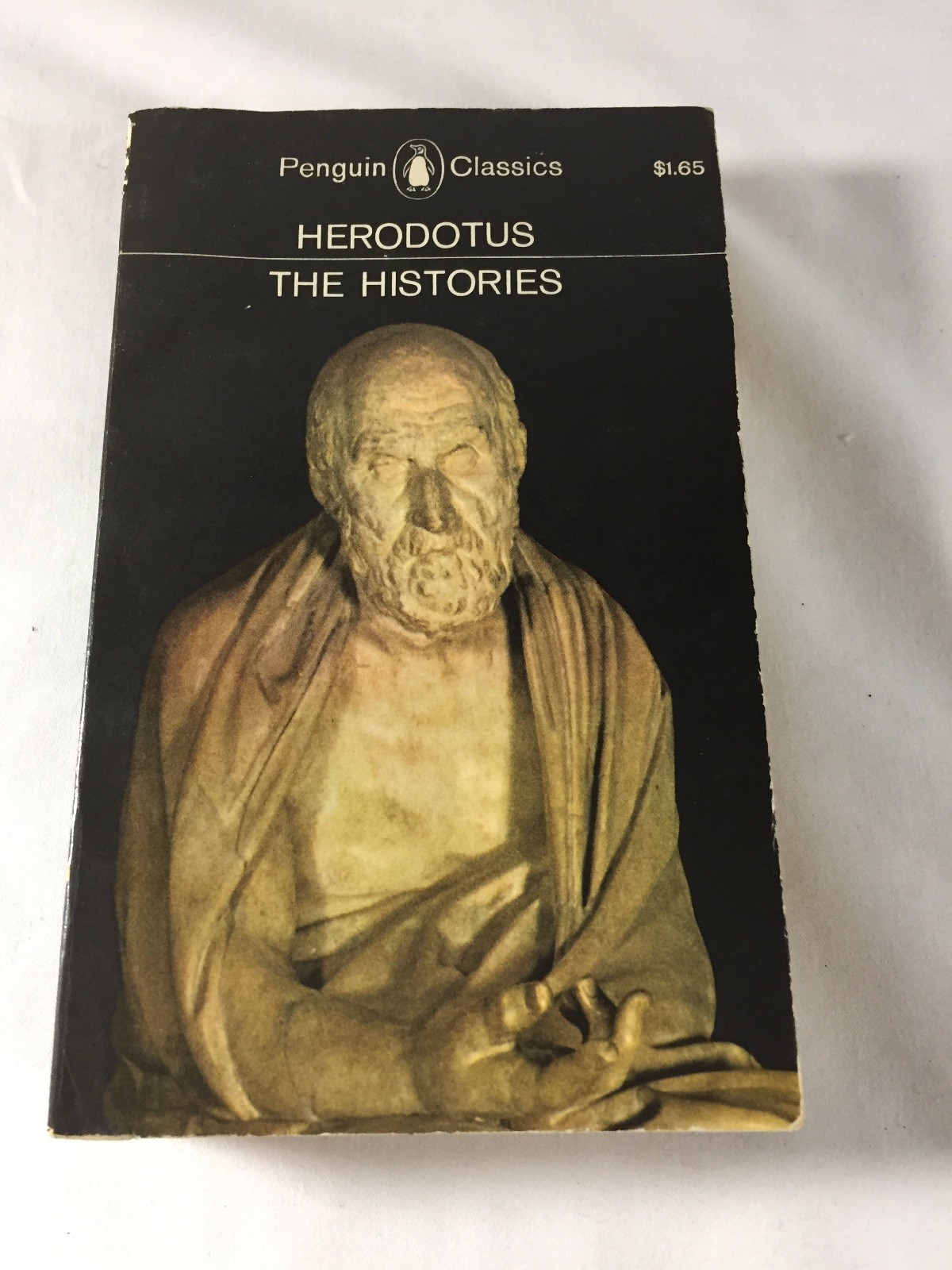
A Very Different World

I’ve been reading Herodotus again, who died in 425 B.C. after writing his comprehensive history of the wars between the Greeks and Persians–part history, part travelogue, all entertainment: that’s why it’s been in print for 2,400 years.

The thing that strikes me most powerfully is how unimaginably different his world was from ours. As widely traveled as he was, Herodotus had no idea of lots of things we take for granted. His world was bounded on the south by the Sahara Desert; on the east by the Indian desert; on the north by cold countries where feathers fell from the sky; and on the west by the Strait of Gibraltar. Beyond those boundaries, nothing was known for sure.

North of the Alps, north of the Danube River, Herodotus’ Europe might as well have been on Mars. Those unknown countries–Britain, Germany, Scandinavia, Eastern Europe, Russia–were said to be inhabited by giants, monsters, dog-headed people, and headless people with eyes in their chests. “I do not vouch for the truth of those accounts,” he admits.

I love reading about the giant ants the size of terriers, from which enterprising Indians stole gold dust, the squeaking “troglodytes” hunted by Libyan nomads, the fantastic treasures stored in assorted public places, and the know-it-all oracles whose advice is never understood but always turns out to be right; and colorful historical characters like Cyrus and the other Persian kings, rich Croesus, wise Solon, and all the rest.

Herodotus repeated so many tall tales that it harmed his reputation; Plutarch called him not “the father of history,” but the “father of lies.” But some of the tallest tales–which Herodotus said he didn’t believe, but were worth writing down as he heard them–have turned out to be shockingly true: like the Carthaginian mariners who circumnavigated Africa 2,000 years before Bartolomeo Dias did it, and the Sarmatians’ women warriors who weren’t allowed to marry until they’d killed an enemy in battle.

His was a colorful, crazy world. And you couldn’t find a MacDonald’s anywhere in Scythia.

Good News! Iranian Christianity Fastest-Growing in the World

See the source image

They’ll seize your Bible, throw you into prison, tear down your church, and maybe kill you–and yet Iran has the fastest-growing Christian community in the world today (https://churchleaders.com/news/288330-story-irans-church-two-sentences-mark-howard-the-gospel-coalition.html?fbclid=IwAR0-1KM_hnSACWu1SACPTxF17Aje8U-O1Qn14af476K-4QlJWfpNJzIZElw), according to Churchleaders.com.

And that’s not all. The country with the second-fastest Christian growth is Afghanistan.

Why is this happening? Two chief reasons are mentioned: the Iranian people have grown increasingly disgusted with their Islamist government’s addiction to violence and cruelty; and grass-roots evangelism has been very effective in Iran. If you subscribe to The Voice of the Martyrs, you already know that.

In fact, Christianity in Iran has grown more in the last 20 years than in the previous 13 centuries put together.

I am sure that God remembers that it was Cyrus the Persian, in obedience to His will, who freed God’s people from captivity in Babylon and commanded that God’s Temple be rebuilt.

Now, maybe, it’s time for the people of Iran to be set free.

‘Does God Use the Lesser of Two Evils to Advance His Kingdom?’

See the source image

This is a thought-provoking essay by missionary Roger Oliver, published this week on the Chalcedon blog:

https://chalcedon.edu/blog/does-god-use-the-lesser-of-two-evils-to-advance-his-kingdom

Before we know it another presidential election campaign will be upon us–actually, it’s already started–pitting President Donald Trump against some socialist wack-job put up by the Democrats. And once again we’ll be hearing from “the Righteous Candidate or nobody!” crowd.

Consider King Cyrus, founder of the Persian Empire, whom God through Isaiah called His “anointed.” Cyrus was not a Jew, not a believer, but God raised him up to greatness; and he served God by restoring the Jews to their homeland and commanding the rebuilding of the Temple. I’m not the only one who sees a bit of Cyrus in our current president.

Cyrus had his faults. He developed a bad cases of conqueror’s syndrome, and at the end it got the better of him. Reaching for too much, he lost all–even his life. But his service to God lived on after him.

I was going to vote for Trump in any event, given the alternative. But I’m very glad I cast that vote–and I don’t think many people truly appreciate what God spared our country when he raised this man to be our president.

I don’t call him God’s anointed. Donald Trump makes no such pretensions. “[T]hat,” writes Mr. Oliver, “distinguishes Donald Trump from his predecessor.”

And how!