Memory Lane: Electric Baseball

See the source image

My brother and I got this toy for Christmas once, sometime in the Fabulous Fifties: Tudor Electric Baseball.

The ball was a tiny white magnet which you “pitched” with a kind of catapult, aiming for a tin sheet representing the batter. Behind the sheet sat your opponent, who, when he heard the ball stick to the other side of the screen, smacked his side with a spring-operated plastic bat. If the ball landed on a circle marked “hit,” he flicked a switch and these little plastic guys with strips of celluloid on their bases ran around the basepaths, accompanied by a loud buzzing sound as the whole gameboard vibrated energetically. The basepaths were thick cardboard guides. Without them, the runners would have dashed all over the place in a kind of brownian movement.

If this sounds complicated, that’s only because it really was complicated.

Our friend “thewhiterabbit” had an Electric Football game. He soon gave up trying to make any sense of it.

Colorforms Baseball, which we also tried, had no electricity–only a dial on a spinner which, when spun, would stop either on an out or some kind of hit.

I have a feeling this toy cost my parents a fair amount of money. We dutifully played it until the day we somehow lost the ball. It was a very noisy game, and lots of times you’d smack the tin sheet and the ball would just fall off and you’d have to have a do-over. Or sometimes you’d smack it and the ball would just stick there.

But it’s the thought that counts!

Memory Lane: The Remco Bulldog Tank

This toy was a hot item in 1960, and my brother, then eight years old, got one for Christmas: Remco’s Bulldog Tank. Battery-powered, its mighty caterpillar treads would take the tank up and down steep hills of my mother’s books, all the while making a not entirely hopeful wheezing noise. Our family’s home movies show it doing that while my brother watches in angelic rapture.

Best of all, it shot! Boom! Well, not “boom,” really. It went “click.” It fired these plastic projectiles and ejected brass shell casings. Y’know something? I don’t think I’ve ever seen a tank in a war movie eject a shell casing. But they must have, right? I mean, you can’t have the turret filling up with shell casings.

I wonder if they still make toys like this for kids–or do they try to make out like there’s no more war, we don’t need tanks to protect us from the bad guys anymore? Meanwhile, the same children deemed too emotionally fragile for a Bulldog Tank spend hours every day playing Zombie Massacre video games. Go figure.

Bonus Video: Fli-Back!

Wow! Remember these? Wooden paddle (usually with a picture of a cowboy on a bucking bronco), rubber ball, and rubber band–the classic Fli-Back toy. How many times could you hit the ball up and down before you lost control?

My Grandma bought me many a Fli-Back when I was a boy, but I never got the hang of it until much later in life. Maybe the lady in this video can say the same. I still have a Fli-Back in one of the kitchen drawers somewhere, although I think the cats batted the ball out to that place from which no little rubber ball returns.

Memory Lane: The ‘I Dare You’ House

Image result for images of haunted house

Patty and I were watching Salem’s Lot yesterday, and as soon as they showed the haunted house, Patty said, “That’s what we used to call an ‘I dare you!’ house.”

I knew exactly what she meant. Every town used to have at least one “I dare you” house–an uninhabited house said (by kids, mostly) to be haunted. As in, “I dare you to go into that house,” or “I dare you to go upstairs/down the cellar,” etc.

Once upon a time the finest haunted house in our town was called “the 1868 house.” Wow–1868! Ancient! Probably Egyptian hieroglyphics on the walls. Trilobite fossils on the floor. It never occurred to us that there were people still around who were alive in 1868. And it looked like an 1868 house should look. It had turrets. And a stone wall around the grounds, and the grounds all overgrown with saplings and bushes, with piles of grey lumber marking all that was left of assorted sheds and outhouses.

One day my friend Ellen and I dared each other to enter the 1868 house without Bobby, her big brother, who usually led these expeditions. To do this without Bobby was an act of incredible audacity. But who could afford to chicken out, and lose face forever? It was a grim duo that mounted their bikes that afternoon…

Well, we did go inside. To say our nerves were tightly strung would be an understatement.

As quietly as we could, we crept into a room that looked like it might have once been a kitchen. At the other end of it, a door was open to a passage filled with darkness. It must have led down to the cellar. Dark as night down there.

“I dare you to go down those stairs!” Ellen whispered to me.

“I dare you to do it!” I whispered back. Hey, we were 11 years old: we knew what would happen. That’s where the freakin’ ghost comes swooping up the stairs as swift as the wind–and gets you.

I forget which of us took the first tentative step in that direction, and I can’t honestly say what I thought I saw coming up those stairs. All I can say is that we both shrieked simultaneously and broke several Olympic speed records charging out of the house, leaping onto our bikes, and pedaling back home faster than a pair of speeding bullets. It must have been a serious scare, because I never once muttered to Ellen, “Chicken!”, nor did she ever accuse me of desertion in the face of heaven knew what. I don’t think we ever told Bobby about this adventure.

But of course the 1868 house is long gone, replaced by half a dozen modern homes; and whatever walked there then, walks elsewhere now.  (Hat-tip to Shirley Jackson: “And whatever walked there [in Hill House], walked alone.”)

Memory Lane: ‘Whiplash’

In 1960 something new appeared on America TV: Whiplash, a western, if that’s the right word, set in Australia.

It should’ve been a hit. The star, Peter Graves, had been a success with Fury, a great kids’ show about a boy and his black stallion. Graves would go on to have a huge hit with Mission: Impossible, but at the time, Whiplash didn’t seem to do much for his career. Maybe because the British and Australian co-producers spent a fortune to film the series in Australia, but Graves insisted on filming much of it in a studio once they got there.

Much of the show was written by Gene Roddenberry, who went on to become famous for Star Trek.

You’d think the exotic locale, stories of adventure in the Outback during the Great Australian Gold Rush of the 1850s, and episodes featuring many of Australia’s most successful actors of the era, would have propelled the show to the TV hall of fame. But it only ran for two seasons, 1960-61. Critics are kinder to it now than they were then.

It even had a cool theme song. What’s not to like?

Well, I liked it! I was eleven years old, I’d been a Fury fan for years, and this show made me want to go to Australia and see the kangaroos close up.

I have yet to meet anyone else who remembers it, though.

Memory Lane: ‘Supercar’

Back in 1962, all the 8-year-olds in my neighborhood ran around singing the theme song from Supercar, a kids’ TV show starring wooden puppets. Anybody out there remember it? C’mon! Mike Mercury behind the wheel of Supercar! You don’t remember that?

Watch carefully, then see if you can answer the question, “What’s wrong with this picture?” I mean, talk about cutting corners on a special effect–!

My brother had a model of a car that, like Supercar, was supposed to ride on downward-thrusting jets of air rather than wheels. You made it do that by blowing through a rubber tube. Alas, no one in my family had enough wind to lift the car. There it sat, immoveable. *sigh*

Memory Lane: Now They Tell Me!

See the source image

In 1953 somebody invented a toy submarine that would dive and surface if you filled it with baking powder. In 1954 it became available as a “free inside” prize in Kellogg’s cereals.

Oh, I couldn’t wait to get my hands on one of these! Only now I find out that you had to put baking powder in it–not baking soda! Baking soda won’t work. The sub will just sit there in the water, usually floating on its side. You know a submarine’s in trouble when it’s floating on its side.

Confound it! I know now what I did wrong. My father did it wrong, too. He filled the kitchen sink, put the dratted baking soda in the sub, and presto–nothing. We tried again and again, and the blamed thing never worked. Well, waddaya want for “free inside”? At least the cereal worked.

The confusion between baking powder and baking soda was so widespread, the WikiPedia article on this toy takes some pains to explain it. But there was no WikiPedia in 1955.

I’ve mistrusted submarine travel ever since. Thank goodness the Navy knows the difference between baking powder and baking soda!

‘Your Old Toys Are Worth Big Bucks’ (2014)

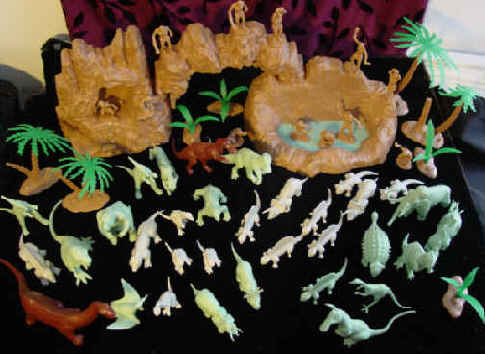
Image result for images of marx dinosaurs

The Marx dinosaur play set. Mine was an earlier, simpler version. But look at all the dinosaurs and cavemen!

I have to think about this. The dinosaur play set my father said we couldn’t afford, back circa 1960, cost $5. It contained many toy dinosaurs. Now, just one of the smallest of those little plastic dinosaurs sells for $5. All the dinosaurs and cave men in the set, sold individually, would fetch several hundred dollars–several times what my father was earning per week at the Ford plant. And that was a good job!

https://leeduigon.com/2014/01/25/your-old-toys-are-worth-big-bucks/

I keep these toys because they remind me of the people who gave them to me: my grandparents, aunts and uncles, and my mother and father are all gone, but I can still feel their love. When I handle one of these, it calls up sunny days in the sandbox.

Besides which, I still think these were really cool toys.

Memory Lane: Football for Kids–Without Adults

Image result for images of children throwing football

Riding my bike this morning, after a solid week of rain, I saw kids playing football–flag football, organized by adults and under adult supervision.

Ain’t the way we played football.

Yes, we followed the sports seasons; so about now, at this point in the year, the kids in my old neighborhood would be changing over from baseball to football.

Without uniforms, without a scoreboard, without coaches, helmets, parents in the stands, or sponsors. Without having to try to get our names in the sports section of our local paper. Just kids playing football, with only three, four, or five kids to a team. And five was a lot. Three was more likely, and sometimes we played with just two.

We played for as long as we pleased. The best yard for it was Mrs. Thomas’ yard, which had no trees, and she didn’t mind us playing there. The only hazard was her oil tank, up against the back of the house. I remember one time when my friend Ellen caught a pass for a touchdown, but couldn’t stop. Boom! Right into the tank. But kids were tough in those days, and after a few brief moments, she was able to continue.

Sometimes we played tackle, sometimes two-hand touch. We had no goalposts, so field goals were out. We had special rules. “No dumping the hiker,” otherwise hiking the ball to the quarterback would be a thankless job that no one wanted. If we were playing touch, we made a rule that you could lateral to yourself and the touch wouldn’t count if the ball was in the air. We would have loved to try a flying wedge, but there were never enough kids for that. Usually we ruled that the defenders, or defender, would have to count to three or four before charging across the line of scrimmage to grab the quarterback. And we had to be careful of the rose hedge that separated my yard from Mrs. Thomas’.

There was no adult to lay down rules, so we made up our own, kept the ones that worked, and forgot about the ones that didn’t. The games went on for hours and hours, and I don’t remember anyone ever getting hurt, beyond a scrape or a bruise or two.

Playing on our own taught us innovation, cooperation, negotiation and compromise–none of which are to be found in organized sports. I’m afraid it didn’t teach us to be docile citizens awaiting the decisions of authority. My parents only laughed when I mentioned joining the Pop Warner league. “You’d hate it!” said my mother. And I see now she was right.

We played as our parents played when they were kids, and it was golden.

I’ll bet they let you play like that in Heaven.

Memory Lane: My Uncle’s Dog

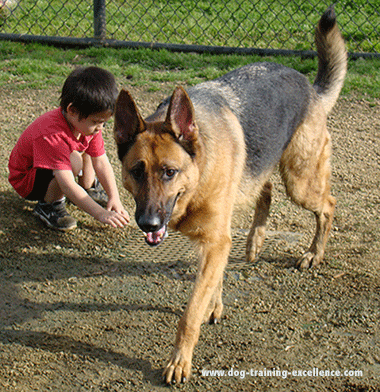
Image result for images of german shepherd barking

Our family was a close one, and on weekends there was always plenty of visiting back and forth.

Often we went to see my Uncle Ferdie, my father’s kid brother, who was approximately twice the size of my father, who was no stripling. Ferdie enlisted in the Marines in World War II, but because he looked like a recruiting poster come to life, they packed him off to Puerto Rico to be an admiral’s chauffeur. Later in life he became an inventor with RCA, with a ton of patents to his name. But I digress.

Uncle Ferdie had a German shepherd named Shep, who always barked like crazy when we visited. I was kind of afraid of dogs and I was very afraid of Shep, who was bigger than me. I should have reasoned that with a house already full of little girls, Ferdie was unlikely to keep a dangerous beast that would eat children. But at seven or eight years old, my reasoning powers were limited.

I don’t know what finally persuaded me to approach Shep: temporary insanity, maybe. Imagine my astonishment when Shep proved that he only barked so much because he loved children and wanted to make friends. This gigantic ferocious dog just loved me! So from then on I joined my cousins in playing with Shep. I guess I knew, instinctively, that my uncle wouldn’t have anything in his house that would hurt me. Well, he did have a .22 rifle, but we never saw it until we were old enough to shoot safely, under his supervision. That was just way cool.

The lesson I learned from Shep was that appearances can be deceiving–in this case, very deceiving.