I don’t know about you, but just listening to these birds carrying on makes me want to laugh, too.
Mr. Nature here, with proof that God does have a sense of humor. He must have, or He wouldn’t have created kookaburras.
Although found only in Australia, the kookaburra’s distinctive loony laughter was a staple in every jungle movie and TV show for decades–and for all I know, still is. The jungle can be in Africa, South America, India, or the Caribbean, it doesn’t matter where–no matter where it is, you hear the kookaburra. Tarzan, Sheena, Jungle Jim, Ramar–they all went about their business with the kookaburra in the soundtrack.
Mr. Nature here–and to this day I have never seen a luna moth. I have to settle for video.
Here’s one that got rained on and needs to dry out before it can fly again. Meanwhile, it seems perfectly content to rest on this man’s finger and have its picture taken.
God creates beauty, for His own pleasure and for ours.
(Note: “Lunar” is an error. It’s “luna,” not “lunar.”)
I have always loved that exquisite moment when the setting sun turns the water of the bay to molten copper: God’s own handiwork, a masterpiece. The greatest of artists, God never needs to sign His work.
In Bell Mountain No. 5, The Fugitive Prince, Wytt entertains himself by catching and eating lacewings, which people in Obann call “fairy flies.”
But he really shouldn’t, because lacewings are about the most beneficial insects you’ll ever meet. Their larvae eat all kinds of plant pests and parasites, and the adults pollinate your garden. Plus they’re exquisitely, delicately beautiful. You can buy lacewings to release in your garden; their services are always in demand.
You’ll see in the video how the female lacewing lays her eggs on silken stalks to protect them from getting eaten by predators.
And the adults have lovely golden eyes.
This is Mr. Nature, and this is more of God’s stuff.
This video shows all of the chameleon’s highly-specialized assets at work.
Lots of mammals have prehensile tails, but chameleons are the only lizards that have them. Wrapped around a branch, the tail anchors the chameleon’s “firing platform.”
Its toes are bunched together into “mittens” that are ideal for a powerful grip. If you don’t believe me, let a chameleon climb your bare arm. No other reptile has this feature.
Its body is vertically flattened for easy passage through thick foliage.
Then there are the chameleon’s eyes, each one packed into a turret and capable of moving independently. The lizard can look in any direction without having to move its body. And the eyes can bring the prey into very sharp focus.
Many lizards eat insects, and most of them have to accomplish that on the run, and by being quicker than their prey. But the chameleon, thanks to its projectile tongue, can attack while it’s still too far away for the insect to perceive it as a threat.
Finally, we have the chameleon’s famous ability to change color and blend in with its surroundings.
Do you honestly believe that each of these special abilities, all of them, “evolved” by pure chance over kazillions of years?
Wanna buy a bridge?
This is Mr. Nature, celebrating God’s amazing handiwork.
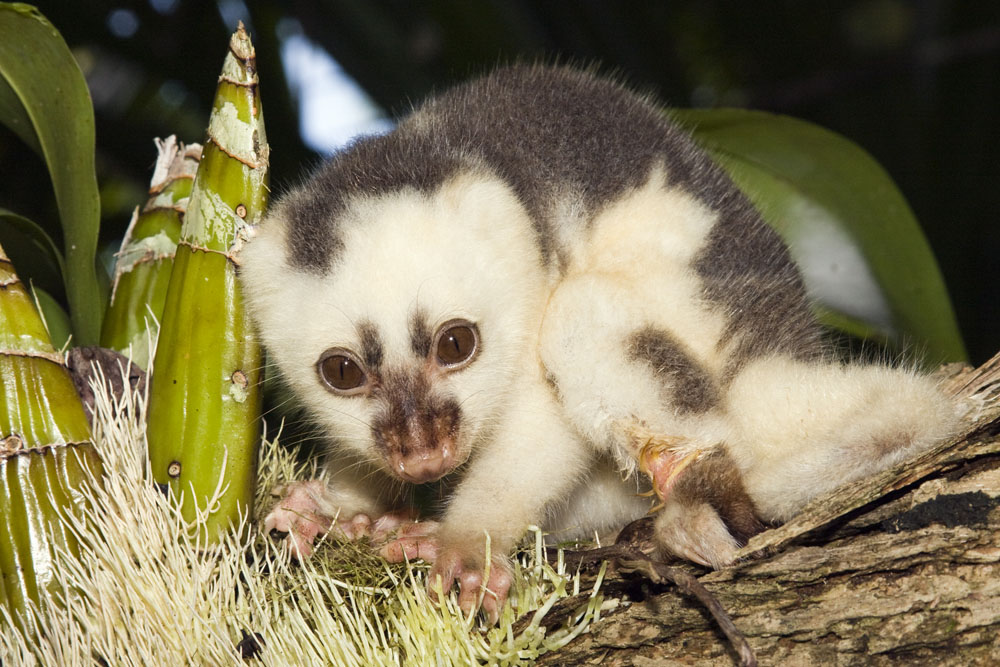
I’ve wondered about this animal ever since I saw it in a picture book when I was six or seven years old. It’s called a cuscus–“common spotted cuscus,” if you want to be formal–and it’s hard to look up in the Internet because the computer keeps trying to direct you to “couscous,” which is something altogether different.
The cuscus lives in trees in the jungles of New Guinea and mostly comes out at night, when it’s difficult to see them: they’re very shy. There are also a few in Cape York, Australia. They have prehensile tails, very similar to a chameleon’s.
Byron the Quokka has been dropping subtle hints about being able to do his contest-runner job better if a cuscus might be hired to assist him. “You just want more pictures of cute animals to pump up viewership,” I parry. “So that’s a bad idea?” Well, he’s got me there. Anyway, if you can’t trot out a cuscus or a potto now and then, what’s the point of blogging?
Fantastically varied realms of nature brought to you by God the Father, who created it all.
Our day today got off to a bad start with an illness scare, plus an invasion of flies, but by and by it settled down and we didn’t have to rush to the emergency room.
Meanwhile, “Unknowable” sent us this video, which has a very soothing effect. I’m convinced these moments, captured on video, give us a foretaste of what our God has in store for us when He finishes His work of restoring the Creation.
Jambo! Mr. Nature here; and today our safari takes us no farther than the nearest pond or patch of moss.
Tardigrades, aka “water bears” because they look sort of like little tiny bears, are only a millimeter long; but they may be the toughest living things on earth. They can survive inside a live volcano, in the depths of an iceberg, or even for 10 days in outer space without oxygen or any of those other amenities we take for granted under the atmosphere. When they go dormant, they can last–well, maybe forever. But just add water and they’re back in business!
I discount the speculation that tardigrades originally came here from outer space. The same God who created the Baluchitherium, coral reefs, Tyrannosaurus rex, and Mozart shouldn’t have had any trouble creating water bears. Trouble, no: fun, yes!
Jambo! Mr. Nature here; and today our safari takes us to an unexplored corner of Lintum Forest, by way of the Triassic Period. It will feature in Bell Mountain No. 13, The Wind From Heaven, which I’m writing now.
Behold Tanystropheus, with its improbably long neck. This fossil was so weird, that when its first pieces were discovered, the scientist thought it might be wing bones from a pterodactyl. But eventually enough pieces were found to yield the reconstruction pictured above.
How did this animal live? There’s nothing even close to it around today, no living creature to compare it to. Did it squat on the shore and use its long neck as a kind of fishing pole? There aren’t enough bones in the neck to make it very flexible. So the answer is, we just don’t know.
Up here in Outer Jersey we’ve had a dark, cold, rainy spring, and I had begun to worry that maybe this time our lightning bugs would sit it out. But this past week they have returned.
Jambo, Mr. Nature here, and I don’t know anyone who doesn’t like seeing fireflies light up a spring or summer night. As kids we used to catch them in jars and put them in our bedrooms at night, only to find them dead in the morning.
A few facts: they’re not flies or bugs, but soft-shelled beetles. Only the males fly around, flashing on and off to attract potential mates. The females remain mostly in safe places on the shrubbery or grass, signaling back. There are thousands of species of lightning bugs around the world, but they all do pretty much the same thing.
More of God’s stuff–and He has outdone Himself this time, creating beauty.
A world without these creatures would be very poor indeed.