A Not-So-Fluffy Puppy

Hi, Mr. Nature here with a critter from another world–the mud puppy.

These big salamanders keep their gills all their lives, and although cold-blooded, they seem to thrive in a really chilly environment. Their legs aren’t much for propelling them efficiently when on the land, but these puppies are fast and graceful swimmers. They’ll eat whatever live food they can catch, and have been known to plague ice fishermen.

Why am I showing you this hideous creature? Well, I’m fascinated by these animals. They’re God’s stuff, and they move me to reflect on the infinite options available to God as He was creating the world. It didn’t have to be the world we know today. Fossils show us there were once amphibians, like the mud puppy, as big as crocodiles.

The next time we question what God did do, we might also spare a thought for what He might have done–but didn’t.
The Honey Guide

No, it’s not a catalogue. It’s a wild bird that has a business relationship with the human beings in its neighborhood. (Thanks to Mike S. for sending us this video.)

Hi, Mr. Nature here. I don’t remember when I first learned about the honey guide. It was either in a “Mark Trail” Sunday color comic strip or one of those Golden stamp and coloring books.

But this bird is really cool. It will lead people to a beehive so they can collect the honey. In return, they share with the bird. This is not something that they teach the bird, so we wonder how the bird learns it. My guess would be from its parents. I’m not interested in any Darwinian fairy tales about “instinct” and “survival strategies.” It’s interaction between people and a wild bird.

It’s God’s stuff, and we love it.

Another Weird Dinosaur

Image result for images of mononykus

See? No hands!

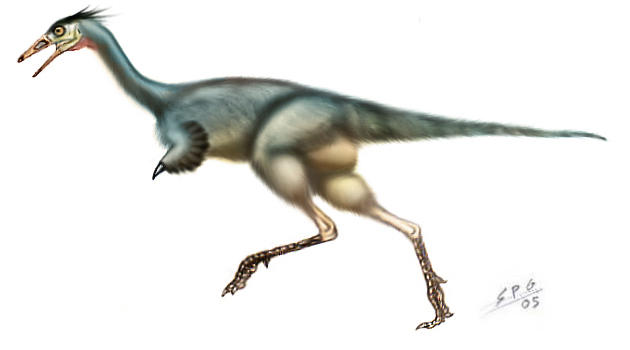
Poor Mononykus! First they had to change the spelling of its name, because a beetle (!) had already been named “Mononychus.” Then they had to change its original identification as a fossil bird. All in all, a most confusing critter ( https://www.newscientist.com/article/mg13818712-900-science-mongolias-early-bird-fails-the-flight-test/ ).

Hi, Mr. Nature here–and to me the most confusing thing about Mononykus is why any scientist would ever have thought this animal–with its very long neck and very long tail–would have lived the lifestyle of a burrower. That has kind of gone by the boards, recently, but for a while there, you had any number of scientists saying, more or less authoritatively, that “Mononykus was a burrower.”

See, Mononykus had extremely short, but muscular, arms–but no hands. Instead of hands, its forelimbs ended in sharp and stubby spikes.

How could it ever have burrowed without its long neck getting in the way? So now the leading opinion is that Mononykus used its extremely strange forelimbs for tearing open termite mounds for yum-yums.

And so we have another prehistoric puzzle which God has given us. We can’t say He didn’t give us plenty of material in which to exercise our brains.

How Do Flies Live Through Winter?

Image result for images of housefly in winter

Hi, Mr. Nature here, to shed a little light on something that may have perplexed you. I know it’s often puzzled me.

It’s winter, one freezing cold day after another–and then an unseasonably warm day comes along, and before you know it, there are houseflies buzzing around outside. How can that be? Where do they come from? ( https://www.abchomeandcommercial.com/blog/where-do-flies-go-during-winter/ )

Most flies have a lifespan measured in days, seven to ten. So the fly you see in February hasn’t been hiding out since Thanksgiving. But they do lay eggs before they die, and some of these eggs can hatch in the winter, if given the chance. And fly larvae may emerge from cocoons. Thing is, there are so freakin’ many flies, and they lay so freakin’ many eggs, that a few of them are bound to survive no matter how long and harsh the winter is.

Chances are that the adult flies you see outside on a warm day in January or February have been… well, hanging out somewhere in your house. Your home is heated, and insects who can get in have a decent chance of making it through a cold snap. And they do get in! Even if it’s just a tiny gap in your aluminum siding, to a bug it’s shelter from the cold.

I have to keep reminding myself that God would not have created flies if they didn’t somehow serve His purpose. In this case it’s kind of hard to know His purpose; but whatever that purpose may be, you can be sure He hasn’t forgotten it.

Cardinals and Snow

Hi, Mr. Nature here–what what goes together better than red cardinals and white snow? This video, which has the quality of a live Christmas card, is from Oklahoma.

Cardinals and snow: this is God’s stuff, and it tells us, in so many different voices, “God is nigh!” Listen: you can hear it.

Fun Stuff God Has Done: the Diplocaulus

Hi, Mr. Nature here, with some more of God’s stuff that pushes our imaginations to the limit.

This ancient amphibian is Diplocaulus, with its unforgettable boomerang-shaped head. It has left behind abundant fossils, so we have a pretty good idea of its life cycle, its diet, the way it moved, etc. This is one of those prehistoric animals that you only have to meet once, for it to stick in your mind.

Feel free to ignore the narrator in this video. He’s a little bit too certain about things.

There is a famous picture of a Diplocaulus in a bucket, as if the animal had been caught by a fisherman. There is no reason to believe the photo is anything but a fake. Very nicely done, though!

Image result for images of diplocaulus in a bucket

So there probably are no more Diplocauluses for us to see in the flesh, and we’ll have to make do with fossils for the time being… Until the Lord regenerates His whole creation. And won’t that be something!

Where Do They Go?

Image result for images of deer in snow

Hi, Mr. Nature here. I didn’t see the deer today when I went out to look for them. That’s not unusual. Sometimes you see them, sometimes you don’t.

What is unusual is the whole idea of rather large animals so successfully concealing themselves in rather small spaces. This is the suburbs, where I live. The few remaining woodsy patches are very small indeed. So how do they do it? How do deer make themselves, for all practical purposes, invisible?

It’s simple, really. For one thing, deer excel at staying perfectly still. If they’re doing this even in a little bit of underbrush, it makes them very hard to see.

For another, their color blends in with the leaf-litter on the ground. And finally, they are experts at picking out the best hiding-places, and they’ll move around from one to another. Where they hide today is probably not going to be where they hide tomorrow.

And they don’t need much. Just little patches of cover. There might be three deer hanging out in your suburban back yard and you’d never know it.

How God provides for them, under what seem like such adverse conditions, is truly wonderful.

Not Quite an Elephant

Hi, Mr. Nature here–with another animal that I wish I could have seen in the flesh.

Deinotherium was a kind of elephant, but very different from the elephants we’re used to. Well, maybe you’re not used to elephants at all, but you get my point. Its tusks grew out of the lower jaw instead of the upper, and nobody’s quite sure how the animal used them.

But one thing we are sure about was that Deinotherium was big–bigger than today’s elephants, almost as big as a Baluchitherium. Unfortunately for those of us who are interested (like me), no one ever painted or carved or drew a Deinotherium from life: at least, no pictures were made in any kind of artistic medium that has survived. So we’ve got the skeletons, but that’s all: the rest can only be guesswork.

God created a lot of cool animals, many of which aren’t with us anymore. We don’t know why. Then again, He could always bring them back someday. He has the whole universe at His disposal.

Spiders in the Sea

Hi, Mr. Nature here–and here are some critters which most of you have never heard of, let alone thought about.

“Sea spiders” aren’t really spiders. In fact, scientists aren’t quite sure what they are, exactly. There are thousands of species of them, all over the world–but who noticed?

Look at them closely, and you’ll wonder how they can live. They seem to be mostly a bunch of disembodied legs. It’s even more surprising to learn that the male sea spiders take care of the eggs and hatchlings. Where is the brain on this thing? Where are the vital organs? Well, just sort of stuck on, here and there.

I find them interesting as a very little-known detail of God’s creation, which is more complicated than we can possibly imagine. We’ll never know the whole of it; but that only adds to the pleasure we can take from it.

The Return of the Hellbender

The Toledo Zoo is working to re-establish America’s biggest salamander in the wild, through captive rearing and release.

Hi, Mr. Nature here–and I am a hellbender fan. You’ve gotta love a salamander that starts out looking like a little black newt that you might buy in the pet store, yet can grow to the size of your hand and forearm. In fact, it has a close relative in Japan that can grow to the size of a 12-year-old boy.

But the hellbender needs to live in cold, clear, clean, swiftly-running water, and streams like that are getting hard to find. Progress, you know! Gotta build them condos everywhere! Happily, a lot of private property owners in Ohio are getting behind the zoo’s efforts to conserve the giant salamander.

Some salamanders are gorgeous in bright colors. The hellbender is not. Some salamanders are cute. Most definitely, the hellbender is not.

What the hellbender is, is just way cool. Only God could create something as cool as this. If you find this animal ugly, maybe even a bit scary–well, it’s still way cool.

I am glad  conservationists are working to actually conserve this salamander.

If only our leaders who call themselves conservatives would actually try, at least, to conserve our culture… we might have a chance.