Never Existed… then Went Extinct

Aliwalia | Dinopedia | Fandom

Keeping up with dinosaur discoveries is probably more work than actually making the discoveries.

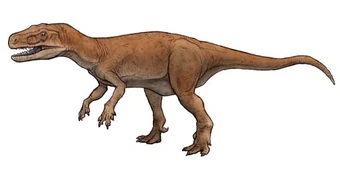
Back in the Nineties I enjoyed reading about Aliwalia rex, the super-predator of the Triassic Period, already as big as an Allosaurus long before carnivorous dinosaurs had actually sorted themselves out. It lived in South Africa and ate everything.

Imagine my recent disappointment when I learned that Aliwalia rex… is no more. Worse, he never was.

See, they found this great big leg bone, and a jawbone with some sharp teeth in it, and a scattering of other bits and pieces; and acting under the presumption that all these pieces came from the same animal, they cobbled together a super-predator the like of which no one had ever suspected could possibly have lived in the Triassic. Wow! Carnivorous dinosaurs got terrifyingly huge right from the git-go!

Well, they looked again, and now it’s been decided that those pieces don’t belong together, after all: so much for the super-predator. He struts and frets his hour upon the stage and then is heard no more. Except his part got written out of the play before he ever got to play it.

I don’t mean to make fun of paleontologists. Their field of study naturally lends itself to human error. They do the best they can.

But I sometimes think they take too much upon themselves. The Mesozoic Era, the Age of Dinosaurs, scientists have divided into three periods–Triassic, Jurassic, and Cretaceous. These are pretty much arbitrary terms. No dinosaur ever turned to another and said, “Dude, don’t you get tired of living in the Triassic? Why couldn’t we live in the Jurassic?”

The Triassic is fun because nobody’s quite sure what to make of it. The discovery of Triassic pollen was a shock. They repudiated the Triassic bird footprints, so that embarrassment has been dealt with, for now.

But if you can cobble a dinosaur together out of unrelated parts, and call it real, and put it into textbooks–well, how hard can it be to cobble together a Triassic Period? Or even a whole Mesozoic Era? The modern discovery of soft tissue in dinosaur fossils will lead us–where?

Sure, you can find literally hundreds of Centrosaurus fossils, and for that species you don’t have to do much cobbling. But so very many dinosaurs are “known” only from a single bone, a tooth, or a chip of broken bone. It doesn’t stop speculation from running wild. I don’t blame scientists for that. Where’s the fun in paleontology, if you don’t let your imagination loose?

But hard, fast, solid, incontrovertible, settled science… uh-uh. Not even close.

Out of Ideas?

Confused Cat Images, Stock Photos & Vectors | Shutterstock

Let’s see… Gotta shop for groceries this morning, I wonder how many stores we’ll have to visit, to get what we need for the week. Gotta bring my car home from the garage. Write a Newswithviews column (good luck with that, dude!). And somehow generate blog posts.

But posts about what? Honk if you’re totally sick and tired of reading about some stupid virus that Red China unleashed on the world and now hopes to get away with. Is anybody’s appetite for virus nooze so insatiable that they even have to get it here?

We watched a really scary movie last night. I suppose I could review it. That might be fun. Anybody up for a movie review?

Dinosaur news? Aliwalia rex is no more. Blow me down. He was never anything but bones from several different dinosaurs mistakenly cobbled together. Devastating, isn’t it? The super-predator of the Triassic never existed. Next thing we’ll find out, the Triassic never existed, either.

Maybe I’ll write about that.

But first the quest for groceries…

The Tanystropheus–at Last!

See the source image

Hi, Mr. Nature here, with that Tanystropheus I would’ve shown you yesterday if I’d only remembered to do it.

This was one of the most unusual creatures ever to walk the earth. Supposedly it lived in the Triassic Period–which was less a real thing than it is merely a way for geologists to talk about earth history. Anyway, there are no more Tanystropheuses.

Marvin (I thought it needed a shorter name) was about 20 feet long, and 10 feet of that was just his neck. Marve is often depicted with this snaky neck that can practically tie itself into a sheepshank, but that would have been impossible: there were only 12 or 13 bones in that long neck, severely limiting its flexibility. A giraffe has only seven neck-bones, and you see what they have to go through if they want a drink of water. Marvin’s neck would have been almost as stiff as a giraffe’s.

He’s also depicted, often, as living mostly in the water–probably because scientists just don’t know what to do with him on land. We have no evidence for this. Some of the fossils suggest a lot of muscle in the pelvic area, which would have counterbalanced the weight of the neck. But how this animal actually lived is a mystery to everybody. Don’t be too hard on paleontologists for not having figured it out. There are lots of things in the fossil record that no one will ever figure out.

What did God do with these strange and spectacular animals He created–the ones that aren’t here anymore? Well, frankly, we don’t know: He hasn’t made it known to us.

Maybe someday He will.

A Bird With Claws

We can worship God in many ways; and one of those ways is by enjoying and marveling at His handiwork. No matter which way we turn, the work of His hands is in front of us. It testifies to Him, and we do well to listen.

Hi, Mr. Nature here. Behold the hoatzin, a bird that lives in the Amazon rain forest. Its babies are like no other bird in the world–baby hoatzins have claws on their wings, which they can use to climb and crawl and grasp, and sometimes get themselves out of trouble.

Oh, but we’ve seen birds with claws! Well, fossils of ’em. Archaeopteryx had claws on its wings. It also had a beak full of teeth, which the hoatzin doesn’t have. But maybe the hoatzin is the last of the Archaeopteryx tribe.

(If you look closely at this famous Archaeopteryx fossil, you’ll be able to see it had claws on its wings, just like a baby hoatzin.)

Yes, I know, the Evolution crowd will climb all over this. “See! See! Birds evolved from dinosaurs!” Please ignore the perfectly modern-looking bird tracks discovered in Argentina in rocks supposedly dating from the very beginning of the age of dinosaurs. And under no circumstances trouble yourselves with the Protoavis bird fossils from the early Triassic.

We are at liberty to ignore those people.

As we are at liberty to enjoy the Lord Our God in his handiwork.