An Appreciation: Churchill

Image result for images of winston churchill

In 1931, while visiting New York, Winston Churchill very nearly died in an auto accident.

Think about that: World War II with no Churchill. I’ve begun to re-read William Manchester’s Alone, the middle volume of his three-book biography of Churchill. It focuses on the run-up to the most catastrophic war in human history–a war which Churchill, practically alone, saw coming, saw the risks involved, and tried to move the Western world to avert calamity.

This maddeningly eccentric man, steeped in the Victorian Age with all its moral standards, all its virtues and its vices, became, at the age of 65–retirement age!–prime minister of Britain in 1940–with France fallen, the Third Reich triumphant everywhere, Stalin allied with Hitler, and the British army, minus all its heavy equipment, just barely saved from extinction by its mass evacuation at Dunkirk.

Think of a world without Churchill. Who else could have rallied Britain to fight on? Who else could have given the speeches, made the decisions, absorbed the punishment, and not only preserved his country, but led it to victory against a force that will be remembered forever as the most evil, ruthless power ever to arise in Europe? Who else could have survived a decade of political isolation, enmity, mockery, and massive disbelief of everything he said?

Churchill’s career reminds me of how a classical Japanese smith makes a peerless sword. He starts with a heap of scrap iron that no one else wants, melts and hammers it into a single rod, then folds it back upon itself and hammers it out again. Then folds, hammers, folds, hammers, over and over again, so that the steel will be in microscopically thin layers–hundreds, sometimes even thousands, of them. Heat, fold, and hammer. Heat, fold, and hammer. And at the end, much later, the product is a perfect sword that can cut through almost anything.

In Churchill’s case the smith was God, and all that folding and hammering was God’s way of forging one man into an instrument that would preserve an entire civilization. The work took many years, but God is patient.
 

‘Adeste Fideles’ (Bing Crosby, 1942)

Think what it meant to sing this Christmas carol in 1942.

The United States and Britain were losing World War II. France was conquered. the next Germany offensive was expected to finish off Russia. No one would have been much doubted, if he predicted that no one but bloodthirsty dictators would come out of this war on top: a world given over to Hitler, Stalin, Mussolini, the Japanese warlords, Mao Tse-tung. Lights out.

This is the world into which Jesus Christ entered in the flesh. Because God intervenes in history, the lights that went out in 1942 were turned back on. Because Jesus Christ is King of Kings and Lord of Lords, we dare to sing to celebrate His birth, we dare to hope, we defy the powers of this fallen world.

Sing, sing, and sing louder!

A State that Came up Short

Do you know who this is? It’s Pu Yi, the last Emperor of China, the last of the Ch’ing Dynasty–that is, the Manchurians who conquered China centuries before–and the one and only figurehead of the short-lived, never entirely real country of “Manchukuo.” This was a puppet state set up by the Japanese when they seized Manchuria from China in 1932. It was dissolved at the end of World War II in 1945, with Pu Yi packed off to China as a political prisoner, as told in the movie, The Last Emperor.

Stamps are fragile, flimsy little bits of paper that can tell us much. Sometimes they’re all the storms of history may leave behind. There is no Manchukuo today: hardly anyone in the Western world is aware that it ever existed.

But it did, it did. And that’s what makes stamp collecting such a cool hobby.


Movie Classic: ‘A Matter of Life and Death’

Image result for images of a matter of life and death movie

We watched a film classic yesterday: A Matter of Life and Death (1946), also known as Stairway to Heaven.

David Niven plays a WWII British pilot who is killed in action when he’s forced to bail out of his plane without a parachute. But for reasons that aren’t made quite clear, even though he’s supposed to die, he doesn’t.

His arrival in “the next world” is delayed by 20 hours, during which time he falls in love with an American girl (Kim Hunter). Because he has hallucinations about a “conductor” who is trying to move him on to the next world (only they aren’t hallucinations, are they?), he comes under the treatment of a neurosurgeon (Roger Livesey).

Ultimately he has to have a trial in the next world to see whether he can go on living or have to die, after all.

Now, this is an extremely creative and entertaining movie, but no one ought to watch it expecting a theology lesson. The Christian viewer has to have his wits about him, because the “next world” in the movie might be Heaven, but if it is, it’s an interfaith mish-mosh of Heaven in which pretty much anything goes, doctrinally: Plato and Mohammad, for instance, are set on the same plane with Moses and Our Lord Jesus Christ. It’s no use getting offended: this movie is a romantic fantasy, whose theme is the great power of love.

The war was still going on when production of the film began; and if you’re too young to have seen it for yourself, you need to know that World War II had its hand on everything. No one could get away from it. The war permeated every aspect of life, for everyone. Those of us who didn’t live through it ourselves might find this rather hard to grasp; I know I do. I find I don’t quite like it. But maybe that’s because I wasn’t there. Slightly older persons tell me there was something quite good about everybody being on the same page, every day. But it’s hard for me to imagine.

“The next world” is full of Allied soldiers and airmen, but no Germans or Japanese. A British or American audience of 1946 would have been scandalized to see any of the enemy in those scenes.

Anyhow, it’s something different, with a witty screenplay, high-quality acting, and will give you a few things to think about.

An Amazing Historical Surprise

Betcha didn’t know the youngest son of Benito Mussolini–yes, that Mussolini!–had a long and successful career as an internationally-recognized jazz pianist and jazz trio leader. And here’s a bit of his music to prove it.

One critic joshed that Romano Mussolini, as musician, “made the refrains run on time.”

One of the dictator’s granddaughters is a big wheel in Italian politics and has served in the European Parliament.

I find this kind of hard to take in. How about you?

Here Come the Torpedoes

I grew up on World War II movies. My father served in it, and so did the fathers of most of the kids I knew, and TV played a lot of newsreel footage from the war: so it was very real to us who had only been born four or five years after the war ended.

I still think in terms of WWII imagery, sometimes. Like now.

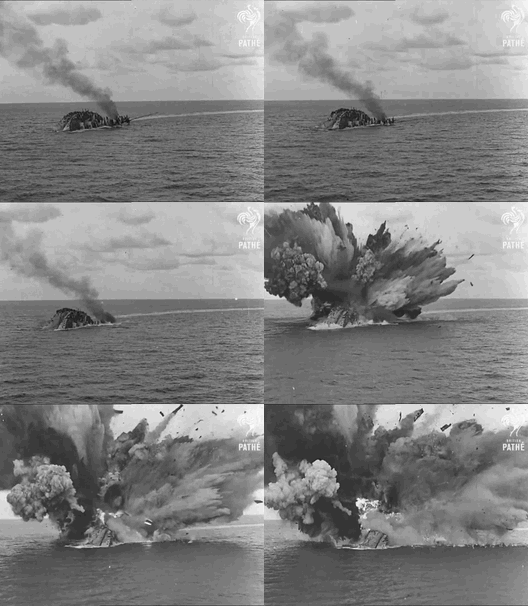
I see the United States as a great ship separated from her protective convoy, with the U-boat wolf pack closing in. They’ve got her in their sights. The periscopes are trained on her. And then the U-boat captains launch the torpedoes.

“Fire one!” Allow illegal immigration, amnesty for millions of illegal aliens–and freebies, too.

“Fire two!” “Gay” rights and same-sex parodies of marriage. Take down the family, and you take down the nation. And you can use it as a hammer against Christianity, too. Both family and Christianity are obstacles to the absolute dominance of the state.

“Fire three!” Race-baiting from the top down. Politicians, teacher unions, hard-left college profs all trying to stir up violence. Liberals will never let the races live in peace.

“Fire four!” Transgender movement. “Fire five!” The Global Warming hoax, a biggie–biggest science fraud in history. “Fire six!” Feminism. “Fire seven!” “Eight!” “Nine!”

The water now is full of torpedoes, all streaking toward the great ship’s waterline. Their wakes scratch harsh white lines over the grey surface of the sea. Even if the ship takes evasive action, there are now too many torpedoes homing in on her, she can’t possibly escape.

And then the explosions. Boom! Boom! Boom! One after another.

Only then do the U-boats surface, to machine-gun the survivors.

That’s current events today.