Is There Another Narnia Novel?

Image result for images of bbc chronicles of narnia

Once a king or queen in Narnia, always a king or queen in Narnia

My friends and I were excited, back in 1964, when a new Edgar Rice Burroughs novel came out–15 years after his death. It was unearthed among his papers.

And of course “new” works by J.R.R. Tolkien came out pretty regularly, rescued from oblivion by the author’s son, Christopher.

But what I want to know is: did C.S. Lewis write another Chronicle of Narnia that has not yet been discovered among the vast amount of papers that he left behind? And we’ve also heard that he meant to go back to the published Chronicles and make certain corrections.

A blog called A Pilgrim in Narnia ( https://apilgriminnarnia.com/2016/07/06/linkscsl/ ) has a list of “lost” C.S. Lewis writings that have been recently published; and there’s still a great deal left that has to be sifted through. Letters, notebooks, ideas for stories or novels or lectures, some poetry–there is a raft of material that Lewis, like his friend Tolkien, never got around to publishing in his lifetime.

If there were an eighth Chronicle of Narnia, what would it be? I know I’m not the only one who’d like to see how Queen Susan ever got back to Narnia. In The Last Battle, she is missing: she has given up Narnia. But Aslan did say, “Once a king or queen of Narnia, always a king or queen of Narnia.” So either he’s wrong, which is not possible, or else there was another Narnia novel that badly needed to be written. In fact, some of C.S. Lewis’ legion of fans have already tried their hand at it: but I think it needs the master’s touch.

Is that story still hidden in a pile of unpublished material? No expert seems willing to bet on it.

But I wonder. Yes, I wonder.

C.S. Lewis’ Literary Art: Narnia

One of the things that makes readers keep coming back to The Chronicles of Narnia, whether they are consciously aware of it or not, is C.S. Lewis’ understated but uniquely effective writing style. The words you choose to put on paper, and your skill in arranging them, has a lot to do with how your story is received. I’m afraid many aspiring writers don’t pay enough attention to this.

In The Voyage of the Dawn Treader we encounter a boy named Eustace Scrubb, one of Lewis’ most memorable characters. Eustace is an obnoxious little prig who has an awful lot of growing up to do.

But first we meet his parents.

“He didn’t call his Father and Mother ‘Father’ and ‘Mother’, but Harold and Alberta. They were very up-to-date and advanced people. They were vegetarians, non-smokers and tee-totallers, and wore a special kind of underclothes. In their house there was very little furniture and very few clothes on beds and the windows were always open.”

Does that not tell you, in a very few well-chosen words, everything you need to know about Eustace and his upbringing? Is it any wonder that he’s such a twerp, and thinks so highly of himself?

No one ever beat C.S. Lewis for packing so much pertinent information into such a small paragraph.

Some writers don’t tell you enough, and so the story and the characters never come alive. And some tell you way too much, and bog the whole thing down.

I guess a lifetime of reading, studying, discussing, and writing about great literature wasn’t wasted on Mr. Lewis.

You’ll never be able to imitate him, but anyone who wants to write a novel can surely learn from him.

C.S. Lewis and The Deplorable Word

In the hall of Charn’s dead kings and queens, Queen Jadis returns to life. But she hasn’t learned her lesson.

For me, one of the most memorable scenes in C.S. Lewis’ Chronicles of Narnia occurs in The Magician’s Nephew when Digory and Polly travel to a world called Charn and find it completely dead. No blade of grass, no drop of water–all dead, all dust.

In the dead city of Charn they find a hall of perfectly preserved dead kings and queens of Charn. How did this happen?

Two queens, sisters, both of them incredibly powerful witches, battled each other to become the supreme ruler of all of Charn. There’s always someone who wants to become the Supreme Ruler of Bloody Everything. On the point of losing the war, Queen Jadis utters a spell, The Deplorable Word, which wipes out all life on Charn. Another spell, inadvertently activated by Digory, brings her back to life so she can go on to become the White Witch, supreme tyrant over Narnia, where she made it “always winter, but never Christmas.”

This was written in the 1950s, when fear of a world-destroying nuclear war was a new thing, and very real to many people. World War II was also fresh in memory. Can there be any doubt that Hitler, cornered in his bunker, would have spoken The Deplorable Word, if he’d had it?

When the Serpent seduced Eve with his “ye shall be as gods” snake-oil, he tapped into a fatal aspect of human nature that remains with us today–the desire to be, like God, supreme ruler over everything. But God has promised that honor to His Son, Jesus Christ; and instead of a Deplorable Word, God says, “Behold, I make all things new” (Revelation 21:5)–thus highlighting the difference between a righteous, loving God and sinful, fallen man.

The lust to rule the world is still with us, in spades–in the U.N., in Washington, D.C., in Brussels, in ISIS, among the Global Warming mob, and liberally strewn throughout the minds of intellectuals.

But God is with us, too, and His word shall prevail.


A Brief Defense of C.S. Lewis (and Narnia)

Tom Baker as Puddleglum in the classic BBC production of The Silver Chair… One of my favorite Narnians

I still get comments from Christians who think The Chronicles of Narnia are rubbish and their author, C.S. Lewis, just two shades short of being an out-and-out pagan.

Well, his friend, J.R.R. Tolkien, warned him: put all those fauns and centaurs and river gods in Narnia–and Bacchus, of all things!–and readers are going to think there’s something not quite right about your Christianity. Worse, in the Narnia finale, The Last Battle, he has the old Professor say, “It’s all in Plato!” I love these books, but that line makes me cringe.

Nevertheless, I am here to plead with Narnia-knockers–please, give the man a break! He was an academic, surrounded by other academics along with college students. He could have just as easily wound up worshiping a box of rubber bands. That he had any Christianity at all is cause for celebration.

There is Christian gold in Narnia. It’s not hard to find. If you don’t care for it, only a fool tries to convince someone that he ought to like something that he doesn’t like. But at least grant me this:

For a man who started out as an atheist and was a college professor for most of his life, old “Jack” Lewis did just fine.

Fantasy Novels That Didn’t Quite Make It

Someone, I think it was Mickey Rooney, once said, “If I have seen farther than others, it’s because I’ve stood on the shoulders of giants.”

But sometimes you can do all right standing on the shoulders of midgets, too.

Here are a few old fantasy novels you’ve never read and never heard of,  but which have nevertheless inspired some very famous novels.

The Hamster, the Alchemist, and the Sock Drawer by G.M. Karz was almost certainly the inspiration for C.S. Lewis’ Chronicles of Narnia (starting with The Lion, the Witch, and the Wardrobe); but in Karz’ case, the various elements of the story never quite came together. There’s something unconvincing about a hamster that inspires awe, and a whole public school class of 12-year-olds accidentally entering another world while putting Limburger cheese in the headmaster’s sock drawer.

A Game of Throneberry, by Imhotep B. McGonegal, tries to re-interpret the 1962 New York Mets’ baseball season as Shakespeare’s plays about the Wars of the Roses. The Mets in 1962, their first season, lost their first twelve ballgames. Then along came Marve Throneberry and they got it together to win 40 games while only losing 120. But I dunno: presenting Marvelous Marve as a kind of modern-day Richard III, drowning poor Elio Chacon in a great big barrel of wine hidden behind the set of Kiner’s Korner–really, I can’t imagine what Mr. McGonegal thought he was doing. Inspiring today’s Game of Thrones franchise?

In The Slobbit, Prof, B.Y.O. Boose created a fantasy world centered around extremely slovenly little people called Slobbits. A Slobbit named Bulbo accompanies a group of leprechauns on their way to slay a dragon. It’s difficult because Bulbo is always losing things. Scholars believe this little-known tale prompted J.R.R. Tolkien to write The Hobbit. Could be, could be…

Last but not least, we have The Wizard of Pfudd by Priscilla Chumply, an obscure 19th century fantasy that introduced the whole idea of an entire nation being duped by a fraudulent wizard–although poor Miss Chumply undermined her own work by writing all the dialogue in garbled Classical Greek. Many modern masters of fantasy have been inspired by Pfudd, but none have ever admitted to it.

Some Wise Words from C.S. Lewis

Here is a quote that just jumped out at me this morning, as I was reading the “Christian Marriage” chapter in Mere Christianity, by C.S. Lewis.

“[M]ake sure that you are judging me by what you really know from your own experience and from watching the lives of your friends, and not by ideas you have derived from novels and films. This is not so easy to do as people think. Our experience is colored through and through by books and plays and the cinema, and it takes patience and skill to disentangle the things we have really learned from life for ourselves.”

Wow! And he wrote that before we had television, comic books, and video games to confuse us even more.

In Don Quixote, Cervantes wrote of a man going totally bonkers just from all the silly books he read. But Lewis is not talking about popping your cork. No–he’s talking about not being able to tell the difference between the inside and the outside of the bottle anymore, or even to realize that the bottle is there.

What do any of us know that we really only know from television?

If that thought doesn’t make you want to cling to God’s word with both hands, for all you’re worth, I don’t know what will.

Can Satan Be Tempted to Do Good?

Can the Devil be tempted to do good, instead of evil?

That’s a question, so I hear, which may be addressed by the new devil-friendly TV series, Lucifer Morningstar. I’m not looking to give them free publicity, so after these remarks I’ll shut up about it.

Before Hollywood screenwriters can grapple with this question, they ought to demonstrate that they know the difference between good and evil–something which is very much in doubt. Most of their output indicates that they have mistaken one for the other.

In an age of rampant Biblical illiteracy, Hollywood is more illiterate than most. Just look at their product. Not that everything they produce is pure toxic slime: but an awful lot of it is nothing else.

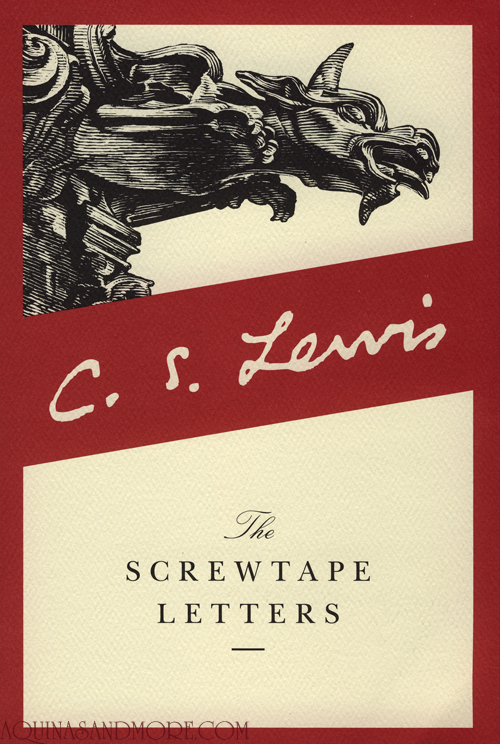
In his classic, The Screwtape Letters, C.S. Lewis wrote a whole book from the viewpoint of a devil. What do you want to bet none of the Lucifer Morningstar crowd ever read it?

There’s nothing a TV series will be able to do better than C.S. Lewis has already done it.

All Out for Narnia

There’s a bus that will take you to Narnia in time to help Peter and Edmund stand against the White Witch. It’d be nice if there were another bus that could bring them here to help us against our own wicked witches: but then, as Aslan might say, “You have looked, my child, but you have not seen. Look again!”

Or perhaps the Prophet Elisha put it even better, when he and his servants were surrounded by the chariots of the king of Syria: “Fear not: for they that be with us are more than they that be with them.” But the servant couldn’t see what Elisha saw, so Elisha asked God to open the young man’s eyes: and he saw; and, behold, the mountain was full of horses and chariots of fire about Elisha. (2 Kings 6:14-17)

You board the bus to Narnia, needing no money for the fare, just by opening the book, or starting the tape, or even looking into your mind instead of looking out: because that’s where the bus stop is. Usually the bus is already there, waiting for you.

Now there’s not much point in going to Narnia except to see the Lion, Aslan. In our world He has another name: Jesus Christ the Son of God, Our Lord and Savior. Sometimes here in this complicated, fallen world, our vision grows dim and we don’t see Him. For some of us, a visit to Narnia and a glimpse of Aslan is all it takes to get our eyes focused back on Jesus.

They that be with us are more than they that be with them.

God said it, so it’s true. The chariots of the wicked will exist for not a moment longer than God allows them to exist. They glory in their imagined power, as the White Witch gloried in hers.

All aboard!

The Next Narnia Movie (Maybe): ‘The Magician’s Nephew’

First it was going to be The Silver Chair, but everything got shuffled around and now the next Narnia movie’s going to be The Magician’s Nephew–or so it seems ( http://teaser-trailer.com/the-magicians-nephew-movie/ ). Really, I just can’t keep track of it anymore. But they’ve got a movie poster ready for it, even though they can’t give us a release date. Not this year, and probably not next year, either.

Whoever is actually working on the movie now–guys, could you please get this one right?

(While you’re waiting for them to get it right, sit back and enjoy this rendition of the theme music from the BBC-TV Narnia productions of the 1980s–still the gold standard for bringing Narnia to the screen.)

The first three Chronicles of Narnia movies of the 21st century didn’t do all that well at the box office, and no one in Hollywood seems to know why. Allow me to enlighten them.

Yo, the movies underachieved because:

a) You guys kept messing around with the stories, and the changes you made were never for the better. Never.

b) You’re afraid of C.S. Lewis’ forthrightly Christian message, so you kept soft-pedaling Aslan, which was to miss the whole point of the stories.

c) You don’t seem to think your audience is capable of appreciating the stories as C.S. Lewis wrote them, so you keep trying to shape them to what you think is the taste of a dumbed-down, text-messaging, doofus audience.

Like many, many others, I want these movies to succeed; but so far the movie-makers have been their own worst enemy.

But we should be thankful they haven’t taken the books down with them.

My Second-Favorite C.S. Lewis Fantasy

Outside of the Chronicles of Narnia, the C.S. Lewis novel that I return to again and again is That Hideous Strength, which Lewis described as “a modern fairy tale for grown-ups.”

In this novel, post-WWII Britain has been taken over by a scientific consortium, NICE (National Institute for Co-ordinated Experiments), which aspires to create an earthly paradise by the application of “science,” along with a few not-so-scientific tactics like murder, brainwashing, propaganda, and terror. Their utopia will be organized and regimented along strictly “scientific” lines, doing away with obsolete hindrances like religion, morality, and the worth and rights of the individual. Their ultimate goal is to scour the earth clean of life itself–and somehow nothing but “pure mind” will be left.

This already sounds depressingly familiar, doesn’t it?

Key to their scheme is a plan to dig up and revive the body of Merlin, King Arthur’s great magician. Merlin isn’t really dead, you see; they’ve discovered he’s in a state of suspended animation. Once they’ve got him back among the living, they believe they will have access to the lost “science” of Atlantis, of which he was the last practitioner.

Granted, this is by no means as fantastic, or as loopy, as today’s fantasies of Global Warming or Income Equality. What do you want for a book written in 1945? But NICE’s fictional  master plan has much in common with these real-life idiocies: to wit, the faith that the human race is perfectible by human efforts–especially the efforts of an all-powerful government. They realize they’re going to have to break an awful lot of eggs–but the omelet will be worth it!

To me, the most impressive aspect of That Hideous Strength is its depiction of the academic or “intellectual” mind-set. Although Lewis was an academic, and loved the academic life, no one ever more devastatingly analyzed the failings of the academic mind. As long as there’s adequately intellectual window-dressing, the academic with terrible ease discards both morality and common sense: he can rationalize any crime, any outrage, as long as it serves the Great Cause.

And what is that cause? Simply the expectation that if enough coercion is applied, perfectible man will be perfected by men who have power, and that “experts” will lead us to a perfect world. As long as this bait is held out in front of them, academics will–with a clear conscience–do just about anything to glom onto it. This explains why, throughout modern times, academics have a track record of enthusiastically embracing Hitler, Mussolini, Stalin, Mao, and every other bloodthirsty tyrant who ever vexed the human race.

That Hideous Strength speaks more clearly to us today than it did in 1945. And its message can be summed up very neatly in a single line from the Bible:

“All they that hate me love death.” (Proverbs 8:36)

This is a book you need to read if you want to understand our demon-haunted modern world.