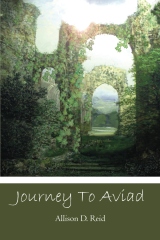
Book Review: ‘Journey to Aviad’ by Allison D. Reid

I’ve been looking high and low for fantasy fiction that’s suitable for Christians and their children–stories that edify, rather than wallow in the mire of a dying culture.

Well, how about that! I’ve found one.

Alison D. Reid’s Journey to Aviad first won me over with its near-total absence of fantasy cliches. No Invincible Female Warrior doing jumpin’, spinnin’ kicks. No know-it-all Elves. No little 11-year-old girls wiping up the floor with grown men.

Even better: no writing “ya” for “you,” and no insertion of annoying Americanisms like “you guys,” “okay,” and “yeah.”

You may counter that it’s a fantasy set in a medieval-type world, which is in itself a cliche. I grant the point. But given that one of the main purposes of any fantasy is to aid and abet the reader in a temporary escape from the world of here and now, it’s not surprising to see so much of it set in something like the Middle Ages.

But best of all, Allison Reid’s story honors God and seeks to serve Him. Here, His name is “Aviad”: but we can recognize Him as the God who reveals Himself to us in the Bible.

Indeed, Ms. Reid boldly goes so far as to identify the God of her imaginary world as a Holy Trinity. Who else has dared to tackle this concept? She discusses it coherently, too.

I’ll try to steer clear of spoilers, but I do want to mention a couple of highlights.

*The heart-cry of a brave young warrior, a servant of God, who is losing his faith: “The fingers of evil reach far, and deep. I can see their workings all too readily. The dark minions call out, and they are answered and aided. Every day they grow in number and strength. Those of us who can see through the darkness, those of us who are willing to stand against it–who answers when we call out in desperation? The most righteous people I have known… where are they now? What help has come to them?”

Which of us has not felt this very thing?

*An attack on a nearly defenseless little town by monstrous Trolls–very nicely done, and quite exciting.

*An interesting exploration of the concept of “the right kind of prayer.”

Because Journey to Aviad is so clearly the first book of a series, the ending of the story is not really an ending. It leaves you hanging. I wanted to keep on reading, but Ms. Reid has not yet finished writing the sequel.

The book has a few flaws, which I mention only in a spirit of constructive criticism. Actually, there’s nothing wrong with it that ordinary editing couldn’t fix. But Journey is self-published, which also means self-edited: and we are none of us the best editors of our own work.

So the pace could stand some picking-up, and characters ought not to waste time telling each other about things the reader already knows. (Don’t go into “Here’s what happened to me…” when the reader has already seen what happened.) And if the writer is trying to describe a complicated situation, there has to be a better way of doing it than allowing a princess to discourse about it to some common folk whom she’s only just met. Don’t turn any of your characters into talking heads.

But the flaws could all be fixed without major rewriting. And again, as a committed booster of plain English, I would not let my characters say “nay” when a simple “no” would do.

Journey to Aviad is available from amazon.com in both paperback and Kindle formats. I am glad I read it, and I look forward to the sequel.

Fictional Characters as Real People

We haven’t been talking much about fantasy-writing on this fantasy-writing blog. Oh, we discuss plenty of out-and-out fantasy–like the campus rape culture, Global Warming, microaggression, income equality achieved by the brute force of government: stuff that has no basis in reality whatsoever. Why, just today, one of the Red Pope’s henchmen blasted “Climate Change deniers.”

Sometimes I just can’t stand it anymore. So on to something more constructive.

The picture above (if it comes out!) is from The Wonderful World of the Brothers Grimm, showing Jakob Grimm (Laurence Harvey) sick in bed, to the point of death, being visited by all the characters in his fairy tales. This is what I’m getting at today.

If you’re writing a fantasy (or any other kind of story) that you want your readers to believe in, you have to believe in it. And the thing that makes any novel fly is characters. You have to believe in your characters.

Teach yourself to see each and every one of them as a real person–someone who has a whole life in addition to the tiny bit of it that you’re writing about.

That does not mean you have to map out a cradle-to-grave biography for every walk-on character. That’s a primitive technique that can easily lead to overloading a story with irrelevant information. You don’t have to actually know that character’s whole life: just be fully aware that he or she has one.

The needs of the plot, if you allow it, will generate characters as needed. They come walking into your story from Character-Land, ready and willing to do a piece of work for you.

For instance, in my just-started book, The Throne, I needed a new commander of the Thunder King’s bodyguard–and in walked a big, fierce, superstitious lout named Bassas, fast with his fists, greedy for gold, but with no real idea of how to spend it, and some small scrap of honor left in his soul. I already know I’m gonna love this guy!

True, this is not the easiest thing in the world to do. It takes years and years of practice.

But once you’re able to do it–boy, can you have fun writing!

How to Write a YA Best-Seller

If my publishers and I were not committed to books fit for the Christian family, I could make a lot of money for us.

See, I’ve learned the formula for creating a Young Adults fiction best-seller. Reading and reviewing a lot of real YA best-sellers has given me a feel for it.

Try it yourself. Here are the ingredients.

1. Kids with super-strength, super-smarts, great kung-fu, or magic. The 11-year-old girl in your story must be able to beat up full-grown, able-bodied men. Kids get a real rush out of this. In real life, adults are always telling them what to do. But in YA fiction, the tables are turned and the kids always come out on top.

Don’t be afraid to make these confrontations really violent. Anything goes, as long as the child wins.

2. Invisible, irrelevant, or totally ineffectual parents. You may have noticed that some YA kid heroes and heroines come from homes where the parents are just out to lunch. Don’t laugh–remember “After-School Special”? When did you ever see a normal set of parents on that hit show?

Harry Potter, for instance, got to have his cake and eat it, too. His real parents, wonderful people, were dead. His foster parents were jidrools, and he ran rings around them. This way you get to honor your parents and make fools of them at the same time.

3. Lots and lots of blood ‘n’ guts. Go for the graphic. The bad guys in your stories, or anyone who happens to get in the kids’ way, don’t deserve to live, anyhow. Make internal organs external. Remember, if it ever evolves into a video game or a movie, there will be lots of screaming and many bodies flying all around the place.

4. Always include a dollop of soft-core paganism. Don’t go overboard and show your super-kids flaying human sacrifices to Xipe Totec and dancing around in the skins. But the pagan flavoring is indispensable! Especially if you want to wind up getting published by Scholastic. [Oops. Did I just kill my chances here? Oh, well…]

It doesn’t have to be all that subtle. I read one YA fantasy novel in which the super-girl was actually the niece of the pagan Philistine fish god, Dagon. Or your kid characters can acquire immortality. Or commune with Nature Spirits and get really good advice from them.

5. But whatever you do, avoid the real God! If you’ve efficiently packed your YA novel with pagan gods and goddesses, assorted “spiritual entities,” deathless vampires, and immortal teens who are really hot although they still have go to school and sit through algebra classes (can you imagine an eternity of that!), there will be no opening for the real God to get in.

6. Just don’t make it too obvious. You want to rope in the Christian parents who want their child to develop the habit of reading. These potential customers are not inclined to look too deeply into any book their children might enjoy. If you are reasonably discreet about your paganism, these Christian readers will never notice it.

And there you have it, boys and girls–now sit right down and write some truly awful YA fiction. Let’s see how far these ingredients can take you.

My Fantasy Tool Kit (8): Butt Out!

http://www.realtownblogs.com/members/Judith2/files/98%20pound.jpg[Every now and then I remember the purpose of this blog is to get you interested in my books–so please feel free to click “Books” and look them over.]

If you ever want to write a fantasy novel–or any other kind of novel, for that matter–that’ll be sheer torture to read, be sure to make a thinly-disguised version of yourself the hero of the story.

Not that the reader is going to recognize you. But most readers can recognize pure poppycock when they see it. And few are so dense that they can’t detect irrelevant personal issues from the writer barging in between the reader and the story.

When you’re telling a story, butt out! I take it for granted that no one wants to read about me–not when they could be reading about Wytt or Helki. [You’ll have to read my books to get to know these characters.] Nor do they want to read my opinions on politics or the problems of this modern world that I’m supposed to be taking them away from.

To any writer, the same advice: Get out of the way! Don’t be like the jidrool who gets up and shambles around in front of the screen in the most exciting part of the movie.

If you want your readers to believe in your characters, you have to believe in them first. Don’t make them extensions of yourself or of the people in your lives. Think of them as real. Don’t try to control every little thing they say or think or do. Get so deeply into them that they start to say and do things you never expected.

Yes, I know–if it was easy, everyone would do it. A lot of published authors can’t do it. But you don’t even want to imagine the mountain of wasted paper produced by those would-be authors who don’t even try to keep themselves out of the story. That no one ever spent any money to publish their work goes without saying.

We are always being advised, “Write what you know.” But that’s no way to go about creating imaginative fiction.

Caveat: Let no one take this to mean I endorse the practice of lazily omitting to do research and just “intuiting”–that is, making up–false information about something for which real facts are easily available. For Pete’s sake, do not write about tribal customs of the Navaho unless you first read up on it: the ghost of Tony Hillerman will show the Navaho exactly where to find you.

Lefty Loons Try to Take Over Science Fiction

http://www.previewsworld.com/catalogimages/STK_IMAGES/STK460001-480000/STK473553.jpg

Not even the realm of science fiction is safe from being commandeered as a battleground in the Culture War–as usual, because lefty loons got there first and tried to take it over, lock, stock, and barrel. Well, at least they’d made a pretty good start at taking over science fiction’s annual Hugo Awards–until they ran into some unexpected pushback from science fiction writers ( http://thefederalist.com/2015/04/08/the-hugo-awards-culture-wars/ ).

Unlike, say, the Oscars, thousands of SF fans vote on the Hugos. All you have to do is go to a certain convention, pay a small membership fee, and you’re eligible to vote for the Hugo Awards.

This made it easy for ordinary people to join in the fun: very democratic. But it also made it easy for radical ideologues to organize and lobby so that only writers who had a reliably loopy left-wing political slant could ever win an award.

But after a while conservatives in the science fiction world cottoned on to what was happening, and counter-organized–

With such success that the 2015 Hugo nominations provoked a loud and anguished outcry from the usual gang of idiots. Sexism! Racism! Ho-mo-phobia! Too many white males! There oughta be a law! Do-over, do-over!

How the conservatives accomplished this makes very interesting reading. Consult the link to the article in The Federalist.

Again we see that, to the alleged mind of the progressive, no sphere of activity is immune to being swallowed up by politics. Everything, and they do mean everything, must be made into a vehicle to push the earthly paradise that will surely be ours, once the whoopee crowd has all the power and has utterly crushed and extirpated every vestige of opposition or dissent.

Not to mention the collateral pleasure of spoiling other people’s fun. How dare they enjoy their science fiction! Oh, we’ll fix them! Arise, you victims of oppression…

But this time it looks like the good guys have won.

Not Only Dumb, but Evil

In describing some of the Young Readers fiction I’ve been reading lately, I’ve concentrated on its penchant for literary malpractice. The writers and editors seem to be purposely trying to stunt the readers’ mental growth.

But they’re also throwing poison darts at moral growth.

It’s not just that they have characters inhabiting exotic, imaginary worlds talk like not-very-bright middle school kids who watch too many cartoons. It goes way beyond that.

Granted, if you want to write about the daring adventures of a character who’s 12 years old, you’ll have to find a way to get him out from under the direct supervision of his parents. No parent in his right mind consents to his child being involved in life-threatening adventures.

But in these books–again we resort to Tui Sutherland’s Wings of Fire series by Scholastic Books–adults are not just inconvenient. They’re selfish and cruel, and a menace to their own children. So the juvenile dragons, because every adult dragon’s hand is raised against them, can only look to their age-group peers for love and loyalty. “Don’t trust anyone over 30” has metastasized into “don’t trust anyone over 13.” Even their own parents are perfectly happy to sell them for a cow or two, and the daughters of dragon queens are expected to kill their mothers: it’s the only way a dragon tribe can get a new queen.

In Scholastic’s Spirit Animals series, assorted authors depict an 11-year-old girl using the inevitable jumpin’, spinnin’ kicks to beat up and sometimes even kill adult bad guys. The kids in these books are always coming to blows with adults. Again, grownups are basically bad and you just can’t trust them. Only the kids in your public school class will be true to you.

Gee, that ain’t the way I remember childhood.

These books are important because they are part of the Godless, Christless, hubris-laden pop culture that gets poured into our heads every day. Children are highly susceptible to it. This bilge helps shape a person’s character. It gets mixed into his foundation.

We need to start paying closer attention to what our culture is teaching us. Adults and children both.

How to Write a Really Rotten Novel

In my years of reading, I have learned to recognize many techniques whose employment guarantees a truly impoverished work of fiction. In case you’re interested in writing one, I’m going to share them with you.

1. Make your main character an avatar of all your fantasies about yourself–unbelievably smart, strong, sexy, cool, etc. This works especially well if you are a pencil-necked geek or a big squishy puffball and you write yourself up as Bonzo the Barbarian or Mr. Cool the super-spy, or the drop-dead gorgeous female pirate captain, whatever.

2. All the other characters are only there to be put in the shade by your protagonist. If your hero is a male, all the women in the book must throw themselves at him. All the other men are constantly shown up by him. Please don’t bother to give these ancillary characters any depth or personality.

3. Make sure the villains in your story are impotent pygmies who can never get the better of your hero. Don’t be afraid to rely on extremely improbable coincidences to make your hero come out on top.

4. Above all, stock your story with absurd situations that make no sense at all. Two memorable examples will illustrate what I mean.

In one of the few truly awful mysteries I’ve read, the protagonist, a 55-year-old homicide detective, spends most of the hottest night of the year toiling over a particularly gruesome and disgusting murder scene. Then he goes home to his 17-year-old girlfriend and they go at it like rabbits for the next six hours.

In a horror novel, the heroine, a 40-plus-year-old, chain-smoking, desk-bound social worker clobbers the living daylights out of three hulking goons who try to murder her. To this day I don’t know how she did it. I hope the author, the editor, and the publisher donated their brains to science for careful study.

We have all encountered most of these in published novels, some of them best-sellers. There are, of course, many more; I don’t have space to discuss them all today. That these techniques are so widely used to produce so many awful novels is a deep mystery of the universe. If you’re interested, I can always list some others. But for the time being, these should surely be enough to get you started in producing fiction that will have your readers pleading for mercy–if it doesn’t make you rich and famous.

Not-So-Minor Characters

Well, at least I can transport my own picture from

the “Bio” on this site, to this page. We advance by little tiny steps.

Among the most unreadable books in existence are those in which the protagonist is merely an avatar of the writer himself, powered by wishful thinking: like, here I am as the smartest  guy in the book, the handsomest,

the sexiest, blah-blah. And all the other characters

are merely names on paper, because the writer is so exclusively interested in himself.

To make your story live and breath, your characters have to live and breath. In that sense, there’s no such thing as a “minor character.” That doesn’t mean that, every time a new character appears, you have to tell his whole life story. He may only be there to say “Here are the gumboots that you ordered, madam,” and then exit.

I first noticed this technique years ago when I was reading a lot of Dick Francis’ mysteries. Every character who appeared, even those for whom a name wasn’t necessary, the writer dabbed with just enough color to make him or her come to life.

I found a wonderful example of this last night, in Inspector Ghote’s Good Crusade by H.R.F. Keating (1966). Here, India’s most famous detective is interrogating a cook whose great concern is to tell the inspector whatever he thinks the inspector wants to hear: he does this because he’s afraid of the police, and doesn’t even notice when his answers are the exact opposite of answers he’s given just moments ago. It drives poor Ghote up the wall, but makes for wonderful entertainment. The cook is only around for a page or two, but he’s a minor character I’ll never forget.

This art requires some subtlety, and a lot of practice. It won’t do, just to tack on something like, for instance, “Here are the gumboots that you ordered, madam,” said a delivery man with a tattoo of a lobster on his cheek. But even that is a step in the right direction. It’s something the writer has to work on before he can master it.

As you can see, I have utterly failed to post my picture in the upper left-hand corner of the page. Well, live and learn.

A Defense of Fantasy

By now you might be thinking, “Boy, this guy sure hates fantasy!” Not so. What I hate is lousy fantasy. And even more, I hate fantasy that serves an evil purpose, no matter how well it might be written.

If you read a few dozen current fantasy novels, you might come to the conclusion that the best you can hope for is fantasy that serves a merely idle purpose. Some Christians refuse to believe there’s any such thing as edifying fantasy. I can hardly blame them. However, the profusion of wicked or at best silly fantasies does not rule out the possibility of using fantasy in the service of God and good.

No, you’re not going to manage it with stuff like The Maze Runners or Game of Thrones.

But why use fantasy at all? Well, here are a few reasons.

1. Why not? We’ve seen it done before.

2. Young readers are crazy about fantasy, can’t get enough of it. So you’ve got a built-in audience–indeed, an audience that needs to be better-served than it is just now.

3. Like other forms of fiction, fantasy can readily be written as an extended parable. Just think of the story of the Prodigal Son turned into a novel. Warning: If you do this heavy-handedly, it won’t work. The reader will resent it when the writer tries to dominate him.

4. Fantasy is more like poetry, or even music, than most other kinds of fiction can ever be. It gets under your skin.

Look, it can’t possibly be as hard as, say, finding a constructive use for rap music.

Of course, if you’re going to write a sermon, write a sermon. Don’t write a sermon disguised as a fantasy. It won’t fool anyone. And even more of course, we’re not talking about creating a “Christian fantasy” by imitating everybody else’s fantasies and then just tacking on some scenes of characters praying or going to church or quoting Scripture at random places in the story.

Why concede to the pagans a whole realm of art, not to mention a very big chunk of the readership market? Are we not in a state of spiritual warfare?

I see John Bunyan, C.S. Lewis, and J.R.R. Tolkien standing tall on this battlefield; and I will run, not walk, to join them.

The Abuse of Fantasy

What set me off yesterday?

I’m going to review a couple of books in that “Spirit Animals” series, as part of my duties for the Chalcedon Foundation ministry. (We’re celebrating our 50th anniversary this year; visit our website, http://www.chalcedon.edu ). For this series, Scholastic Books rounded up several established fantasy writers, a different writer for each book, all telling the same story. I’ve just finished reading Book #1, Wild Born by Brandon Mull.

Earlier work by these authors has somehow landed on the New York Times best-seller list, so it couldn’t have been cheap to round them up for Scholastic. It seems an odd procedure: Scholastic has the muscle to see to it that a book sells successfully, no matter who the author is.

But I am convinced Scholastic has paid these authors well and told them what to write. And I don’t like what they’re writing.

Let me describe what I’ve read, as simply as I can: unoriginal, formulaic, cringe-inducing prose, Politically Correct, chock-full of cliches, and–most importantly–delivering a thoroughly pagan, New Age message of “spirituality” devoid of a personal God or any kind of moral law handed down by Him.

As if that weren’t bad enough, the authors sugar-coat it by focusing on children whose spiritual bonds with spirit animals give them super-powers–I hate super-powers–that enable them to whup the tar out of any able-bodied adult male. This is pitched to the sense of powerlessness that torments many teens and pre-teens, seducing them with ridiculous visions of radical autonomy. Being able to beat up a grown man, when you’re only 11 years old and weigh 70 pounds, is radical autonomy.

Scholastic’s last big push was for Philip Pullman’s atheist rant trilogy, His Dark Materials. Once parents became aware of what that was about, the book sales slowed to a trickle and the feature film went belly-up.

Having failed to catch the flies with vinegar, Scholastic is now trying to catch them with honey. Where Pullman spat venom, Spirit Animals seduces: playing on most children’s love of animals, making the animals into a kind of God substitute, and so on.

I object strenuously to this abuse of fantasy. It is being used to sugar-coat poisonous ideas. I object to there being so much of this kind of fantasy.

We have to do better than this. We just have to do better.