Literary Crimes: Anachronisms REPRINT

From January 13, 2016

Let’s say you’re writing an epic novel of the events leading up to Noah’s Flood, thousands of years ago.

Can you envision any circumstances which would induce you to employ the phrase, “strike zone”?

Well, yeah, if you want to remind the reader that he’s not really visiting the ancient world, but just reading a stupid book about it.

My friend “Abner,” in his amazingly successful novelizations of Biblical events, resorts to every anachronism he can think of. Here are a few that light up the second book in his series.

“It depends on what ‘is’ is.”

“Hope and change”

“Fundamental transformation of society”

God accused of “colonialism, imperialism, sexism, speciesism” and also described as “macho”

“I feel your pain”

“You didn’t build that”

“The 99 percent”

“We”–the speaker is an archangel–“saved your rear ends”

All right, let’s be fair: he has stopped short of equipping Adam and Eve, in the Garden of Eden, with cell phones. Well, who would they call? And a cell phone might be a nuisance if pockets haven’t been invented yet.

Strike zone? Macho?

Please, whoever is out there thinking about writing a novel–if you’re writing fantasy or historical fiction, please do not riddle it with stupid and inane anachronisms that won’t make a lick of sense to a reader ten years from now but which surely will, for the time being, remind the current reader that all he’s doing is reading a mutton-headed comic book without pictures.

I must point out that I am paid to read these books. Otherwise I could not endure it.

‘How Not to Write’ (2014)

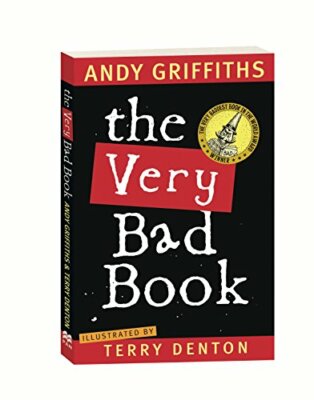
The Very Bad Book by Andy Griffiths Book The Fast Free Shipping | eBay

I admit that I would not open this book, believing as I do that the title captures something very easily achieved by many persons.

Almost everyone thinks he or she could be a writer… “if only I had the time.” Yeah, it’s preposterously easy! Especially novels. Anyone can write a novel.

Like so:

How Not to Write

You wouldn’t believe so many literary crimes could be committed in just one book. Mark Twain was hard on James Fenimore Cooper, but some of the books that are pitched to me put Cooper’s errors in the shade.

P.S.–The computer is rebelling this morning and has so far refused to post a picture. I’ll keep trying. Welcome to the Age of Nothing Works.

‘Yachting with No Pants On’ (2013)

See the source image

A self-inflicted wound (it happens to the best of us!)

Any author as prolific as John D. MacDonald was, is bound to brew up a clanker every now and then. Like this one:

Yachting With No Pants On

Editors are supposed to save writers from making fools of themselves. But more often than not, they dare not demand changes in anything written by someone who makes a lot of money for the publisher. Editors, after all, are just as replaceable as writers.

So there was John D. with his “all-girl nude yacht crew”… and there is the reader asking, again and again, “What ever possessed him to write this? What in the world could he have been thinking?”

[Note: Lisa, who tracked down the book’s title, was for years the keeper of “Lee’s Twitter.” Hats off to Lisa!]

‘How Not to Write Dialogue’ (2014)

Silly Nonsense Gibberish Shirt Jibber Jabber T-Shirt

I’ll have more to say about this later. Literary crimes are being perpetrated today that hadn’t been invented yet in 2014.

How Not to Write Dialogue

I think back to those days when literary agents and editors used to keelhaul new writers for even the slightest lapses in style and grammar–while at the same time, publishing stuff that was barely recognizeable as English.

If you can’t talk intelligently, you can’t think intelligently.

The prosecution rests, your honor.

‘How to Write a Really Rotten Novel’ (2015)

Furious Student Throwing His Laptop Away 896167 Stock Photo at Vecteezy

I post this now and then because readers seem to find some comfort in it. As in, “Yes, absolutely, that was a book that stunk on toast, it was pure rubbish, and no, it was not great art that everyone appreciates but you!”

How to Write a Really Rotten Novel

You could fill Grand Canyon with awful paperbacks that have been published. Oh, forsooth! Remember Leisure Books? They finally bit the dust in 2010. Paid the lowest advances I ever heard of; but the bilge they published didn’t deserve any better.

Hey, if you wanna read that stuff, be my guest. What you do with your spare time is your own business.

‘Stop the Lousy Writing, Please!’ (2015)

In the 1970s and 80s, a fad for horror swept the world of publishing. Readers wanted horror, couldn’t get enough of it. I got four books published, horror novels.

They couldn’t meet the demand, so y’know what they did? They published anything that they could get away with calling “horror.” Including a multitude of really bad books, written by wooden effigies, the kind of thing that makes a reader curse out loud and kick the book across the room… And suddenly no one was buying horror anymore.

Stop the Lousy Writing, Please!

I thought you might enjoy the comments on this post, which are many.

But sheesh! It’s hard enough getting people to read, without torturing them with bad writing.

‘A Really Stinky Book’ (2011)

See the source image

I read this book, and a couple other clangers, in preparation for an interview. I think it was with Joshua’s uncle, Kevin, on his internet radio show. I look back with amazement that any published book could be this bad.

A Really Stinky Book!

Sometimes when adults write about teenagers, they come off as space aliens trying to write about human beings without having the slightest understanding of humanity, they might as well be writing about catfish. A book like this is an insult to every poor devil who ever tried and failed to get published. A monkey could write a better one, if you gave him a keyboard.

You owe it to yourself to give this book a wide berth.

‘Another Literary Crime’

See the source image

There are many things a writer can do to wreck his own work. One of them is to make the reader think that you think he’s a dunce who can’t tell good from evil.

Another Literary Crime

Why else would the author continually editorialize about his characters? How badly do we need to be told that the villain is a bad guy? Page after page after page?

And yet we see this, sometimes in fantastically successful best-selling books. Never mind that those books will be forgotten someday, while better books live on. For the time being, they’re selling like hotcakes.

I think it’s just further evidence that we’re living in a fallen world.

A Lame Excuse for a Literary Lapse

michael_gothard_archive | Ivanhoe: screencaps

Sir Walter Scott’s Ivanhoe will last forever as a literary classic. Even so, there’s one little clinker in it that makes you wonder if Scott was quite sane at the time.

To show the futility of any dream of ousting the Normans and putting a Saxon noble on the throne of England, Scott gives us a lout named Athelstane as the last remaining repository of that hope. Although descended from Saxon royalty, Athelstane’s main interest in life is eating. You could put him in a stall with a feed-bag, and he’d be happy.

Toward the end of the story, Athelstane gets killed in a battle. The larders of England breathe a collective sigh of relief. The reader promptly forgets there was ever such a character as Athelstane–

Until, in Chapter XLII, Sir Walter Scott brings him back to life.

Now, this was not like Conan Doyle being forced by public outrage to bring back Sherlock Holmes after drowning him in the Reichenbach Falls. Why bring back Athelstane, a clod? Let’s let Sir Walter himself answer that question, in his own footnotes to Ivanhoe.

“59. The resuscitation of Athelstane has been much criticised, as too violent a breach of probability, even for a work of such fantastic character. It was a ‘tour-de-force,’ to which the author was compelled to have recourse, by the vehement entreaties of his friend and printer, who was inconsolable on the Saxon being conveyed to the tomb.”

That’s his excuse–an inconsolable printer? Well, it’s feeble enough to be true. What a soft-hearted fellow Sir Walter must have been! The return of Athelstane was unnecessary, unwanted, and preposterous; and you wonder how a literary giant could have taken such a fall. It’s like Hamlet’s pants splitting with an audible riiiip! in the middle of “To be or not to be.”

Note to aspiring authors: Don’t think you’ll ever get away with a honker like this.

‘Literary Crimes’ (2015)

Image result for images of fantasy cliches

I read a lot of fantasy, and a lot of it is poop. That’s usually because it’s full of literary crimes.

Literary Crimes

The Know-It-All Elf and The Invincible Female Warrior–what would certain writers do for characters, if they didn’t have these worn-out cliches to fall back on?

Then there’s crazy dialogue. There’s only one thing worse than long passages of speech written in what the author images to be dialect. That’s long passages of speech in which the author wanders in and out of dialect.

The mystery of it all! We wouldn’t know these cliches for cliches if they weren’t crammed into books that actually got published–thousands of ’em.