This Is One of My Favorites

C.R. Knight - Uintatherium with Eohippus in the foreground

Behold the massive Uintatherium, brought to life in this painting by Charles R. Knight, the master painter of prehistoric life. As a bonus, he threw in a few Eohippus (“dawn horse” in the foreground.

And Lord Reesh got a fleeting glimpse of one in The Last Banquet.

Digging Up the Past to Understand Our Climate Future | Natural History  Museum of Utah

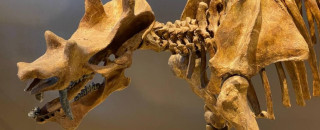
Look at that skull, all knobs and fangs. They used to have a Uintatherium skull in the Rutgers Geology Museum. The skull alone was as big as a full-grown German shepherd. I could never walk past it without stopping to wonder at it. The whole animal was about the size of a car.

I never could figure out how it got by with such a tiny brain case. Maybe that didn’t matter much, back then. The animals that competed with it for food weren’t exactly College Bowl material.

I would be very happy to dream of Uintatherium tonight.

‘Sanity Break: the Woolly Mammoth’ (2018)

See the source image

It’s one of my life’s major disappointments that I’ve never seen a woolly mammoth. Imagine looking out your bedroom window and seeing these crossing your back yard at night.

Sanity Break: the Woolly Mammoth

Yeah, I know, I know–“Someday we can bring them back by cloning!” Just like Jurassic Park. The end of the Ice Age put the mammoths out of business. In the regeneration of all things, the LORD will put them back in.


Look What Mike Has Done!

image001

Our friend and esteemed colleague “ElderMike” carved this graceful image of a Diplodocus, with eggs and a baby. I don’t think Charles R. Knight himself could do a better job of it (he sculpted in clay, not wood).

As someone who couldn’t do a work like this to save his life, I can only enjoy and admire it, and share it with the rest of you. It took Patty several days to figure out how to transfer the picture from e-mail to our blog’s Media page–no small achievement, that.

This really is beautiful, isn’t it? Thank you, Mike!

I Think I’ve Been There

Entelodon | Cool Dino Facts Wiki | Fandom

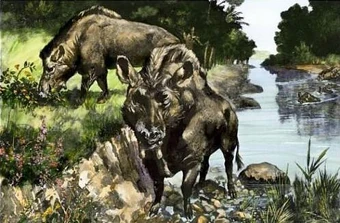
This is Charles R. Knight’s 1894 painting of Elotherium, an extinct animal that resembled a wild boar. That’s cool–but what I’m really interested in is the backdrop.

This reproduction, the only one I could find, doesn’t quite capture the dried-out yellowish tones of the banks of this gully. You’ll have to imagine that. The gully is full of water and the animals are crossing it. Farther up toward the horizon, the gully feeds into a more permanent stream. And then a river? Then the sea?

The thing is–I think I’ve been there! Years and years and years ago. You got there if you went all the way down Orchard Street, back when there was still an orchard there, well past all the houses, and then just park your bike where this little bridge went across the gully. You could easily climb down and wade in the water–which of course you wouldn’t do if  there were Elotheriums present. They look irritable.

It wouldn’t surprise me to learn that Knight used real places as the backdrops for his paintings of prehistoric life. I wonder: did he wander into my childhood, or did I wander into one of his paintings?

A Good Dinosaur Gone Bad

TRILOGY OF LIFE - Ballad of Big Al - "Ornitholestes" - YouTube

One of these days I’m going to want to bring a dinosaur or two into the fantasy world of my Bell Mountain novels.

Ornitholestes was the most famous small dinosaur when I was a boy–and by famous I mean in all the books, on all the posters, toys and museum souvenirs: if you were at all interested in dinosaurs, you knew Ornitholestes (the name means “bird hunter”)–probably from this famous drawing by Charles R. Knight, found in just about every children’s book on dinosaurs.

Love in the Time of Chasmosaurs: Vintage Dinosaur Art: The Bird Hunter

See? There he is, catching a prehistoric bird.

The fame of this creature rests upon a single fossil, consisting of a damaged skull and some bits of the skeleton–to this day, the only fossil of Ornitholestes yet discovered.

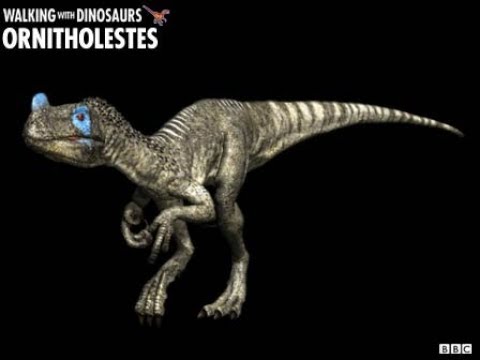
By the time the popular documentary, Walking with Dinosaurs, came out in 1999, Ornitholestes–it really needs a shorter name; how about “Bob”?–had been jazzed up a lot. Now Bob had a kind of crest on his nose–very sporty. Looks great in a movie. But after only a few years they decided Bob’s flashy nose crest was really only a piece of the skull that had gotten knocked loose, so now he’s back to where he was when Charles R. Knight drew him in the 1930s. Only some artists like to give him feathers. No feathers have been found, there’s only one fossil, oh, well…

In spite of all the confusion, I find it easy to imagine this critter darting in and out of the undergrowth in Lintum Forest—–Wait a minute! Hold the phone! Did I just get the faint whiff of an opening scene for Bell Mountain No. 14? You know what? I think I did!

I think the Lord has just given me a birthday present. And this is not the first time that’s happened. Thank you, Father! This is just so cool!

Places that Never Were–Or Were They?

See the source image

Charles R. Knight, who died in 1953, became famous in his own lifetime as the world’s most convincing painter of prehistoric life. Among my early memories are trips to the American Museum of Natural History, and looking up at Knight’s great murals, my mind full of wild surmises for which I wasn’t old enough to find words.

I still love Knight’s work, but I’ve learned to appreciate another aspect of it–his background scenery. There are a lot of people who can paint or draw prehistoric animals. I can do that. But only a very few are able to bring us into the world those creatures lived in.

The painting above launched Knight’s career, when it was still the 19th century. The animal is Elotherium. Never mind that. The scenery which Elotherium inhabits–the longer I look at it, the realer it gets!

I could just about swear that Knight’s Elotheriums are in a real place. More than that–a place that I know. I used to play alongside a stream just like that, on Orchard Street, before they paved everything over. I climbed and skidded up and down those steep banks. I waded in that water, although it was too deep to wade all the way across. I was there. I didn’t see any Elotheriums, but I was there. If they’d come out of the woods on the other side, I’d’ve seen them.

And where would that stream take me, if I could follow it up to the top of the painting? What enchanted country would I discover?

What a gift the Lord Our God gave Charles Knight! God made us in His image, and some of us He made creators. We can only revel in it, and give thanks.

I think God knows where these places really are. He made them. Oh, for a glimpse, O Lord!

But who knows what He has in store for us?

A Window into Another World

See the source image

Charles R. Knight was always one of my favorite artists. He is best known for the paintings he executed for our country’s great museums–paintings that make prehistoric ages come alive.

This is one of his renditions of Uintatherium, a walking fortress that exists no more. Well, naturally I’m going to groove on the prehistoric animals. But lately it’s been another aspect of Knight’s paintings that has captured my imagination.

His backgrounds.

Look closely. Take your time. Ignore the creature and study the landscape. I don’t know about you, but I would just about swear that Knight’s prehistoric landscapes were real places that he’d visited.

I know about that. I dream of places that are only real when I dream them. In fact, that’s how Bell Mountain started.

I know nothing of Charles R. Knight’s religious beliefs. But I believe that if the Holy Spirit wants to use you, He will, regardless of what you believe. If we approach Knight’s possibly real, possibly imaginary places in the right frame of mind, the Spirit might touch us, too.

God created the world and all living things, and pronounced them good. If He has Uintatherium safely tucked away in some unguessed-at corner of His universe, I wouldn’t be surprised if it were in a place just like the one Knight painted.

And who would be more surprised to discover that than Charles Knight himself?

Mr. Nature: One Big Deer

See the source image

Hi, Mr. Nature here again–with one of my favorite artists, Charles R. Knight.

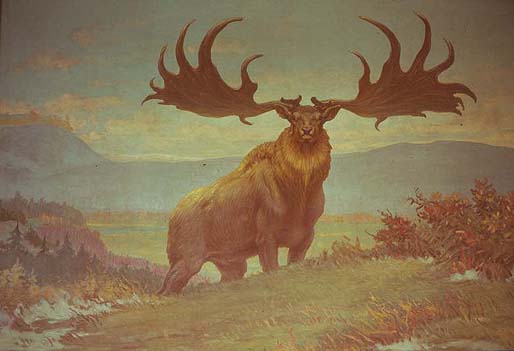
This is his famous painting of Megaloceros, the “Irish Elk,” the deer with the biggest antlers ever. Best known from the Ice Age, there have always been stories of this creature surviving into historical times in Ireland. No one’s been able to prove it, or disprove it.

Ice Age people saw it, though. They hunted it, ate it, and painted its picture on the walls of caves.

This is just one of incalculably many creatures that we can’t find anymore. My own belief is that God, with the whole universe at His disposal, has put them elsewhere. Maybe someday God will let us see these animals again.

I sometimes wonder if He might have given Charles R. Knight a peek at them.

Sanity Break: the Woolly Mammoth

See the source image

Sometimes writing about current events just wears me out. For refreshment, I turn to God’s handiwork.

Behold the woolly mammoth, as painted by the great Charles R. Knight. This was the first prehistoric animal I fell in love with. I used to dream about them. A truck would sound its horn at night, out on Route 1, and I would think it was a mammoth calling to the other mammoths.

And I don’t know why, but somehow I conceived the notion that my Aunt Betty, the nun, had the ability to obtain for me a mammoth of my own, and I used to pester her about it. Give me a break, I think I was only five years old. Poor Aunt Betty. She made me a little toy mammoth out of some kind of fur. Well, she tried. If I still had that toy, it would be among my treasures. But not as great a treasure as she herself would be.

When God restores His whole creation, I’m sure there will be mammoths once again. And we will enjoy them with our loved ones.