The Giant Hedgehog

See the source image

Hi, Mr. Nature here–this time with a giant hedgehog.

If scientists are reading the fossils right–they do try–Deinogalerix was about five times the size of today’s cute and cuddly hedgehogs (see illustration). It once lived in Italy. It doesn’t anymore. You’re not going to get me to walk into the “X millions of years ago” trap. I have learned not to have much confidence in prehistoric dating schemes.

It’s estimated the giant hedgehog weighed ten pounds and grew to two feet long. I don’t know whether it had the typical hedgehog spines: maybe those haven’t been preserved as fossils, or have yet to be discovered. A spineless hedgehog would be somewhat of a letdown.

We marvel at the many forms of God’s handiwork, and we do wish we could have seen some of these creatures from long ago (however long ago it was). And who says He hasn’t found another place for them?

‘I Stand Corrected’ (2013)

I’m still amazed, always, when I encounter conspiracy theories that say dinosaurs never existed, they’re just a massive hoax cooked up by “the corporations” or whoever. How did so many people come to think this way–if you can even call it thinking?

https://leeduigon.com/2013/08/04/i-stand-corrected/

New Dinosaur Found in Egypt

See the source image

Mansourasaurus: note the little armored plates upon its back, a feature not found in the super-gigantic sauropods… so far.

(Thanks to “Unknowable” for the news tip.)

A new dinosaur, Mansourasaurus, has been discovered in Egypt. It appears to be a sort of downsized brontosaur, or sauropod, a bit over 30 feet long.

The find is significant for two reasons. It opened a previously unopened geographical area to the search for dinosaur fossils; and it appears to be more closely related to European sauropods than to others found farther south in Africa, casting doubt on the notion that African dinosaurs were totally isolated from the kinds discovered on the northern continents.

The first news reports were just about useless: the noozies didn’t seem to know what they were writing about. They were citing scientists who called it “the Holy Grail” of dinosaur discoveries, but no one troubled himself to explain why that was so.

I hope you don’t mind a dinosaur story now and then. After writing about Sarah Silverman’s profane and fatuous remarks about unborn human babies, I felt the need for something a little less toxic. We can disregard the Evolution baggage that comes with any dinosaur report, and marvel at the complexity and vastness of God’s creative work.

The Giant Ape

See the source image

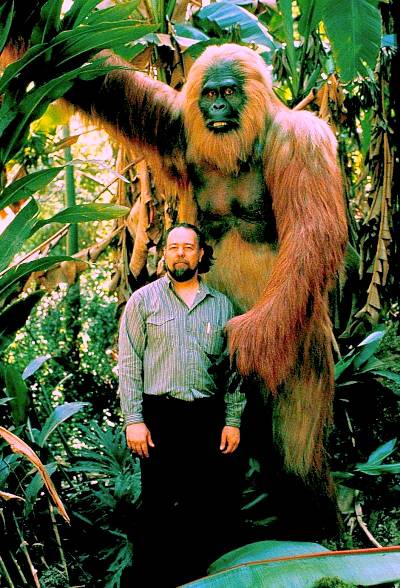
Hi, Mr. Nature here, with a really cool prehistoric creature that ought to get at least a cameo appearance in a Bell Mountain book. Maybe the next one.

Gigantopithecus (“Giant ape”) lived long ago in Southeast Asia. About a hundred years ago, some of its enormous teeth were discovered in Chinese drugstores, where they were sold to be ground up for medicine. To this day all we have of its remains are a bunch of teeth and some bits of jawbone, but the reconstruction is hopefully somewhere near the mark, because these pieces strongly resemble the corresponding pieces in modern great apes. Only much, much bigger! Scientists believe a full-grown Gigantopithecus probably stood ten feet tall. Shades of King Kong.

For a while it was believed those teeth once belonged to gigantic human beings, albeit of a primitive form. Well, that’s Evolution for you. But as Gertrude Stein might say, “A Gigantopithecus is a Gigantopithecus is a Gigantopithecus.” God doesn’t create living things that are on their way to becoming something else. They’re all right just as they are. And all we can say for certain is that there probably aren’t any more of them. Probably.

What must it have been like to see one of these coming your way down a path in the jungle? I don’t think you’d easily forget it!

Sanity Break: the Woolly Mammoth

See the source image

Sometimes writing about current events just wears me out. For refreshment, I turn to God’s handiwork.

Behold the woolly mammoth, as painted by the great Charles R. Knight. This was the first prehistoric animal I fell in love with. I used to dream about them. A truck would sound its horn at night, out on Route 1, and I would think it was a mammoth calling to the other mammoths.

And I don’t know why, but somehow I conceived the notion that my Aunt Betty, the nun, had the ability to obtain for me a mammoth of my own, and I used to pester her about it. Give me a break, I think I was only five years old. Poor Aunt Betty. She made me a little toy mammoth out of some kind of fur. Well, she tried. If I still had that toy, it would be among my treasures. But not as great a treasure as she herself would be.

When God restores His whole creation, I’m sure there will be mammoths once again. And we will enjoy them with our loved ones.

The American Lion

See the source image

It’s snowing today, and we still have our Christmas tree–hooray!

Hi, Mr. Nature here, with another one of those cool Ice Age mammals that aren’t here anymore–the American Lion, Panthera leo atrox, the biggest member of the cat family ever to walk the earth. It was very similar to today’s African and Indian lions, only bigger. A lot bigger.

Why did it go extinct? Nobody knows, really. You’d think it could’ve gotten by, preying on elk and bison and other big game. God does things with His creation that we still don’t understand. Maybe He has stored them somewhere else. Maybe, when He restores all things, He’ll bring back the American lion.

Mr. Nature: Przewalski’s Horse

See the source image

Back in the Ice Age, Europe was full of wild horses. People hunted them and ate them, and painted their pictures on the walls of caves.

Hi, Mr. Nature here. Note the sophisticated artistic style employed by the supposedly primitive caveman. Note the shape and colors. And now, I will leave for a minute to go fetch something from youtube. I’ll be right back, so don’t go away.

All right, here it is, live at the Cincinnati Zoo, but actually native to Mongolia–Przewalski’s Horse, a dead ringer for the horses painted in the caves of France and Spain and Germany. Did the ancient artist get it right, or what?

These beautiful animals came close to being wiped out, but we’re happy to tell you they’ve been saved in just the nick of time. We ought to be good stewards of God’s stuff. If we’re not, how is He to trust us to be stewards of greater things?

Here’s the Skeleton

See the source image

Mr. Nature again.

Some of you don’t think Tanystropheus could have been real: there must have been some mistake in reconstructing it. Not an unreasonable suspicion. In fact, the first scientist to study the fossil, in the 19th century, reconstructed it as a flying reptile. He soon conceded that that was a mistake.

So here’s the skeleton. A number of Tanystropheus fossils have been found, all pretty similar, all with those crazy long bones which are now interpreted as neck bones, leaving us with an animal that’s very hard to understand.

If you can think of a better way to put these parts together, go for it.

The Tanystropheus–at Last!

See the source image

Hi, Mr. Nature here, with that Tanystropheus I would’ve shown you yesterday if I’d only remembered to do it.

This was one of the most unusual creatures ever to walk the earth. Supposedly it lived in the Triassic Period–which was less a real thing than it is merely a way for geologists to talk about earth history. Anyway, there are no more Tanystropheuses.

Marvin (I thought it needed a shorter name) was about 20 feet long, and 10 feet of that was just his neck. Marve is often depicted with this snaky neck that can practically tie itself into a sheepshank, but that would have been impossible: there were only 12 or 13 bones in that long neck, severely limiting its flexibility. A giraffe has only seven neck-bones, and you see what they have to go through if they want a drink of water. Marvin’s neck would have been almost as stiff as a giraffe’s.

He’s also depicted, often, as living mostly in the water–probably because scientists just don’t know what to do with him on land. We have no evidence for this. Some of the fossils suggest a lot of muscle in the pelvic area, which would have counterbalanced the weight of the neck. But how this animal actually lived is a mystery to everybody. Don’t be too hard on paleontologists for not having figured it out. There are lots of things in the fossil record that no one will ever figure out.

What did God do with these strange and spectacular animals He created–the ones that aren’t here anymore? Well, frankly, we don’t know: He hasn’t made it known to us.

Maybe someday He will.

Biggest Mammal Carnivore Ever?

In 1923 a member of Roy Chapman Andrews’ expedition to the Gobi Desert found a yard-long skull that scientists thought belonged to the largest land-dwelling carnivorous mammal ever–Andrewsarchus, named for RCA himself. Since then, no other Andrewsarchus fossils have been found.

I’ve seen this skull in the America Museum of Natural History. It’s a whopper. The muscle attachments are simply huge, indicating a bite of tremendous power. The teeth do look like a carnivore’s teeth, but they also look kind of dull and worn. Based on comparisons to fossils that looked similar, paleontologists reconstructed this awesome beast that had little hooves instead of claws and must have weighed upwards of a ton.

But, despite the wonderful special effects wizardry of Tim Haines, it’s all just speculation. Well, when you see that skull, you can’t help speculating.

I’ve got to work this critter into one of my books, somewhere along the line. Maybe it could eat a villain.