A Nation of Suckers

Image result for images of dunces

According to a new Pew Research Center poll, 49% of Americans who have left church no longer believe in God, or in miracles ( http://www.washingtonexaminer.com/pew-huge-surge-in-americans-who-no-longer-believe-in-god-miracles/article/2600066 ).

Doesn’t that mean that 51% of those who have left church still do believe in God and miracles? But that ain’t the headline.

The Pew report says “‘science’ is the reason they do not believe religious teachings.” Like, once they clue you in to Evilution, you’re just too smart to believe in God anymore. “Rational thought makes religion go out the window,” say some of the poll respondents.

I wonder what these people mean by “rational thought.” Having given up belief in God, what do they believe in now? Space brothers? The good intentions of the Democrat Party? World government?

No, I think G.K. Chesterton was right: Once you stop believing in God, you don’t believe in nothing; you’ll believe in anything.

More Memory Lane: ‘Fury’

(Thanks to Linda for reminding me of this great old TV show.)

It’s almost inconceivable that a kids’ TV show like Fury would be made today: the story of a troubled orphaned boy and a wild, untameable horse–and how the boy and the horse bring love and healing to each other.

This show, starring a young and not-yet-famous Peter Graves ( Mission: Impossible), took off in 1955 and ran until the child star, Bobby Diamond, started shaving. Looking in my box of toy animals, I find I have an awful lot of horses, especially shiny black ones: Fury surrogates, one and all.

Go ahead, tell me the kids’ stuff that we’ve got now is better.

I won’t believe you.

Memory Lane: ‘Tombstone Territory’

Couldn’t resist this!

Every Saturday morning I used to run across the street to my friend Ellen’s house, and we’d watch this show: Tombstone Territory. I never forgot the theme music. (Psst! See if you can spot Leonard Nimoy before he grew his Vulcan ears.)

Well, that was the Bronze Age for you, tons and tons of Westerns on TV. I don’t even want to think about what the kids are watching now. Probably in today’s TV the marshal is the bad guy and the bank robbers and murderers are the good guys.

But what am I saying? Who’s even allowed to run over to a friend’s house anymore?

Come, Lord Jesus, come!


‘Fragile World’: A Heads-Up for a Fine Christian Film

Courtesy of writer-director Sandy Boikian, Patty and I have just watched an excellent movie, Fragile World (http://www.fragileworldmovie.com/). I’ll write a full review for The Chalcedon Foundation, and one for this site, too, once my allergies stop tormenting me. But I just wanted to tip you off to it now, so you can take advantage of any opportunity to see it.

What happens when a vulnerable young woman, with a history of delusions, falls in love–and can’t be sure the man is really… well, real? Is he another delusion? She has a new friend who wants to help her, but isn’t sure how.

This story has a good time keeping you guessing. And I’m happy to say it isn’t one of those “Christian movies” that’s just like any secular movie only with some Christian stuff slapped on like a decal. You’ll begin to suspect it’s about magic of some kind, but there is one thing you can be sure about–it’s about faith: “the substance of things hoped for, the evidence of things not seen” (Hebrews 11:1). And the relationship between faith and what we know–or think we know–as reality.

Movies like this need to be made, and watched, and thought over, and talked about. Movies, TV, books, and all the rest of our popular culture–this, people, is how we educate ourselves. We spend thousands of hours consuming this stuff, and it shapes our whole way of thinking.

Heal the culture, and you heal the nation.

I think God is calling us to let Him use us for that purpose.

And I am sure that the nation cannot be healed unless we can get the culture out of the sickbed.

PS: Sorry, couldn’t get the trailer to display separately. You’ll have to click the link to see it.

PPS: Never mind, I got it from youtube (*!*)


Do Libs Love America?

Image result for images of idiot detective

I really love Sherlock Holmes stories, but I wish I could rewrite them, because they need some big changes.

First I’d drop that Watson character like a hot potato, and then I’d drop that whole 221B Baker Street, London, England, foggy streets etc. I would shift the setting from Victorian England to… yes! modern-day state of Chiapas, Mexico. And that detective business has got to go, too. Who wants to read about all that crime? Instead of a detective, I would make Holmes a peaceful Mexican peasant, and the stories would be about how hard he has to work to grow his crops. And for that matter I’d change his name, too: who ever heard of a Mexican peasant named Sherlock Holmes? From now on, his name will be Jose Santiago Olmos…

Now does that sound like I really love Sherlock Holmes?

Actually, it sounds like liberals spouting their alleged love for America.

If you love your country, you’re not always trying to impose drastic changes on every facet of its culture, politics, and economy: why would you want to radically change something that you love? It would be like turning Sherlock Holmes into a Mexican peasant. And if you love your country, you certainly don’t waste half your breath denouncing it as a racist, sexist, transphobic, homophobic, Planet-destroying hell-hole.

No, it simply isn’t honest, when Democrats and other liberals let on that they love America.

No kind of love can account for the things they say and do; but hate and detestation can.

A Sobering Lesson from History

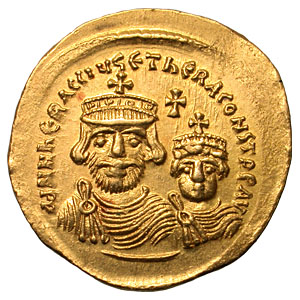
Image result for images of heraclius

Medallion of Emperor Heraclius and his son

In 610 A.D. a man named Heraclius become Emperor of Rome (they were still calling it the Roman Empire, but we remember it as the Byzantine Empire). He inherited an empire in crisis: barbarians pouring in from the north and west, and an aggressive Persian Empire gobbling up Roman territory in the south. The empire’s finances were in disorder, the army was demoralized, and religious controversies brewed chaos on the home front.

By strenuous military and domestic efforts, Heraclius restored stability. In 624 he finally forced the Persians to sue for peace, regained all the lost territories, and a war that had gone on for some 400 years ended in a total Roman victory.

Finally it was time to rest. The treasury was replenished, all the empire’s enemies had been thoroughly defeated, and it seemed as if a new day had dawned. History, for all practical purposes, was over. There was no one left to fight. The people celebrated, and Heraclius struck commemorative gold coins and medallions to seal his victories.

But he lived to see the Arabs come roaring up from the south under their new banner of Islam, seizing Egypt, Syria, the Holy Land, and sweeping through Asia Minor to mount a siege of Constantinople itself. Heraclius watched from the walls as the Arabs, who had no proper siege equipment, shattered their armies against the city’s defenses. But the lost provinces were lost forever, and from then on the empire would be fighting for its very life against Islam, with the city finally falling to the Turks in 1453.

Does any of this sound familiar?

The point is that history wasn’t over: that with all the old enemies quelled, and no expectation of further trouble, a new and more powerful enemy arose–and history rolled on and on.

When the Soviet Union fell, Western leaders and alleged thinkers proclaimed that now history was really over, the great enemy was no more, and we could all just go back to making money and screwing around with our culture.

Like the Byzantines, our leaders were wrong.

I don’t think they have quite come to terms with that–do you?

A Grim Little Insight from History

Image result for images of the fall of rome

Consider this quote by Edward Gibbon, from The Decline and Fall of the Roman Empire, Chapter XV:

“The incapacity of a weak and distracted government may often assume the appearance and produce the effects of a treasonable correspondence with the public enemy.”

Which, I think, explains why we are so often moved to ask, concerning our own national leaders today, “Are they wrecking the country on purpose?”

As Gibbon summed up the causes that led directly to the fall of Rome, he noted:

*The destruction of the middle class, leaving only a small stratum of the super-rich and a vast population of the intractably poor, most of them on welfare.

*Public entertainment that became a substitute for work and family life.

*Wave after wave of invading barbarians–many of whom had been invited into Italy by the Roman authorities themselves. And why? As our own leaders might have put it, “to do work that Romans won’t do.”

Does any of this sound at all familiar?

If history is sometimes boring, it is also sometimes shocking.

The Absurdity of ‘Diversity’ and ‘Inclusion’

Image result for images of confused and puzzled person

I’m trying to make sense out of these twin pillars of liberalism, but it’s tough sledding.

Why must “diversity” be sought out and promoted as an end in itself? Doesn’t life just automatically yield a certain amount of diversity, everywhere you look? So why must it be set up artificially?

How do you maintain “diversity” among ideas and standards which mutually contradict each other? For that matter, why must all cultures, all ideologies, all religious beliefs, be “included” all the time? (Except for Christianity, of course: that’s the one thing that can always be excluded.)

If you must “include” everyone and everything, as all being equally valuable and praiseworthy, and valid, then what about those standards which contradict each other? Theism and atheism can’t both be true. One has to be false. The only way they can be “equal” is if both are false.

This boxful of tosh is the foundation of our Western ruling classes’ ideology.

By comparison, a foundation of mud or sand looks like an improvement.

America Without Us

Small-town America. Middle America. Flyover country. Home to clean, decent, hard-working, honest, law-abiding, mostly Christian citizens–and their homes, their small businesses, their churches, their ancient cemeteries, and their public parks

This is the America that pays the bills for our leaders’ quixotic social engineering schemes, whose tax money, that they worked for, is doled out to assorted groups who vote for those leaders in return for free stuff. This is the America which her politicians, intellectuals, teacher unions, “gay” activists, and special interest groups despise and make fun of.

This is the America without whom the whole country would take a nose-dive into oblivion so fast, it’d make your head spin.

This is the America which must be saved if there is to be any kind of America at all, other than a debased, defeated, and demoralized United States that bears nothing of the original except the name.

That’s what this year’s election is about. And don’t let anybody tell you different.

Pagans and Christians

I read a very wise thing in John MacArthur’s Parables. Consider it well:

“The underlying error… the belief that people can gain God’s favor by being good enough–is the central lie that dominates all false religion.”

In pagan religions, worshipers are always trying to buy the gods’ favor, or, as it were, hire the gods as their employees, by promising to do this or that good work, or sacrificing this or that prize animal. And where does it get them?

In Homer’s Iliad, Zeus, the king of the gods, is upset by the sight of Hector fleeing from Achilles. Zeus exclaims, “Confound it, I love that man whom I see hunted round those walls! I am grieved for Hector, who has sacrificed many an ox on the heights of Ida or the citadel of Troy. And now there is Prince Achilles, chasing him round the city of Priam. What do you think, gods? Just consider, shall we save him from death or shall we let Achilles beat him?” (W.H.D. Rouse translation)

And of course, in spite of Hector’s piety, in spite of all the sacrifices he gave the gods throughout his life, it turned out Zeus couldn’t save him, after all.

In contrast to every  religion ever invented by man, Christianity teaches that we cannot hire God, we cannot buy His favor, there is no magic word or special kind of prayer that will compel Him to do our bidding.

Instead, His favor, His grace, our salvation, eternal life, forgiveness of sins–these are all free gifts, given by a sovereign God and paid for, paid for on the cross, by Jesus Christ the Son of God. God saves us; but when we reach for our wallets, we discover the bill has already been paid. By Jesus Christ.

At the root of it, Christianity is very simple. How simple? In Acts 16:30, during a crisis in which he was within an inch of taking his own life, the jailer in Philippi asks of Paul and Silas, temporarily his prisoners, “Sirs, what must I do to be saved?”

And they said, Believe on the Lord Jesus Christ, and thou shalt be saved, and thy house. (v.31)

And that’s the whole theology.

You couldn’t possibly do enough good works, sacrifice enough bulls or rams, donate enough money to the church, to earn, to deserve, eternal life. But God can give it to you. It’s as simple as that.