Down With Father Serra!

Let’s face it–college campuses have to be made incredibly safe, and no member of any minority should ever have to see, hear, or read, or even be aware of, anything that might possibly offend him. As for members of the majority, well, who cares?

“Activists”–shorthand for “arrogant pinheads bullying poor schmucks who are too timid to resist”–at Stanford University have demanded that the Serra Mall be renamed. See, it’s named for Father Junipero Serra, a saint of the Catholic Church. And Father Serra’s crime, for which he must be tried and found guilty hundreds of years later, and cast into outer darkness, was…

Being a missionary. Father Serra planted churches and missions all over California, in the days when it was a Spanish colony, and taught Christianity to the natives.

Humongous and inordinate crime! To rob people of the blessings of paganism and spook worship, and thrust upon them the hope of eternal life! I mean, that is downright mean! Once they take his accursed and oppressive name off the mall, maybe they can start tearing it out of history textbooks, too.

Had enough yet, folks?

When Is It Schlub History Month?

Every cherished minority has its own month with which to annoy the rest of us (https://en.wikipedia.org/wiki/List_of_commemorative_months ). In fact, the most cherished minority of them all, sexual anarchists, have three months all their own. June is “LBGT Pride Month”–pride?–October is LGBTQ “History” Month, and November is “Transgender Awareness Month.” That’s a quarter of the year devoted to some 1.5% of the population.

But how about a month devoted to the appreciation of the poor benighted schlubs who have to sit there and take it on the chin for all twelve months of the year, and who don’t even know any better than to go along, almost lifelessly, with anything and everything Our Glorious Leaders and their pet minorities can throw at them? How about a Schlub History Month?

What? Schlubs don’t have any history? But of course they do! Just because it’s incredibly boring history that teaches no moral lesson whatsoever doesn’t mean it isn’t history.

Schlubs of the world, rise up! You have nothing to lose but your schlubness.

I Hope God’s Listening: ‘The Maker’

This comes from my chess buddy, Jessicafischerqueen–it’s Canadian singer Daniel Lanois performing The Maker.

Why am I posting all this music? I’m not really a music kind of guy.

Well, I’ll tell you–to me, it just feels and looks like our whole civilization’s going down the tubes, getting devoured by the ungodly and the wicked, farther down each day… and what can we do, you and I? What is there to show for our conviction, our reasoning, our rhetoric, our passion, or our works? Nor does our cleverness seem to be getting us anywhere.

We need for God to hear us. We need for Jesus Christ Our Lord to set things right. Let fire out of Heaven consume the false prophets of this age.

And we need to sing louder.

The Age of Davos Man

Alas, poor Piltdown Man! Turns out he never existed. But I’m afraid Davos Man does.

Who says political scientists aren’t good for anything?

Political scientist Samuel Huntington has coined the term “Davos man,” and it’s a good one. Davos Man is the guy who flies to Davos, Switzerland, in his private jet, takes a limousine to the hotel, and, while sipping overpriced cocktails, gets together with other Davos dudes to plot their takeover of the world.

Davos Man is “completely international,” runs the definition. He doesn’t believe in nations anymore. Sort of a John Kerry type. He doesn’t identify with his own nation. Global government, that’s his bag–run by himself, of course, and some of his friends.

Doesn’t it make you feel like singing?

Davos, Davos man–I wanna be a Davos man!

Davos, Davos man–you gotta be a Davos man!

Abolish every nation, and have a celebration,

We gonna do our groovy global thing!

We love that immigration, it’s great for desolation,

Erase those borders, now we gotta sing! Davos, Davos man…  etc.

Aren’t you glad your country, and everybody else’s countries, are in such good hands? Almost makes you wish Obama could have a third term.

Just kidding.

The Sex-Bots Are Coming

In case anyone wonders why we’ve been posting so many hymns here lately, just take a peek at the news today.

I have to call attention to this stuff because I am, in a way, a watchman. So here goes.

Robots for companionship–in lieu of other human beings–and as sex partners–in lieu of other human beings–are gonna be “the biggest trend of 2016,” according to The Mirror ( http://www.mirror.co.uk/news/world-news/sex-robots-could-biggest-trend-7127554 ).

Lord, if you’ve got any plans for this fallen world, don’t let us delay you. Speaking only for myself, I am rendered almost speechless by the magnitude of our fall from grace. Nor do I have the slightest notion of what we ought to do.

But that’s only one news story, just one, out of piles and piles of copy today. All the others are just as bad.

If I really need to explain to anyone why robot sex is the ultimate in degeneracy, a cultural trend that needs to be blown out of the water today and not tomorrow–well, there’s someone who’s too far gone to understand the explanation, anyhow.

Read the article, get a load of the pictures. You’ll see what I mean.

Just don’t try to do it on a full stomach.

Did the Queen Really Say It?

Image result for images of queen elizabeth ii

Here she is–what does she know that we don’t?

Supposedly Queen Elizabeth’s annual Christmas message that the world heard this past Christmas was most certainly not her original version of it.

According to various “sources,” the Queen, in her first version of the speech, darkly hinted that the royal family had Princess Diana murdered because “she knew too much,” and then delivered this gem: “I hope you enjoy your final Christmas” ( http://bible-storytelling.beforeitsnews.com/terrorism/2015/12/queens-2015-christmas-message-enjoy-your-final-christmas-2456776.html ).

Yowch! What did she mean by that?

Of course, the video of this version of the speech has been “pulled,” so there’s no proof she ever said a word of it. But meanwhile she’s got a lot of people bug-eyed. “What does she know that we don’t know? What does she mean?”

Will they outlaw Christmas? Will Moslems take over and ban Christian holidays? Is the world due to come to an end? Will Britain be vaporized in a nuclear war?

Or was it all just a nice gift to the conspiracy theory community?

Unless someone comes up with the video, we’ll never know. Even then, videos can be doctored and faked. But if you are able to imagine the Queen of England sitting in front of the cameras and microphones and fessing up that she and her family had Princess Diana bumped off, then you have a pretty lively–if unglued–imagination.

It Was in the Bible First

Pyrrhus the king, whose death in 272 B.C. was almost an exact match to the death of Abimelech in the Book of Judges, 1,000 years earlier.

You’ve heard of a “Pyrrhic victory,” a victory that costs so much, it might as well be a loss. It was named for a real person, a king, Pyrrhus of Epirus, who invaded Italy and everywhere else he could get to, in a bid to conquer the world. There’s always some fool who wants to conquer the world.

Pyrrhus died in 272 B.C. Writing about him in the 1st  century A.D., the historian and philosopher Plutarch told how Pyrrhus came to a bad end. Attacking the city of Argos, Pyrrhus got caught up in the street-fighting. Watching from a rooftop, an old woman picked up a heavy tile and threw it down at Pyrrhus. It knocked him from his horse and, although it didn’t kill him outright, rendered him defenseless. A soldier on the scene then finished him off.

This is history. No one takes the trouble to dispute it. But let us turn to the Book of Judges, Chapter 9, in which Abimelech, illegitimate son of Gideon, tries to make himself the ruler of all Israel. He starts out by murdering his brothers, and all goes well for him until he gets involved in heavy fighting in the streets of a town called Thebez. And then:

“And a certain woman cast a piece of a millstone upon Abimelech’s head, and all to brake his skull. Then he called hastily unto the young man his armourbearer, and said unto him, Draw thy sword, and slay me, that men say not of me, A woman slew him.” (verses 53-54) And that was the end of Abimelech.

We don’t have exact chronology for the Book of Judges, but certainly Abimelech lived and died about 1,000 years before the death of Pyrrhus.

How could these two deaths be so much alike? Could Plutarch have read Judges? Even if he had, it’s highly unlikely that he would’ve just lifted information from the Jewish scriptures and plugged it into his secular history.

Are we dealing here with repeated patterns in history? Or with traditions that slowly work their way into the collective memories of widely separated nations? Or events that so strongly impressed people, that reports of them worked themselves all over the world, being slightly changed and distorted with every repetition?

All we can say for sure is that this story, this report, was in the Bible first, centuries before the birth of Pyrrhus or Plutarch.

It’s something to think about.

‘Books? Yes, We Have Books’

(From George Pal’s The Time Machine, 1960)

Watch what happens when the Time Traveler from 1900 tries to question the dull, almost brainless Eloi of almost a million years into the future. In real life, of course, thanks to public education and nearly universal collidge, we’re getting there a lot faster than H.G. Wells ever dreamed. Many of our people have already attained Eloi-hood.

Knowledge gets lost, even when it’s written down. If no effort is made to preserve it, knowledge evaporates into the past.

The Kardashians. Comic books. Movies based on comic books. Video games about zombies. University-level courses in comic books. Courses in zombie studies. Feminism. Rap music. Gender-neutral pronouns and safe spaces. Hitch ’em all to the sleigh and they’ll take you straight to Eloi country.

In The Time Machine, the Eloi do serve a purpose: the Morlocks, who dwell in darkness underground, eat them.

What purpose is served by a 25-year-old living at home with Momma while he works for his bachelor’s degree in Gender Studies?


A Doomed Expedition–and an Enduring Lie

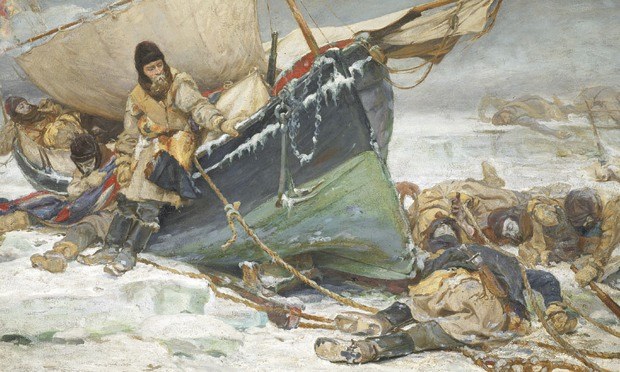
In 1845 Sir John Franklin took two British Navy ships and their crews into the Arctic to try to find and sail the Northwest Passage. The ships were never seen again, and no one from the expedition survived it.

Urged on by Franklin’s widow, and by a public clamoring to know what had happened, the Royal Navy sent out search party after search party, without success. It remained for Dr. John Rae, patiently traversing the Arctic on foot, over hundreds of miles, to discover the expedition’s fate.

But the news he brought back to England was so horrifying, so unwelcome, that his findings were rejected. Interviewing many Arctic natives, and collecting artifacts from the expedition, Rae found that the ships were destroyed in the ice and their crews, having reached land, died of exposure and starvation, with the last few of them resorting to cannibalism to prolong their lives. The men, for as long as they could, wasting what little strength remained to them, hauled behind them rowboats full of desks, books, and other useless items–irrational behavior that has led modern historians to suspect that these men were victims of lead poisoning from their canned provisions.

We have just watched a 2008 documentary from the Canadian Film Board, Passage–a gripping two-hour show that examines how Lady Franklin, with the help of Charles Dickens–yes, the famous Charles Dickens–got Rae’s story discredited and replaced by a lie. Thanks to Mr. Dickens, most of the British public believed that the members of the Franklin expedition, when they were most vulnerable and weakened, were attacked by savage “natives”… and eaten.

It’s a fact that, of the many explorers of the Arctic, not one of them ever reported being menaced, let alone attacked, by the native Inuit people. Instead, they found the Inuit friendly and helpful.

The Franklin Expedition came to grief because it was too big to live off the land, it was improperly equipped, totally untrained for survival in the Arctic, improperly provisioned, and had no business being there.

What the public wound up with was a story that was a lie, a slander against the Inuit–because it was impossible for Victorians to believe that Christian Englishmen could ever be reduced to cannibalism. We learn from the documentary that the Inuit found this libel hard to bear: and that it took an apology from Charles Dickens’ great-great-grandson to heal the wound.

Not that the great-great-grandson had anything to apologize for.

I’ve gone on a bit longer than I meant to, but only because I have an abiding interest in history, and I know how hard it is to know what really happened, even without people actively spreading lies and fictions. Poor Dr. Rae! He discovered truth that no one wanted to hear; so they replaced it with a lie. Makes you wonder what other truths of history have been successfully replaced by lies.

Anyhow, Passage is a fascinating film and I strongly recommend it.

The Lost River of Eden

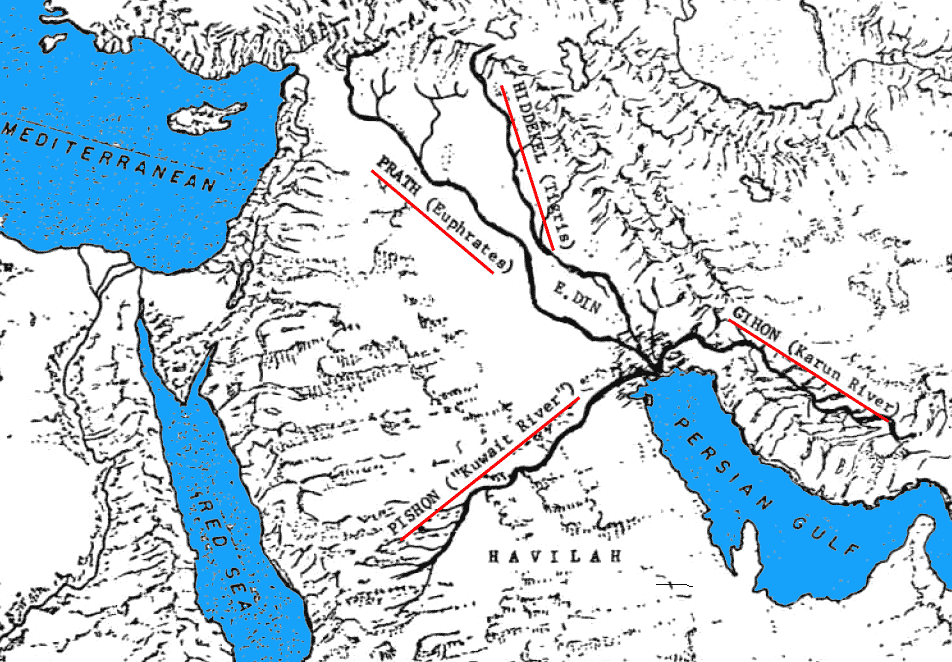
The Bible preserves the memory of an ancient river that flowed across Arabia many thousands of years ago.

God speaks to us in many ways.

I was raised in a close-knit Christian family, but came out of four years of college with the kind of precious know-it-all attitude for which the university is the ultimate greenhouse. And in that wilderness I wandered for 30 years or so, until the Good Shepherd brought me back.

One of His tools was an article in Biblical Archaeological Review, Vol. 22 No. 4, July/August 1996, “The River Runs Dry.” This told of the discovery, via satellite photo analysis, of a long-vanished river that ran across Arabia into Mesopotamia. (I can’t figure out how to navigate the BAR site, but this will help you, http://kata-aletheia.blogspot.com/2007/01/ancient-geography-lost-river-of-eden.html )

The Bible preserves much ancient knowledge which would otherwise be lost. In Genesis 2, the “four rivers of Eden” are described. Two we know today as the Tigris and the Euphrates, in Iraq. But in verse 11 we read, “The name of the first is Pison [or Pishon]; that is it which compasseth the whole land of Havilah, where there is gold…”

“Havilah” refers to what is now the western part of Saudi Arabia. Geologists for years wondered about the presence of certain kinds of pebbles and stones in Kuwait which were not original to that country. But as satellite photos revealed the bed of a mighty river now buried under the Arabian desert, it became clear that these stones and pebbles came from far away, carried there by a river which dried up and disappeared thousands of years ago.

So there is information in that chapter of Genesis that has no business being there unless it is an accurate record of truly ancient things. Never mind the Reputable Bible Scholars Inc. who say the whole Bible is just a bunch of fables and stories invented by priests in Babylon after 500 B.C. to wile away the time spent in captivity.

Geologists estimate that the Kuwait/Pison River ceased to exist by, at the latest, 2,000 B.C. So then they talked about it for 1,500 years?

Reading about this lost river of Eden, now found again, shocked me deeply: shocked me with the revelation that Genesis is true. It got me started back on the road to the Bible. It continues to fascinate me 20 years later.

It’s God’s Word, it’s true, and we can trust it.